

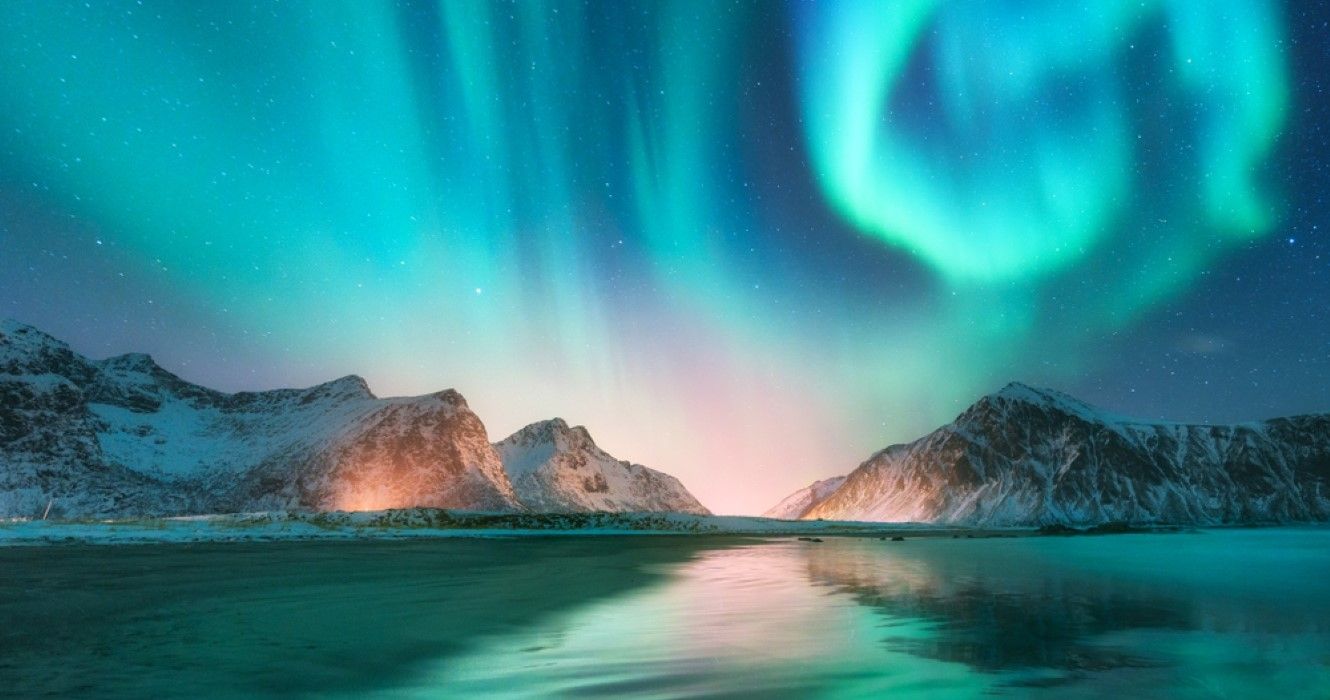
Among Mother Nature’s most breathtaking spectacles, the northern lights are breathtaking. And the northern winter is a great time to witness this spectacular light display. However, the Northern Lights are more complex than they appear at first glance. It’s the result of particles of gas colliding in Earth’s atmosphere in addition to solar ionization and charged solar particles that produce the dancing greens and pinks of the aurora. There are many places to see the Northern Lights, and viewing them is worthwhile.
Gas molecules produce different colors when they collide; like oxygen, produces greens and nitrogen pinks. Here’s a list of 10 things we might not know about the Northern Lights.
10/10 Charged Sun Particles Travel Millions Of Miles Reaching Earth To Create The Phenomenon
When the corona is heated, charged particles escape the sun’s gravitational attraction. Solar particles “blow,” creating solar wind. The particles travel 150 million kilometers at 800 km/s before reaching Earth. Solar wind collisions can cause aurora borealis and other phenomena. Sun plasma eruptions are rare. These explosions are called CMEs or solar storms. If solar storms reach Earth, their radiation is deflected by Earth’s magnetic shield and dumped at the poles. The phenomenon causes the natural beauty humans get to behold.
9/10 The Northern Lights Hues Are Affected By Gas And Distance
The electrons from space collide with gas particles in Earth’s atmosphere, producing the rainbow of colors we see. Different collisions occur above the ionosphere and produce different colors; it’s all about the gas and the altitude. Below 97 kilometers (60 miles) above the ground, oxygen produces green lights, whereas above that, it produces red lights (322 km). Particles of nitrogen gas lead to colored lights of blue or purple-red. Although it is unusual, a contrasting orange and white hue has been spotted on occasion.
8/10 The Northern Aurora Borealis And Southern Aurora Australis Occur Simultaneously And In The Same Shape
Solar storms generate vivid lights across the board, across the Northern and Southern Hemispheres, as they reflect off of the Earth’s magnetic fields and strike the poles. Plus, they’re complete opposites of one another. Seriously, could it get much better than that?! Even though the aurora australis is most visible in Antarctica, it may be viewed from the southern beaches of Argentina, Chile, Australia, and New Zealand. More specifically, 2017 was the first time that New Zealand offered commercial flights that passed through the Southern Hemisphere’s aurora borealis.
7/10 ISS Astronauts Sometimes Fly Through The Northern Lights
Strictly speaking, very few people have witnessed the Northern Lights physically, and even fewer people have flown straight into the aurora borealis! However, several astronauts have done so! About 248 miles above the surface of the Earth is where the International Space Station now resides. Because the Aurora Borealis may appear anywhere from 97 to 1000 kilometers above the surface of the Earth, it is a happy accident that astronauts are occasionally treated to a breathtaking display.
6/10 The Northern Lights Are Not Unique To Earth
Contrary to popular belief, Earth isn’t alone in the solar system. And it stands to reason that the same occurrence, Forces from the Sun repelled by the magnetic shields to produce magnificent colored lights, also occurs on other planets. Although all have strong magnetic fields, their colors may differ from Earth’s because of the varied types of gas they contain. In addition, many of these planets have numerous moons that are much bigger than Earth’s, and these moons can alter the spectrum of light reaching the surface.
5/10 The Northern Lights Are So Faint That Cameras Can “See” Them Better Than People Can
Why don’t people discover how many things exist in the cosmos that our eyes can’t detect? Humans are fortunate to have access to amazing technologies such as cameras, which are much more powerful than the eye’s lens and able to identify colors thus that our naked eyes would miss. Amazing photos wouldn’t be possible without some expert photographic work, though. People who want stunning photos of the northern lights need to hire a guide to assist them in finding them and going to the best viewing spots.
Native Arctic residents, including the Inuit and others, have a rich oral tradition, and it is through this tradition that many myths and stories about the northern lights have been transmitted. When the northern lights appear, it is a game that the dead continue to enjoy after they have passed on. What about the ball? The skull of a walrus. The wording in certain variants varies a bit more sinister, and they have an amusing case of walruses messing around with a human skull instead of the other way around.
3/10 In The Early 17th Century, GALILEO Used The Term “Aurora Borealis” To Describe The Northern Lights
Ancient Greek and Roman terminology seem like the most likely candidates for the origin of the English phrase “aurora borealis.” After all, the names of the planets are derived from mythological deities. Galileo is credited with first using the name “aurora” in the 17th century, naming it after the goddess of the rising sun. Similarly, the word “north wind” in Greek is referred to as “Boreas.” Even though Galileo was not entirely sure exactly what those Northern Lights were, the moniker survived even after more than 400 years.
2/10 Aside From Being A Sight To Behold, The Northern Lights Are Also Known For The Sounds They Make
It’s so bizarre; it could only come from a sci-fi movie! Several individuals have reported hearing what sounds like radio static or hissing when gazing at the lights. Without a doubt, solar-charged particles are responsible for it in some way. An inversion layer is a layer pertaining to the atmosphere in which the temperature rises rather than falls with increasing altitude. It is this layer that effectively traps a discharge of negative electricity. The cracking and crackling sounds that may be witnessed in conjunction with the Aurora Borealis are caused by the discharge of negative electrical charge from the inversion layer during a severe solar storm.
1/10 The Best Place To See Them In North America Is In Places Like Churchill
The name “northern lights” is not chosen at random. In truth, the finest area in North America to watch the aurora borealis is up north. Churchill, Manitoba. Location is a key factor. The auroral oval, a vast ring around Earth’s geomagnetic North Pole where the northern lights are best seen, passes straight above Churchill. Also, a trip to Churchill from Winnipeg takes just two hours, so one might only need to make one stop en route to the North Pole to witness the Aurora Borealis. Tundra Buggies and the Thanadelthur Lounge provide excellent vantage points to view the Aurora Borealis. Many Hotels also offer views of the Northern Lights.