


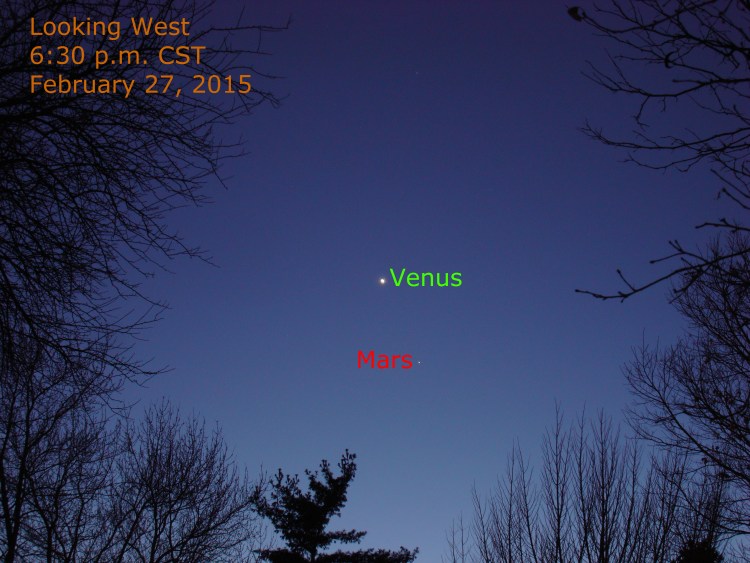
February 21, 2024: Before sunrise, Venus is on final approach to Mars leading to their conjunction tomorrow morning. Jupiter and the moon are visible after sundown.


by Jeffrey L. Hunt
Chicago, Illinois: Sunrise, 6:38 a.m. CST; Sunset, 5:31 p.m. CST. Check local sources for sunrise and sunset times. Times are calculated by the US Naval Observatory’s MICA computer program.
Summaries of Current Sky Events
Summary for Venus as a Morning Star, 2023-24
Here is today’s planet forecast:
Morning Sky


Two hours before sunrise, the gibbous moon, 91% illuminated, is low in the west-northwest, 5.0° to the upper left of Pollux, one of the Gemini Twins. The moon’s brightness may overwhelm Pollux and its Twin, Castor.
Venus is on Final Approach to Mars


Venus rises in the east-southeast sixty-eight minutes before sunrise. Since the beginning of the month, the planet lost forty-two minutes of rising time compared to daybreak. By forty minutes before sunup, the brilliant planet is less than 5° above the horizon. Find an unobstructed view of the horizon in Venus’ direction.


Venus steps eastward in front of Capricornus, but the stars are not visible at this level of morning twilight. Ten minutes later, use a binocular to see Mars 0.7° below the Morning Star. Venus passes Mars tomorrow morning.
Mercury nears superior conjunction on the far side of the sun in a week. The planet is hiding in bright sunlight and it is not easily visible.
Evening Sky
Saturn slips into bright sunlight, setting less than 30 minutes after the sun.
Evening Moon


This evening’s bright gibbous moon, 95% illuminated, is less than halfway up in the east. It is in front of Cancer’s dim stars, less than halfway from Gemini’s Pollux to Leo’s Regulus. The moon appears farther westward during the night, from Earth’s rotation. Tomorrow morning the lunar orb is low in the west-northwest during morning twilight. It sets before sunup.
Jupiter
Bright Jupiter is about halfway up in the southwest as darkness falls. It moves eastward in front of Aries. The planet has a slow rate, but its place in front of the distant stars is easy to note from night to night. The planet is 11.1° to the lower left of Hamal, Aries’ brightest star, and 12.5° to the upper right of Menkar, the Sea Monster’s nostril. Jupiter is approaching an imaginary line between the two stars.
Jupiter sets in the west-northwest before midnight an over five hours after sundown.
RECENT PODCASTS
LATEST ARTICLES
- 2024, February 21: Venus is on Final Approach to Mars
February 21, 2024: Before sunrise, Venus is on final approach to Mars leading to their conjunction tomorrow morning. Jupiter and the moon are visible after sundown.
- 2024, February 20: February’s Moon-Pollux Conjunction
February 20, 2024: Look for February’s Moon-Pollux conjunction in the eastern sky after sunset. Find bright Jupiter in the southwest.
- 2024, February 19: February Evening’s Gemini Moon
February 19, 2024: This evening features February Evening’s Gemini Moon. Jupiter is visible in the southwest after nightfall.
- 2024, February 18: February Gibbous Moon is between the Horns
February 18, 2024: After sundown, the February gibbous moon is between the Horns of the Bull. Bright Jupiter is in the southwest.
- 2024, February 17: February Evening Moon is with Taurus
February 17, 2024: After sundown, the February evening moon is with Taurus in the southern sky. Bright Jupiter is in the southwest.

Follow Canada News Media
Get the day's top Canadian stories and our two daily 60-second news videos wherever you scroll.
X Threads Facebook Instagram LinkedIn TikTok YouTube Pinterest Reddit Substack Flipboard Newsletter RSS