


:format(jpeg)/cloudfront-us-east-1.images.arcpublishing.com/tgam/ZKTOQY6T6FOVRB6C7L3JMPYDQQ.JPG)
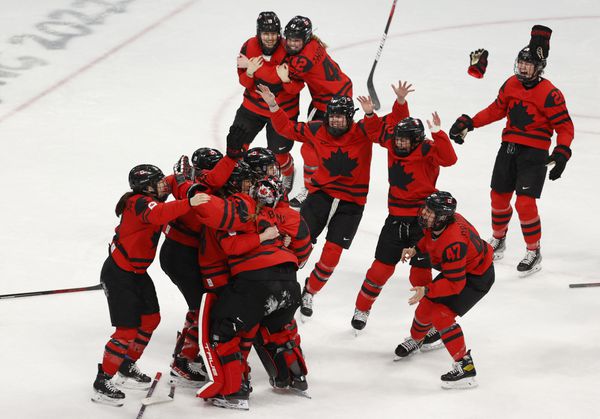
Canada players celebrate victory against United States in the women’s hockey final at the Wukesong Sports Centre, Beijing, China, Feb. 17, 2022.DAVID W CERNY/Reuters
After she’d been buzzed, jostled and full-on trucked at least twice, someone tried to coax Team Canada goaltender Ann-Renée Desbiens into talking about friendship.
Team USA had been out there running her over for two-plus hours in the Olympic final of women’s hockey, but weren’t they all really just great pals? What about this one on the U.S. team and that one and that other you played wherever with?
Desbiens stood there, still sweating, rubbing her gold medal in that covetous way people who’ve just won one all have – my Olympic precious.
Desbiens wanted to be helpful and go along with this line of questioning, but only vaguely. Prompted to get specific, she decided instead on the truth.
Opinion: Olympic men’s hockey doesn’t matter if the NHL isn’t there
Was it hard playing against your friends?
“Not hard at all. You just have to put this jersey on,” Desbiens said. “There’s no friendship here.”
That’s how it looked there. Not ugly, but not friendly. Canada dominated for the first half and, having taken a lead, absorbed pressure for the second. It was a perfect game plan. Because it worked. If it hadn’t worked, we’d now be saying that it was a colossal failure of ambition. But that’s how these things go.
Canada won, 3-2.
:format(jpeg)/cloudfront-us-east-1.images.arcpublishing.com/tgam/VIFTGJZGJNJGPNFRJL2UPXJP6Q.JPG)
Canada’s players leap from the bench after their victory over the United States.DAVID W CERNY/Reuters
Afterward, they celebrated like maniacs. Every glove and helmet thrown celebratory in the air was immediately scooped up by a small army of Chinese volunteers on skates. Canada whooped it up, Chinese volunteers circled, and the Americans stood at a non-respectful distance staring at them both.
There is a tableau that must be created after this quadrennial game, and everyone instinctively understands where and how to stand.
Next the medals. The winner beams and cries. The loser is piteous and cries. The third-place team looks startled to be there and cries.
Then they all trek through the mixed zone and do it again. Often, someone is angry. But not at this Olympics. The Americans were outclassed and they knew it. They came armed with their excuses – COVID-19, Brianna Decker’s injury in the first game here, general malaise. They’re good excuses, but they’re still excuses. If they’d won, they’d just be adversity.
Canada got the privilege of being magnanimous. Those women over there, yeah, they’re a tough team, it means something.
While Canadian defender Renata Fast was talking about what it’s like to get a gold hung around you’re neck – “Wow. This is heavy.” – U.S. captain Kendall Coyne Schofield was standing two metres from her shouting between sobs, “Women’s hockey cannot be silent!”
When Canada beats the U.S. in this tournament, the show that follows is almost as compelling as the one on the ice. There’s nothing quite like it in sport, in part because it’s so predictable. It’s as if the same two players made the final of Wimbledon every year, and they made them spend the hour afterward handcuffed together.
Mostly what exudes from these women is the sense that they don’t like each other very much, not in this context, but that they are bound together. For however long you last as a player in the American or Canadian national set-up, this game is your highest calling. It’s your professional rationale. Lose it, and nothing else you do really matters.
Canada lost the last time in the 2018 Pyeongchang Games – making it 1,460 days between meaningful wins.
This time around, women’s hockey didn’t feel like the most important event in this Olympics. It felt like the only event. If Canada could win this one, all the other near misses would be bearable.
So, mission accomplished. They beat the Americans twice. They beat everyone else up.
But this victory over the U.S. felt a little like piling on. Not at the level of players. But in terms of where they are as a country and we are in relation to them.
We might ask ourselves – is right to beat the U.S. any more?
Of course it’s right. That’s the point of coming here. But does it give us the same satisfaction?
This old rivalry – which has reached its perfected version in this smouldering enmity – is born out of the very 1970s idea that the U.S. is a little bit better than we are.
They are loud and confident. We are quiet and mousey. They have Hollywood. We have Murdoch Mysteries. They swagger around the world picking fights. We trail after them calming everyone down.
It was a great Mutt and Jeff routine for a long while. We were happy with losing most of the time because we secretly wanted to be more like them. It gave us something to aspire to. Every now and again, usually on a hockey rink, we got to win one.
The tables haven’t exactly turned, but they are radically reoriented. America’s a basket case. Who’d want to be more like that? What satisfaction is there to be taken from getting on top of someone after they’ve already wrestled themselves down on the ground?
Our proximity and interconnectedness makes it inevitable that all their worst instincts bleed over the border and infect our tendency to sober judgment. All the big fights in Canada today are America’s cultural proxy wars.
If Canada’s voting routines are any indication, most of us don’t want to be like America any more. We want to be a lot less like them.
Don’t call it a breakup. Call it a break. We can still be friends. Give us a shout in a couple of years when you’ve stopped with the attempted coups.
Early in this tournament, Canada’s Fast was asked if she ever feels pity for the other team as they’re getting their head metaphorically and repeatedly hammered into the boards.
“Not really,” Fast said. “By us playing them hard, it makes them better. They’re going to learn things.”
What do you think the U.S. learned on Thursday?
There is the obvious – that life is pain. Some of these American players can count on one hand how many times they’ve lost in the red-white-and-blue.
“I won’t forget this probably forever,” Team USA’s Amanda Kessel said afterward, but doubtfully. Like she wasn’t totally sure it had actually happened. Beyond that, there’s nothing to learn from losing at sports. The learning lesson here is the game itself. The thing considered outside its result.
One of the few nice things Canada and America still share is a love of playing together. Their sports leagues are full of Canadians, and our league is full of Americans. We remain happily intertwined through sport.
As our world views splinter, it can sometimes feel like it’s the last thing left that we have in common.
That’s what’s actually precious now. It’s a tether back to each other at some future, less zany point in history.
So we beat them and they beat us and in the end, both sides win.
At least, that’s the hope.
Our Olympic team will be writing a daily newsletter to land in your inbox every morning during the Games. Sign up today to join us in keeping up with medals, events and other news.