


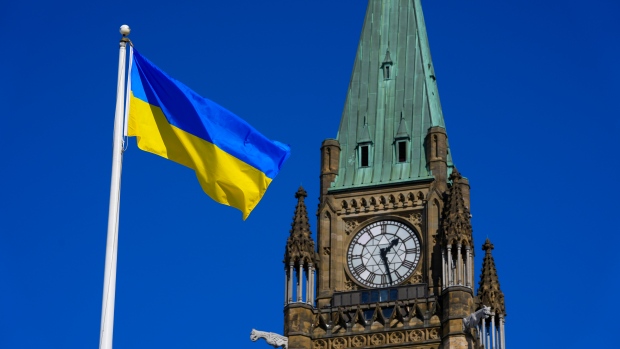
The Canadian government is sending an additional $100 million in humanitarian assistance to help Ukrainians, and as of later this week Russian ships will be prohibited from entering Canadian ports and internal waterways in response to Vladmir Putin’s continued unprovoked attacks on Ukraine.
The pair of announcements came as the federal cabinet met on Parliament Hill Tuesday morning.
International Development Minister Harjit Sajjan said in a statement that the $100 million will help “respond to immediate needs arising from the Ukraine crisis.”
This includes emergency health services like trauma care; support for displaced populations; as well as shelter, water, food, and sanitation supplies.
It will be going to what Global Affairs Canada is calling “experienced partners” to address the pressing on the ground needs in Ukraine and in neighbouring countries where hundreds of thousands of Ukrainians have fled.
Speaking with reporters Tuesday afternoon, Sajjan said the government is still working with organizations and other countries to coordinate how the aid will be dispersed.
The latest aid commitment follows a previous federal pledge to send Ukraine $25 million for humanitarian supports.
“The lives of the children of Ukraine have been thrown into chaos. Their classrooms have been replaced by bomb shelters. Their playgrounds have become battlefields. Their beds have become the hard ground,” said Sajjan in the statement.
Cabinet colleague and Transport Minister Omar Alghabra also announced Tuesday that, effective later this week through a special economic measure order, Canada is banning Russian-owned or registered ships and fishing vessels from entering Canadian ports and internal waters.
“Russia must be held accountable for its aggression in Ukraine. Canada will continue to do what is necessary to respond,” said Alghabra in a statement.
Speaking with reporters following the cabinet meeting, Alghabra said that while there are not often many Russian ships entering Canadian waters, it is a step being taken in alignment with other countries and together, it “will have an impact.” He said officials will monitor for any supply chain consequences.
Minister of Fisheries, Oceans, and the Canadian Coast Guard Joyce Murray said in the same statement that the Canadian Coast Guard and its members will play a role in helping to enforce this new order.
In the House of Commons, opposition leaders continue to call on the federal government to expel Russia’s ambassador from Canada, and recall Canada’s ambassador to Russia. There’s also been a concerted cross-party push among opposition MPs to see Canada drop visa requirements for Ukrainians wanting to come to Canada.
“Canada has to do everything we can in our power to support people in need. One of the things we can do is to support Ukrainians who are seeking refuge in Canada. So will the prime minister commit to a simple, straightforward, barrier-free process for Ukrainians who are seeking solace and refuge in Canada?” asked NPD Leader Jagmeet Singh during question period on Tuesday.
So far, the federal government has said it is continuing to look at options for further immigration and consular supports, with Minister of Immigration, Refugees and Citizenship Sean Fraser telling reporters on Monday that additional measures are coming soon.

Follow Canada News Media
Get the day's top Canadian stories and our two daily 60-second news videos wherever you scroll.
X Threads Facebook Instagram LinkedIn TikTok YouTube Pinterest Reddit Substack Flipboard Newsletter RSS