

:format(jpeg)/cloudfront-us-east-1.images.arcpublishing.com/tgam/PEQKELJMPZK47GNHLZYRW25EFM.jpg)
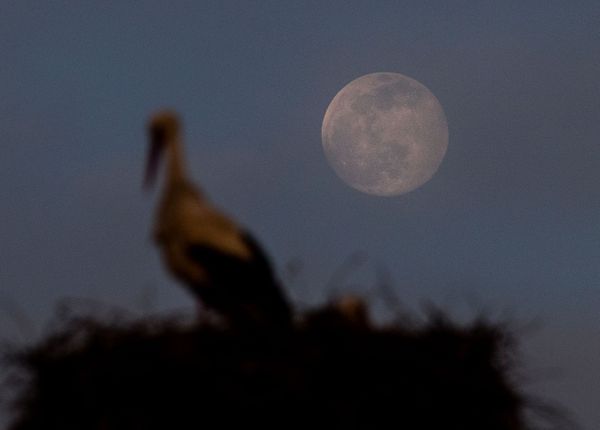
The Pink Moon is seen behind a stork in the village of Rzanicino, Macedonia on April 15. It will reach peak illumination at 2:55 p.m. ET on Saturday.ROBERT ATANASOVSKI/AFP/Getty Images
Many Canadians looking outside their windows this Saturday afternoon may be surprised to see a full moon rising during the day. And not just any moon – the Pink Moon.
When can I see the Pink Moon?
The moon will reach peak illumination opposite the sun at 2:55 p.m. ET, but won’t be visible above the horizon until after sunset. For those observing other time zones, the peak time will be 11:55 a.m. PT, 12:55 p.m. MT, 1:55 p.m. CT and 2:55 p.m. AT.
The Maine Farmers’ Almanac, which gave the Pink Moon its name, has created a postal code based moonrise and moonset calculator that can be used here.
Why do we call it a Pink Moon?
The Pink Moon’s name has surprisingly little to do with its colouring, which differs little from other full moons. In the 1930s, the Maine Farmers’ Almanac began applying Indigenous, European and North American settler names to label each month’s full moons to track the seasons. Now, they’re mostly used as nicknames for each full moon.
“Although we wish this name had to do with the colour of the moon, the reality is not quite as mystical or awe-inspiring,” the Almanac said in an online statement.
:format(jpeg)/cloudfront-us-east-1.images.arcpublishing.com/tgam/HQZLIAT4ANFFHEHK7BNVPNBYOA)
In mid-June, the Arctic tundra roars to life with pink Alaskan phlox and wild blue forget-me-nots. Moss Campion, seen here, is a small mountain-dwelling wildflower found throughout the high Arctic.
“In truth, April’s full moon often corresponded with the early springtime blooms of a certain wildflower native to eastern North America: Phlox subulata – commonly called creeping phlox or moss phlox – which also went by the name ‘moss pink.’ Thanks to this seasonal association, this full moon came to be called the ‘Pink’ moon.”
The Pink Moon has many names. The Easter Moon, the Pesach, Passover, or Paschal Moon for many; the Sprouting Grass, Egg, or Fish Moon among coastal tribes; the Easter Moon; the Hanuman Jayanti Festival Moon as noted by Hindus; or as it is also known among Buddhist cultures: the Bak Poya.
A crash course in the full moon
The moon cannot produce visible light, so the radiance we see comes from other objects, such as the sun or distant stars. A full moon occurs every 29.5 days once the moon has completed its lunar cycle, according to the Greenwich Royal Conservatory. Once the moon completes the cycle, the whole side of the moon that faces the Earth is lit by the sun’s rays, appearing as a shimmering orb in the sky.
A majority of months in our modern calendar year are comprised of more than 29 days, paving the way for the possibility of two full moons in the span of a single month.
Canadians celebrate religious holidays this weekend amid sixth wave of the COVID-19 pandemic
Our Morning Update and Evening Update newsletters are written by Globe editors, giving you a concise summary of the day’s most important headlines. Sign up today.