



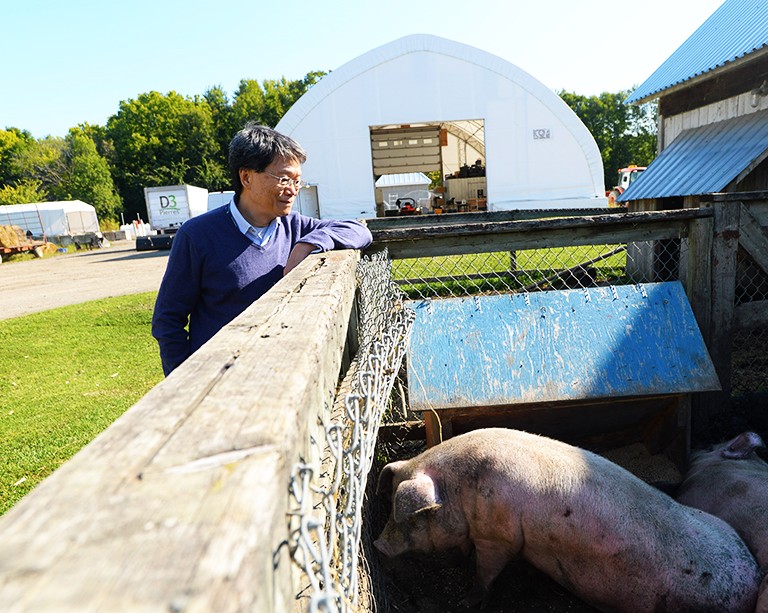
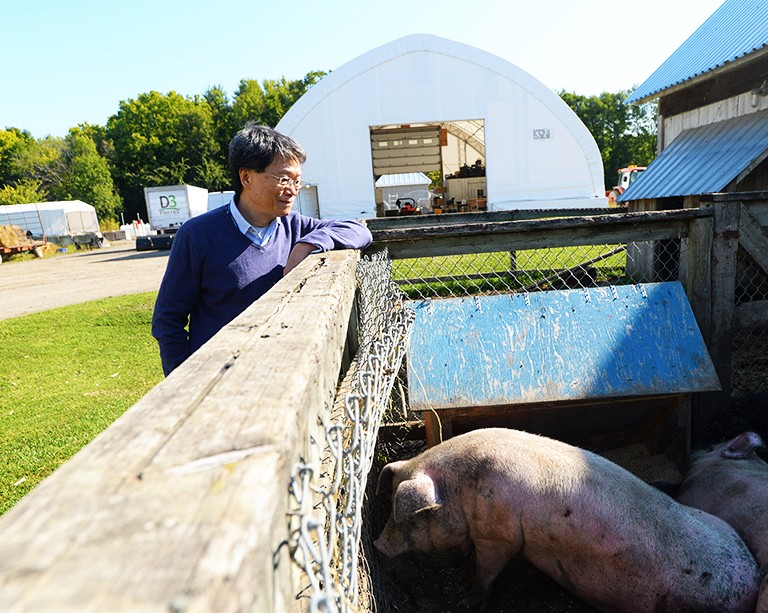
As part of a pan-Canadian competition, the Genomic Applications Partnership Program (GAPP) has awarded $6 million dollars over three years to Adrian Tsang, Concordia professor of biology.
The research funding will support the production and engineering of an alternative to antibiotics in livestock animals’ feed and comes from Genome Canada and Génome Québec and is in partnership with Elanco Animal Health.
Tsang is director of the Centre for Structural and Functional Genomics, one of 25 university-recognized research units. He will use this investment to build on work from two previous awards he received from Genome Canada and Génome Québec.
“We are very pleased that Adrian has received another significant investment that will allow him to continue his ongoing multi-year research on this topic,” says Paula Wood-Adams, interim vice-president of research and graduate studies.
Tsang’s past projects used genomics-enabled technologies to identify and characterize lysozymes, which are naturally occurring antibacterial enzymes that are part of animals’ immune systems. These enzymes can perform as well as antibiotics in reducing disease transmission production. Use of antibiotics in livestock production has been linked to the spread of antibiotic-resistant bacteria, which can be transmitted to humans through the food chain and posing a threat to human health.
Now, Tsang and his team of Concordia research assistants, associates and technicians are working on stabilizing the lysozyme formulations for feed pellets. “The work is continuing, and we are modifying the property of the product and also improving the production level,” he says.

Follow Canada News Media
Get the day's top Canadian stories and our two daily 60-second news videos wherever you scroll.
X Threads Facebook Instagram LinkedIn TikTok YouTube Pinterest Reddit Substack Flipboard Newsletter RSS