

Article content
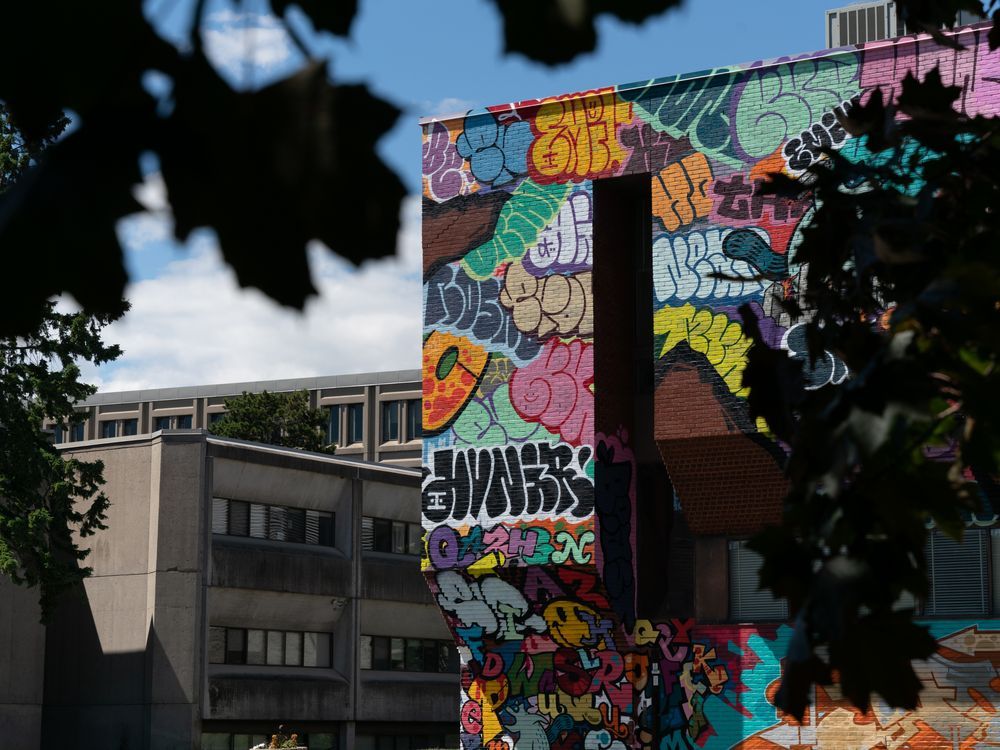
The facades of the Agnes Etherington Art Centre are sporting a fresh makeover.
Article content
Over a four-day period, six graffiti artists used 4,500 cans of spray paint to cover a 55-metre stretch of wall in a graffiti art exhibit known as Transformations. The artwork was unveiled last week.
“It’s reoriented the Art Centre in a way,” Emelie Chhangur, director and curator of the Art Centre, told the Whig-Standard. “This brick building is actually beautiful architecturally. It’s all about changing perceptions.”
The new installation is meant to distinguish the corner of Bader Lane and University Avenue from the ubiquitous limestone low-rises of Kingston. It also intends to break the norms of art galleries.
“Agnes might be the only institution in the world that can say it has graffiti on the outside and Rembrandt on the inside.”
The Art Centre opted for an open-ended approach to Transformations. Rather than blueprinting and actively directing a redesign, Chhangur entrusted the six artists’ collaboration to create something “six times more beautiful than what each of them make (on their own)”.
“It was very organic.”
Diverse styles of graffiti art now cover the walls of the Art Centre. Within the mix, Emily May Rose’s signature raccoons make an appearance, and locals may recognize Kingstonian artists’ contributions from their other works in the area.
Kingston-raised graffiti artist Oriah Scott took the lead on assembling the team. He and Chhangur met while Scott was painting in a Toronto alleyway.
“Agnes is deeply connected to its local (surroundings) and manifests a civic function,” Chhangur said. “This is a curated project that brings art conservation, Agnes, graffiti artists, and the facades (of the Art Centre) together into a new relation.”
Article content
“The main process was building trust with artists who are not shown in institutions, artists who have a long history of being rejected in the city streets.”
Scott and others, who according to Chhangur used to refuse to step foot onto the Queen’s University campus, are now involved in the Queen’s art conservation program.
“Next thing you know, they’re in the lab giving talks to our students.”
Chhangur refers to Transformations as a “reciprocal” relationship building project resulting in the “transformation” of an art institution.
In other news of transformation, the Art Centre will be undergoing a renovation dubbed “Agnes Reimagined” beginning in June 2023, marking the expiry date of the Transformations exhibit.
Similarly to the graffiti exhibit, the Art Centre is leaving it up to artist collaboration to determine exactly what the renovation will entail. The Art Centre recently held a competition to choose its architects, and plans to continue consulting community groups in the decision-making process.
“Transformation doesn’t have an end goal in sight,” Chhangur said. “You don’t know where it’s going to lead you. But if you do it in a good way, you’ll end up with something very spectacular.”

Follow Canada News Media
Get the day's top Canadian stories and our two daily 60-second news videos wherever you scroll.
X Threads Facebook Instagram LinkedIn TikTok YouTube Pinterest Reddit Substack Flipboard Newsletter RSS