


The Maple Leafs are 6-3-3 without Jake Muzzin in the lineup this season. But make no mistake, this team misses Jake Muzzin.
They’re worse without him, clearly.
“It’s a tough loss for us. He’s a very important player for many reasons,” Leafs coach Sheldon Keefe said after the news of Muzzin’s indefinite absence was officially announced.
Muzzin will be out for the next three and a half months at the very least with a cervical spine injury, and likely, the rest of the season.
Which makes it imperative that the Leafs find a replacement for him somehow. The timeline for even the possibility of Muzzin’s return basically ensures that.
It won’t be easy. Defencemen of Muzzin’s calibre, with his particular brawny, defensive style of play, are difficult to find — and come at a high cost. (To acquire Muzzin in the first place, the Leafs parted with a first-round pick, a top prospect in Sean Durzi, who has since become a highly impactful defenceman, and NHL forward in Carl Grundstrom.)
But the Leafs are going to have to try.
What they have internally without Muzzin isn’t enough, not for a team that’s trying to win the Stanley Cup. And as Leafs GM Kyle Dubas noted on Monday afternoon, it’s very much murky whether Muzzin will be able to return at all this season.
“If we had any experience with this type of thing,” Dubas said, referring to Muzzin’s neck injury, which came from a hit by Arizona’s Clayton Keller last month, “I’d stand up and give some semblance of a clear answer. But because of the nature of the injury, and because we really don’t have a lot of experience with this type of injury and you’re more relying on other sports that don’t replicate hockey exactly, it’s hard to predict.”
As Dubas noted, this is the second “notable incident” of this kind for Muzzin. There was the scary scene in Game 2 of the 2020 playoff series against Columbus when Muzzin had to be stretchered off the ice along with the more recent collision with Keller.
Muzzin has also had a long history of back issues and suffered a pair of concussions last season.
His body has been through a lot.

(John E. Sokolowski / USA Today)
“It’s not something I think you want to really mess around with,” Dubas said. “We have to do what’s right for his long-term health. He’s a father of two young children and a husband. We have to make sure that we’re doing right by him. As important as he is to us as a player, his health is paramount.”
Muzzin showed in last year’s first-round series against Tampa what makes him so special and unique to the Leafs. His most frequent forward opponent in the seven-game series was Lightning superstar Nikita Kucherov.
In those 42 minutes, the Leafs were basically even on the shot clock (21-22) and scoreboard (1-1). That’s what neutralization looks like.
With a hand from T.J. Brodie, Muzzin made Tampa’s top players work. He made passage to the net difficult with that large 6-foot-3, 230-plus pound frame. He was physical, dishing out 25 hits in the seven-game series. He also blocked 16 shots.
Muzzin is the only Leaf defender with that particular set of skills — big and brawny and perfectly suited to play playoff hockey.
It’s why the Leafs decided not to spend his long-term injured reserve money last season, amid those concussions, and risk not having him around for that postseason — a choice they almost certainly won’t have this season. (More on that in a second.)
Muzzin is immensely valuable off the ice, too.
“His experience and his voice in the room and in the games, that’s another area that you take him out and other people are now having to say more, address different situations,” Keefe said earlier this month.
Muzzin can still help with the intangible stuff. He’s remained around the team the last month and has sat in on some meetings. But the Leafs lose his presence on the bench and in the dressing room.
Keefe can put together a perfectly decent group of six without Muzzin, something like this when Brodie returns from an oblique injury in a couple of weeks:
Rielly – Brodie
Giordano – Holl
Sandin – Liljegren
A group like that might be able to win a round. Not four.
The Leafs have been reluctant to stress Mark Giordano — and with good reason. He’s not just the oldest defenceman in the league, he’s the oldest player in the league, period, at 39. It’s too much to ask him to do the top-line tango every other night in the postseason at this point in his career.
Justin Holl has played better of late after a rough start to the season. But ideally, he’s not asked to duel with elite talent night after night in the playoffs. Holl is best suited to a third-pairing role, with major penalty-killing responsibilities. (That’s another area in which the Leafs will miss Muzzin.) He had success doing just that on a third pair with Giordano last spring.
Then, there’s Rasmus Sandin and Timothy Liljegren.
When asked about trade possibilities in the aftermath of the Muzzin news, Dubas pointed to the two young defencemen and the expectation that both would take on increased responsibility in the weeks and months to come.
Step one for management without Muzzin indefinitely, Dubas said, was to see “how much (Sandin and Liljegren) can handle, and whether they can, with the increased opportunity, continue to elevate themselves as they each have in their respective starts to their careers with us.”
“Step two,” he went on, “would be then identifying, even if they elevate themselves, whether it’s going to be enough to help us really accomplish what we want to accomplish, and then evaluate the trade market and go from there.”
That’s the key right there.
Truth is, even the best possible versions of Sandin and Liljegren, at this age especially, don’t fill the Muzzin gap.
Not even close. We know that already.
Sandin’s opportunity briefly ticked up after Muzzin was hurt initially against Arizona. It quickly became clear that top-four responsibility, alongside Holl in particular, was too much for him to handle.
The Leafs reordered their pairs as a result.
Liljegren was dropped onto the top pair right away after his return from hernia surgery earlier this month.
Over the weekend, he was replaced by veteran Jordie Benn, who will remain alongside Morgan Rielly for the time being on that No. 1 pair.
Liljegren will hang with close pal Sandin on the third pair.
In other words, even without Muzzin and Brodie, the Leafs will keep things light for Sandin and Liljegren.
The Leafs don’t have the ingredients to put together an ideal shutdown pair — for the playoffs — without Muzzin or an outside alternative of some kind. A Brodie-Holl combo is probably the best possible internal solution, but that leaves Rielly without an ideal partner — and again, asks a lot of Holl.
A Muzzin replacement would have to solve that problem, whether he plays with Rielly, Brodie, or even if it’s not ideal, Holl.
The Leafs will need to come up with someone better than Holl and Giordano and more ready for top-line combat than Sandin and Liljegren. Someone who can survive in elite waters in a playoff series — multiple playoff series.
Muzzin’s timeline basically ensures they’ll have to act.
He won’t be re-evaluated until late February. In other words, the Leafs won’t know if there’s even a possibility of his return until days before the March 3 trade deadline. This means that, unlike last season, Dubas won’t really have a choice when it comes to spending Muzzin’s cap dollars.
The Leafs don’t have the luxury of leaving such a significant roster spot to chance.
They have no choice but to operate under the assumption that Muzzin is not coming back — which puts the possibility of Muzzin’s return this season into even greater doubt. Were they to spend his LTI money, Muzzin (barring other injuries) wouldn’t be able to return until the playoffs. And the chances of Muzzin missing nearly the entire regular season only to return for postseason action are basically none.
It’ll take some serious scouring to find a fit who’s gettable.
If the Washington Capitals fall out of playoff contention, would they be willing to move on from the rugged Dmitry Orlov? He’s headed for free agency next summer, with a cap hit of $5.1 million, and fits the prototype of what the Leafs need to replace Muzzin.
So does (sort of) Senators defenceman Artem Zub. He’s injured at the moment, but has only a $2.5 million cap hit and is due to hit unrestricted free agency next summer if Ottawa doesn’t sign him first.
Is Islanders behemoth Scott Mayfield enough of an upgrade on Holl? He would fit nicely on a pairing with Rielly. So might Chicago’s Connor Murphy, another gigantic right-shooting defender who’s signed for this season and three more after that ($4.4 million cap hit).
The Leafs would surely prefer that any player they acquire to replace Muzzin have some term on his contract, but given the stakes of the season, they may not have the luxury of being quite so choosy.
Muzzin being on long-term injured reserve means the Leafs have the cap space to go get someone.
The other part of the equation: What do they have to trade? Will Dubas be free to move another first-round pick? Would he part with one of Sandin or Liljegren (as part of a package perhaps) if it nets his team a serious upgrade — with term on their deal?
Would he move Nick Robertson?
The news that Muzzin may not return this season isn’t unexpected. But it does all but ensure the Leafs have to do something to replace him.
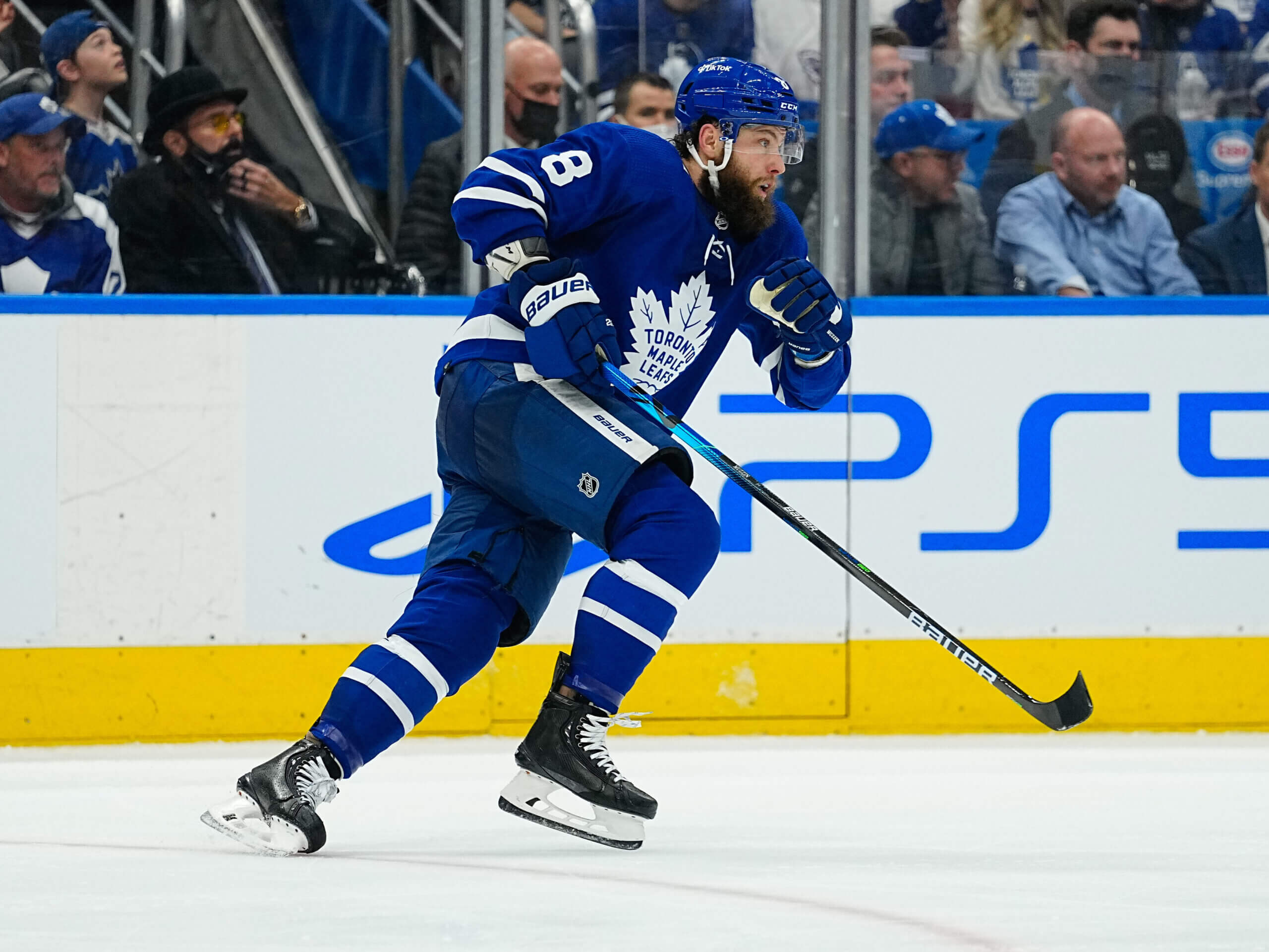
(Top photo by Kevin Sousa / NHLI via Getty Images)
Stats and research courtesy of Natural Stat Trick, Evolving Hockey and Cap Friendly