



Mars is bright in our night skies this week, having reached its closest distance to Earth for the next decade. Now watch this week as the Full Moon makes the Red Planet briefly disappear!
On the night of December 7-8, the Full Cold Moon will shine in the sky. It won’t be alone, though. Look closely and you will spot a tiny bright companion right next to it — the planet Mars.
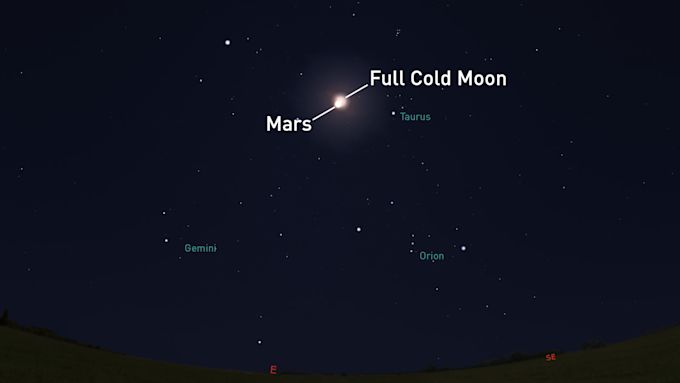 A view of the eastern sky, at around 9 p.m. EST on Wednesday, from southern Ontario. Mars is positioned very close to the Full Moon. Credit: Stellarium/Scott Sutherland
On that very night, Mars will reach Opposition. At that time, it will be positioned on exactly the opposite side of Earth from the Sun.
However, as the night progresses, the Full Moon is going to steal the show from Mars — in a very literal sense — by completely blocking our view of the planet!
This is known as Mars Occultation.
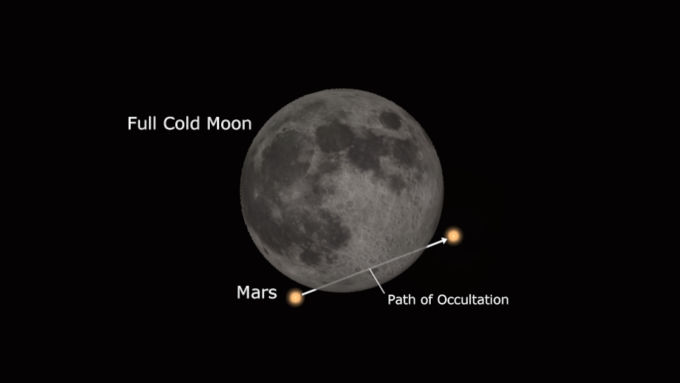 This closeup view of the Full Moon and Mars show the path the planet takes behind the Moon, as seen from southern Ontario. Credit: Stellarium/Scott Sutherland
As long as you have reasonably clear skies, this event is easily visible to the unaided eye. However, it’s even better if you have a pair of binoculars or a telescope to view it up-close.
The exact timing of the occultation, along with how long it lasts, depends on where you are watching from at the time.
In the Royal Astronomical Society of Canada 2022 Observer’s Handbook, David Dunham and David Herald, from the International Occultation Timing Association (yes, that’s a real thing!), give the following durations and timing for different cities across Canada:
- Halifax: 10 minutes, from 12:19 a.m. to 12:29 a.m. AST, Dec 8
- Montreal: 48 minutes, from 10:41 p.m to 11:29 p.m. EST, Dec 7
- Toronto: 48 minutes, from 10:29 p.m to 11:17 p.m. EST, Dec 7
- Winnipeg: 70 minutes, from 9:05 p.m to 10:15 p.m. CST, Dec 7
- Edmonton: 62 minutes, from 8:04 p.m. to 9:06 p.m. MST, Dec 7
- Vancouver: 57 minutes, from 6:55 p.m. to 7:52 p.m. PST, Dec 7
The IOTA has a full list of cities the event is visible from on their website.
The reason for the different timing and duration is the path Mars takes as it passes behind the Moon, due to the latitude and longitude we observe it from.
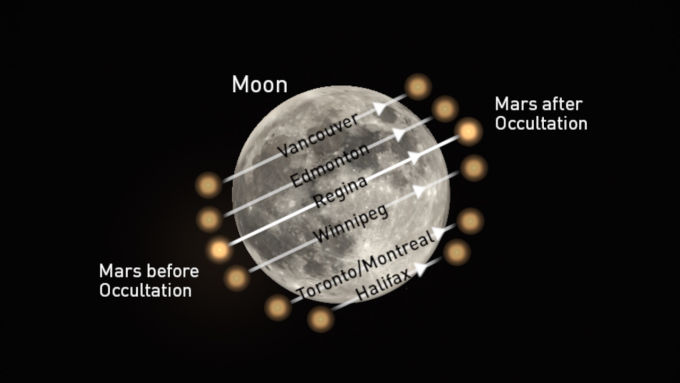 The path of Mars behind the Moon, from a sampling of cities across Canada. The longest durations for this event in Canada will be around Regina, SK, where the path of Mars takes it behind the centre of the Moon’s disk. Credit: Stellarium/Scott Sutherland
For example, observers in Halifax will see Mars will slip behind just the edge of the Moon, reappearing after only 10 minutes have gone by. For someone farther north in Atlantic Canada, such as on Prince Edward Island, Cape Breton Island or Newfoundland, Mars will duck a bit farther behind the Moon’s disk, and thus will take longer to reappear.
Through New Brunswick, Quebec and Ontario, the farther west and north you are, the longer the occultation will last. Manitoba and Saskatchewan will see it the longest, as Mars takes a path that is roughly centred on the Moon during the event. The duration decreases again as you head farther west through Alberta and British Columbia.
Clear skies are essential for observing this event. So, check your local weather forecast, to ensure you’ll be able to see it!
Watch from anywhere!
Is the weather not cooperating in your area? Can’t make it outside to watch? Astronomers have you covered.
The Virtual Telescope Project will be hosting a live-streamed event for the Mars Occultation on Wednesday night, starting at 11 p.m. EST.
The Griffith Observatory in Los Angeles will host its own event, starting at 9 p.m. EST.
What is a Full Cold Moon?
Wednesday night’s Full Moon is 2022’s Cold Moon. The name is one of a dozen given to the Full Moons of the year by the various farmer’s almanacs.
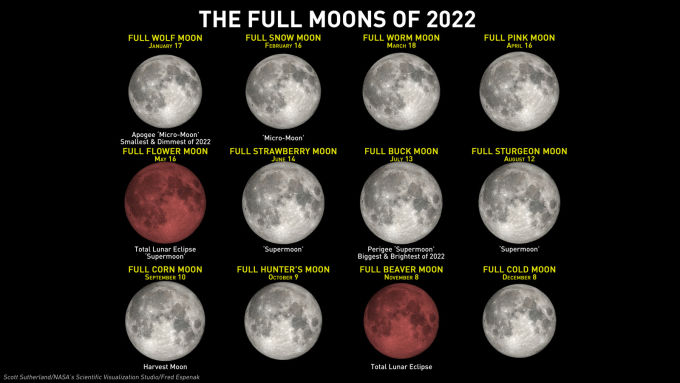
According to the Old Farmer’s Almanac, the names originate from Native American, Colonial and other traditional folklore.
“December’s full Moon is most commonly known as the Cold Moon — a Mohawk name that conveys the frigid conditions of this time of year, when cold weather truly begins to grip us,” they state on their website. “Other names that allude to the cold and snow include Drift Clearing Moon (Cree), Frost Exploding Trees Moon (Cree), Moon of the Popping Trees (Oglala), Hoar Frost Moon (Cree), Snow Moon (Haida, Cherokee), and Winter Maker Moon (Western Abenaki).”