

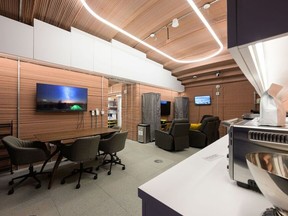
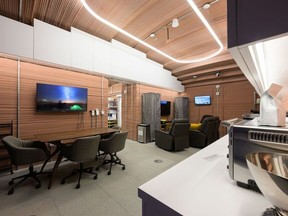
The mission patch for NASA’s newest endeavour looks like it’s for the first humans to set foot on the Mars. There are four astronauts’ names surrounding a crimson landscape beneath a dome of stars, and a mission name, CHAPEA 1.
The CHAPEA 1 mission, or Crew Health and Performance Exploration Analog, is just the latest attempt by the space agency to replicate the rigours of an extended stay on the red planet. The astronauts — technically, “analog astronauts” — entered their 158-square-metre (1,700-square-foot) living space on Sunday evening, and will not emerge until July 7, 2024.
The four volunteers will eat, sleep and work in the 3D-printed structure, dubbed “Mars Dune Alpha,” for the next 378 days. The only time they will leave the habitat will be to spend time on the “Martian surface,” a 1,200-square-foot sandbox filled with simulated Mars regolith.
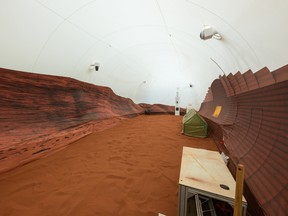
Suzanne Bell, who heads NASA’s Behavioral Health and Performance Laboratory in Houston, told the website collectSPACE.com that the length of the mission, the first of three, was notable. “We also do analogs in something called HERA, the Human Exploration Research Analog, and our missions there have been 45 days,” she said. “And then we collect data at other analogs, too, with varying lengths, but this will be three, over one-year-long missions, which is a really great extended isolation.”
The four crew members may not be “real” astronauts, but the selection process included the same physical and psychological testing as other astronaut candidates, and requirements included a degree in one of the STEM fields (science, technology, engineering or mathematics) as well as professional, piloting or military experience.
“What CHAPEA is really about is Mars-realistic conditions in terms of resource restrictions,” Bell said. “Isolation confined with the living space being one of them. But we’re also restricting the crew to a spaceflight food system, time-delayed communications, mission-relevant timelines, contingency situations and other resource restrictions.”
That means that any crew communications will take 22 minutes to reach mission control, duplicating the maximum time for radio waves to travel between Earth and Mars. The crew will be eating freeze-dried, thermo-stablized and shelf-stable foods.
In addition to being the newest and one of the longest Mars analog missions, CHAPEA 1 is also one of the most accessible. Mars analogs are often set up in remote locations, the better to replicate the harsh Martian environment.
NASA’s Hawaii Space Exploration Analog and Simulation, or HI-SEAS, sits 2,400 metres above sea level on the side of a dormant volcano. The space agency also runs the NASA Extreme Environment Mission Operations, or NEEMO.
Perhaps the most intense Mars analog mission to date was MARS-500, conduced by Russia, the European Space Agency and China beginning in 2007. The 19,000-square-foot (550-square-metre) mockup included a main spacecraft, a smaller landing craft and an “outdoor” Martian landscape. The mission lasted a total of 520 days.

In a lighter (and less scientifically accurate) vein is Stars on Mars, a reality TV show that debuted on Fox this month and places 12 celebrities in a Mars-lookalike landscape in a remote part of South Australia. Contestants include cyclist Lance Armstrong (no relation to Neil), actor Christopher Mintz-Plasse, Super Bowl champion Marshawn Lynch (note the first name) and pro wrestler Ronda Rousey.
“This is the most realistic celebrity Mars colony simulation ever created,” says host William Shatner in the trailer for the show, his wiggle words making it hard to argue with the statement. Unlike more serious-minded analogs, however, Stars on Mars will send one astronaut “back to Earth” each week until only one remains.