

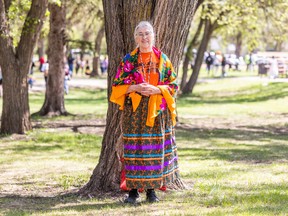
When she was a little girl, Marjorie Beaucage’s grandmother taught her a lesson that would set her on a decades-long path of art, activism and social change.
Those values led Beaucage to become a teacher, a community organizer, a filmmaker, an artist and a founder of Indigenous art spaces like the Aboriginal Film and Video Art Alliance.
Now in her 70s, Beaucage carries on her grandmother’s teachings as a two-spirit Métis Elder, serving as Elder for OUTSaskatoon, Elder-in-Residence for the University of Saskatchewan Students Union, and Grandmother for Walking With Our Sisters.
In her new book, ‘Leave some for the birds: Movements for justice,’ she shares stories and insights with the next generation of activists.
At first, she hadn’t intended to write a book — at a residency in New Mexico, she was exploring ideas for art projects using the journals she had kept from childhood through her 60s.
“Journaling was my survival when I was younger,” she said. “I had no place to put my feelings, and it was mostly anger and rage on those pages — but I didn’t want to carry it around. So it saved my life, really.”
“People were always asking me, ‘Are you writing your memoirs?’” she said. “And I said ‘No, memoirs are just lies you tell yourself about who you were.’ So I burnt them all, and I made a label for the jar of ashes — ‘Memoirs.’ But that jar wasn’t big enough. I had to go and buy a pail from Canadian Tire.”
Since then, Beaucage says she mostly left her journaling behind.
“I have a voice now,” she said. “I don’t need my journals in the same way.”
But even with the original pages gone, the ideas and lessons remained, and when she returned home, Beaucage decided to put them into a book: Not to tell stories about herself, but to offer a resource to others.
“There were some pretty good things I could pass on to future activists. And I didn’t realize there was so much poetry in my journals, either,” she says.
For two-spirit writer, speaker and advocate Prestin Thōtin-awāsis, “Marjorie came into my life when I needed her most.” He says Beaucage’s new book offers readers a chance to learn from her in a new way.
“What I love about this book is that I was able to open it to any page, and was able to read it and feel inspired with every poem and every sharing,” Thōtin-awāsis said. “Movements for justice, I think, is the true definition of Marjorie’s life.”
In revisiting her early writing, Beaucage saw how she had spent her life — “since the day I was born” — questioning everything.
In her book and in her conversations with young activists, Beaucage shares her hard-won lessons about balance — finding the right blend of action and reflection, which she wishes someone had been there to advise her on when she was younger.
“I burnt out so many times,” she said. “Everybody was ‘do, do, do.’ We were human doings, not human beings. And I wish somebody had said — sit down, have a cup of tea, slow down. It was a burning passion and I couldn’t quit. I remember sometimes, I was so 100 per cent ‘on it’ all the time that when I walked into a room, people didn’t want to make eye contact because they knew I was probably going to go into a rant. That wasn’t a good feeling.”
“That’s mostly where I balance myself out — picking berries, working on my garden, the water walks,” she said. “All those things help.”
And, fresh off her book launch, Beaucage seeks balance by continuing her water walk along the South Saskatchewan River.
This summer, she and a small group of water walkers will complete their three-year journey to walk and pray along the length of the river.
“It’s a ceremony for the water,” Beaucage explains. “When we go on pilgrimage or when we walk, we’re carrying the water to keep it flowing and keep it healthy — because the river is really sick, right now. It only has three feet of water in it. …
“It’s not a political act. It’s a ceremony. It’s not a protest. It’s helping the water get well. It’s just another expression of my love for the land.”
“It’s beautiful, being out there doing only one thing and being present in the moment all the time,” she said. “That’s the best part of it. Nothing else matters; just the water. We’re doing it for the water, and every step is a prayer.”