
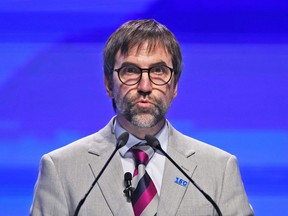
The dreams of the Trudeau Liberals amount to pies in the sky. The Liberals are big on lofty goals, short on pragmatic process and down-to-earth deadlines, the most recent example being their draft regulations for a net-zero energy grid by 2035, announced at a news conference Thursday in Toronto by federal Environment Minister Steven Guilbeault.
Guilbeault used many fine phrases to sell his scheme — “generational economic opportunity,” “good middle-class jobs,” “a future where energy is clean, affordable and reliable.”
He also shared a few bold predictions. Investors, he said, would have to spend $400 billion to realize the Liberal plan, but there would be a net benefit to Canadians of $29 billion by 2050. He also put out on social media a claim by the Canadian Climate Institute that this plan will save Canadians on average 12 per cent on energy costs by 2050.
Those are swell numbers. But how much credibility should we give to economic forecasts by the Trudeau Liberals? Next to zero.
The most infamous of such projections was Prime Minister Justin Trudeau’s “very cast in stone” promise in 2015 to balance the federal budget by 2019. The Liberals have never balanced it, with the federal deficit $53 billion in 2022 alone.
Another whopper? The Liberals promise in 2017 that the Trans Mountain pipeline expansion would cost $7.4 billion, only to see that cost rise to $30.9 billion today.
It’s impossible to accurately forecast the price of consumer power in 2050, but we do know that recent jurisdictions, such as California and Germany, that have moved zealously into unreliable wind-and-solar powered grids have faced major issues with either cost, reliability or both.
Guilbeault is correct that our future is tied to making the right choices on energy. That said, he’s got little credibility on the matter given his decades-long hostility to nuclear power, the single best process to boost Canada’s productivity and slash emissions both here and with reactor exports around the world.
Canadians have a role to play and the quicker Alberta moves on nuclear the better, but the issue of carbon emissions will be decided in countries like the world’s biggest emitter, China, which produced 11.5 billion tonnes in 2021, compared to 550 million tonnes in Canada.
Smith also said, “The draft federal 2035 net-zero power grid regulations are unconstitutional, irresponsible and do not align with Alberta’s emissions reduction and energy development plan that works towards a carbon-neutral power grid by 2050.”
No matter what Ottawa says, Smith promised Alberta will bring on more energy with natural gas plants rigged with carbon capture, utilization and storage, small modular nuclear reactors, hydrogen and “a sustainable” amount of wind, solar and other renewables.
A major sticking point, referenced by Alberta Environment Minister Rebecca Schulz in her news conference, is that Ottawa will put a 20-year time limit on new gas plants, as opposed to their usual 40-year lifespan, greatly limiting their ability to either turn a profit or provide affordable energy. Guilbeault’s plan will drive up consumer costs three, four or five times as high as they are now, Schulz said.
I don’t see that Smith has much choice but to take the strongest of stands here.
If things go wrong with Alberta’s grid, if prices go crazy or power isn’t available to huge numbers of Albertans on our coldest winter days, who will be held accountable?
Even more crucially, who will accept blame?
Guilbeault and Trudeau? It’s hard to imagine. Their base is elsewhere. Their own focus is on hydro, solar and wind, the preferred energy sources of their home province of Quebec. No one there will give much thought if Alberta’s power supply disappears on a cold, dark, windless day or if costly grid transformation drives up our utility bills.
The blame will fall on Smith. The responsibility now falls on her to get this right for Albertans.