

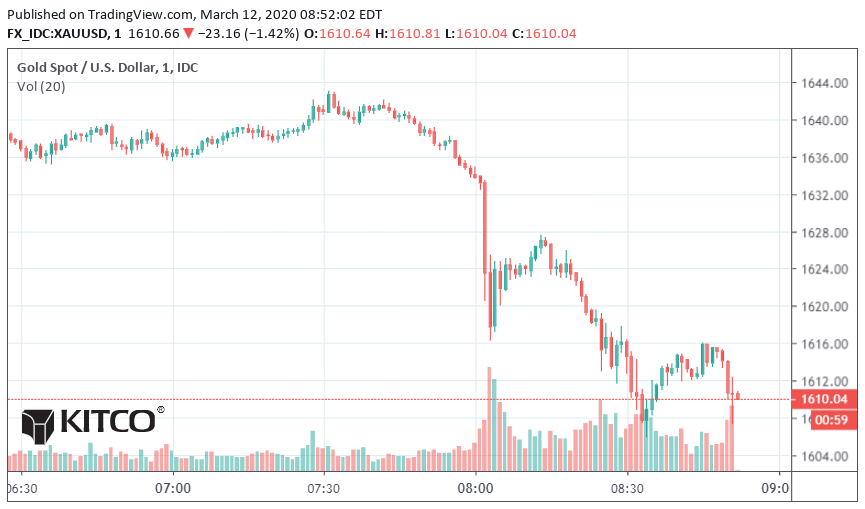
(Kitco News) – The market remain under pressure but prices are holding support above 1,600 an ounce as the European Central Bank left interest rates unchanged but announced measures to support the European economy impacted by the spread of the coronavirus.
Thursday, the ECB announced that the interest rate on the main refinancing operations and the interest rates on the marginal lending facility and the deposit facility will remain unchanged at 0.00%, 0.25% and -0.50% respectively.
The ECB said that it additional longer-term refinancing operations (LTROs) will be conducted, temporarily, to provide immediate liquidity support to the euro area financial system.
“Although the Governing Council does not see material signs of strains in money markets or liquidity shortages in the banking system, these operations will provide an effective backstop in case of need,” the ECB said.
In TLTRO III, considerably more favourable terms will be applied during the period from June 2020 to June 2021 to all TLTRO III operations outstanding during that same time, the ECB said
“These operations will support bank lending to those affected most by the spread of the coronavirus, in particular small and medium-sized enterprises,” the central bank said.
The ECB also said that it will introduce a new asset purchase program of €120 billion for the rest of the year. This is on top if its current monthly program.
“The Governing Council continues to expect net asset purchases to run for as long as necessary to reinforce the accommodative impact of its policy rates, and to end shortly before it starts raising the key ECB interest rates,” the council said in its monetary policy statement.

Andrew Kenningham, chief Europe economist at Capital Economics, said that while the ECB measures are substantial, he doesn’t expect that it will be enough to shift investors’ sentiment in the marketplace.
“Monetary policy is powerless to prevent a deep downturn and, unlike in the US and China, it has little scope to support the recovery afterwards,” he said. “What matters for the economy is the trajectory of the virus itself and the measures which national authorities take to contain it. The most that can be achieved by economic policy is to soften the blow and (hopefully) prevent the downturn from morphing into a financial sector or sovereign debt crisis.”