

The mystery surrounding the potential for a dazzling northern lights show was clearly lifted come early Sunday morning, with scores of visuals brightening up social media.
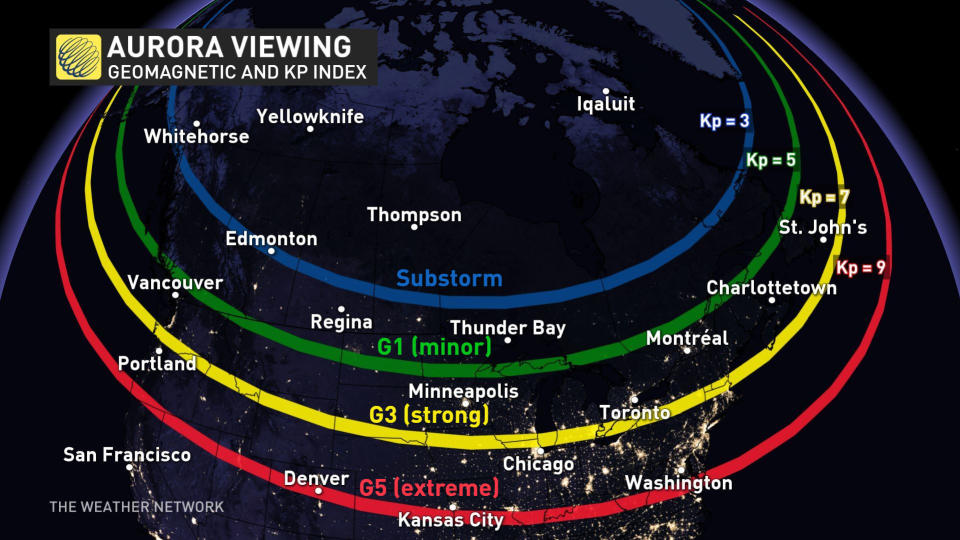
Earlier in the week, NOAA’s Space Weather Prediction Center said a solar storm was projected to sweep past Earth late in the day on Saturday. While the agency forecast a minor (G1) geomagnetic storm from Saturday overnight into Sunday morning, the result was actually a G2, or moderate, event — allowing the northern lights to dance across the skies at even lower latitudes.
There was some uncertainty regarding the timing and intensity of the geomagnetic storm, potentially varying due to when the coronal mass ejection (CME) arrived and how much of an impact it had on Earth’s magnetic field.
The most common impacts from a G1 or G2 storm are the farther-south-than-usual displays of the aurora borealis.
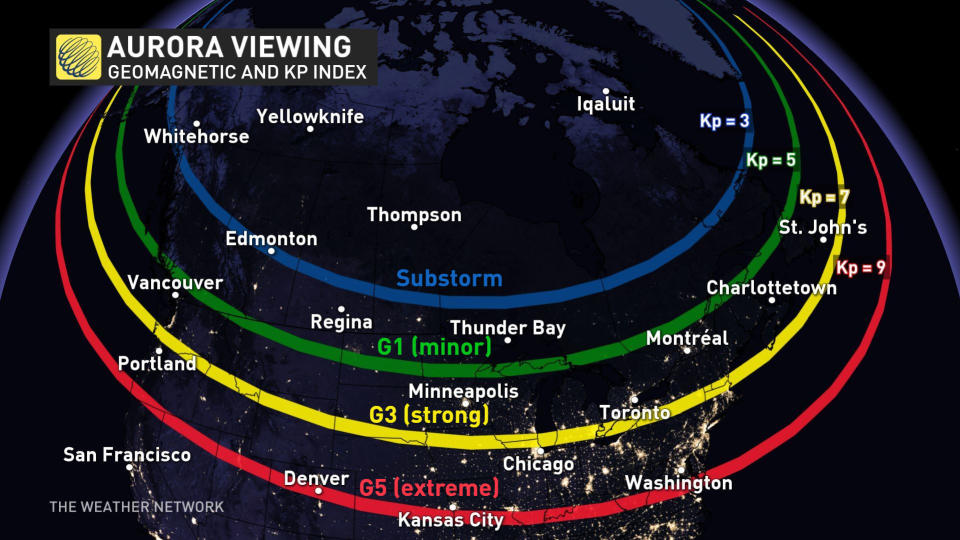
The phenomena is caused by solar flares from the sun, where the charged particles from the flares interact with the gases in our upper atmosphere. The colour variety comes from different gas particles in the atmosphere, as well as the wavelength of emitted light, according to NASA.
Based on visuals surfacing on X, the platform formerly known as Twitter, auroras were captured across large swaths of North America — from Alaska to New Hampshire, including parts of Newfoundland, Quebec, Ontario, British Columbia and the Prairies.
Below is just a selection of what has been posted on social media so far.