

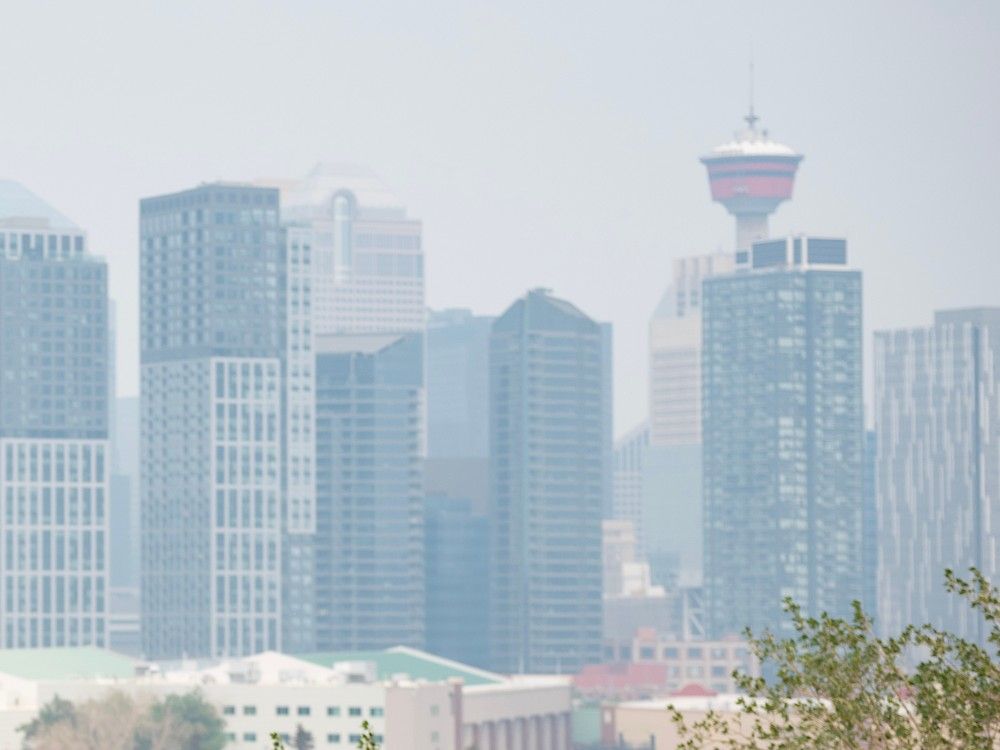
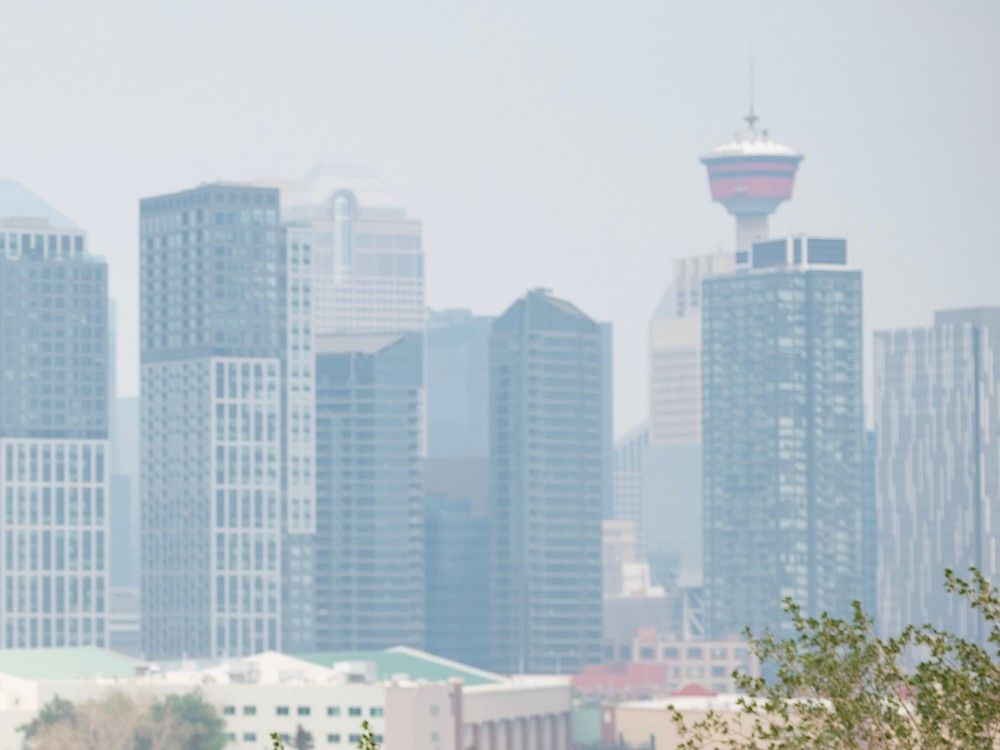
Calgarians awoke to a thick haze hanging in the sky Monday morning, with high concentrations of wildfire smoke triggering air quality advisories for the entire province.
The warning came as Calgary smashed a record for the highest number of smoky hours in a year.
The Air Quality Health Index for Calgary steadily rose over the weekend to reach 10 early Monday, a level considered high risk.
“Wildfire smoke can be harmful to everyone’s health even at low concentrations,” said Environment Canada in a special air quality statement issued Monday morning. “Stop outdoor activities and contact your health care provider if you or someone in your care experiences shortness of breath, wheezing (including asthma attacks), severe cough, dizziness or chest pains. Stay inside if you are feeling unwell and experiencing symptoms.”
With the Labour Day Classic slated for McMahon Stadium this afternoon, pitting the Calgary Stampeders against the Edmonton Elks for their annual gridiron matchup, team officials said on social media they would be monitoring the smoke situation.
The prevalence of smoky conditions in Calgary this spring and summer led to the city setting a record this weekend for the number of hours shrouded under a blanket of smoke.
Sometime on Sunday, the city reached 451 hours smothered in smoke so far this year, according to data published online by weather historian Rolf Campbell, surpassing a five-year-old record for number of smoky hours recorded in a year.
By 8 a.m. Monday, Calgary had seen 472 hours of smoke so far in 2023.
People are encouraged to be aware of potential health problems associated with smoke, said Alberta Health Services on its website.
Those who believe they may be having a heart attack or a stroke, or otherwise need medical care, should call 911 to summon emergency services, said AHS.
“Individuals with respiratory conditions (such as COPD and asthma), and individuals with existing cardiovascular conditions (such as angina, previous heart attack and congestive heart failure), may notice a worsening of symptoms, due to the poor air quality conditions,” said the provincial health authority. “These individuals should monitor for worsening of symptoms and take the precautions recommended by their physicians if a worsening of symptoms occurs.”
The health impact of wildfire smoke may be heightened for children and the elderly, AHS added.
Those who can’t avoid the smoke are encouraged to protect themselves, said Environment Canada.
“If you must spend time outdoors, a well-fitted respirator type mask (such as a NIOSH-certified N95 or equivalent respirator) that does not allow air to pass through small openings between the mask and face, can help reduce your exposure to the fine particles in smoke,” the weather service said.
“These fine particles generally pose the greatest risk to health. However, respirators do not reduce exposure to the gases in wildfire smoke. It is important to listen to your body and reduce or stop activities if you are experiencing symptoms.”
Air quality in Calgary is forecast to improve slightly over the next day but remain at high risk through Tuesday.