
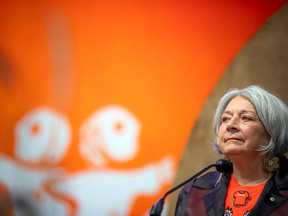
OTTAWA — Governor General Mary May Simon is apologizing for an Order of Canada award given to an Alberta man who served in the same Nazi unit as a man recognized in the House of Commons last month.
In a statement, Rideau Hall said it regretted the award given to Peter Savaryn in 1987. Savaryn was Chancellor of the University of Alberta and President of the Progressive Conservative Party of Alberta in the 1980s. He also served with the Waffen SS, a voluntary Nazi unit in Ukraine during the Second World War.
“It is with deep regret that we acknowledge that Mr. Peter Savaryn was appointed to the Order of Canada in 1987, and we express our sincere apology to Canadians for any distress or pain his appointment may have caused,” reads the statement, which was first issued to Forward, a Jewish news organization.
Savaryn died in 2017 and as part of the constitution of the Order of Canada his award was automatically rescinded. He was also awarded Golden Jubilee and Diamond Jubilee medals, and Rideau Hall is considering whether those can be rescinded.
Last week, former Speaker Anthony Rota resigned after calling on the House to recognize Yaroslav Hunka, a 98-year-old man from North Bay, Ont., who also served with the Waffen SS. The tribute, given during a visit by Ukraine’s president, resulted in international headlines and a public apology by the prime minister.
“Mr. Hunka’s past involvement with the Waffen-SS and his recognition in the House of Commons have been a source of great concern to the Governor General,” reads the statement from Rideau Hall.
“The Chancellery is committed to working with Canadians to ensure our honours system is reflective of Canadian values. Historical appointments to the Order of Canada reflect a specific moment in time and would have been based on limited information sources available at that time.”
Dan Panneton, director of community engagement with the Friends Of Simon Wiesenthal Centre, said it welcomes the Governor General’s apology, but said she should go further and formally remove Savaryn’s honour, even if that requires a new process.
“If, subsequently, evidence comes to light of something as grievous as collaborating with a Nazi regime, that there should be some mechanism where it’s made clear that this individual is rejected by the institution,” Panneton said.
The incident with Hunka has drawn new attention to the Canadian government’s past complacency in allowing former Nazi soldiers and officials to immigrate here in the decades after the Second World War.
The commission was called after news reports that Nazi war criminal Josef Mengele, a notorious doctor who performed cruel experiments at the Auschwitz-Birkenau concentration camp, had lived in Canada.
Deschênes found no truth to those reports, but did identify and interview 774 people who were suspected of being war criminals. Those names were not part of the declassified version of his report.
Panneton said releasing the report is overdue and an important part of Canada reckoning with its history.
“It would be undoing a historical misstep by the Canadian government in covering that up, because it would enable the Canadian public to recognize how deep this problem goes,” he said. “This would provide much needed sunlight into a very dark period that a lot of people don’t know about.”
The Deschênes report found that members of the Waffen SS could not be indicted as a group, but Panneton said it was written before all records were available, and he noted that the Nuremberg trials found the unit was responsible for war crimes.
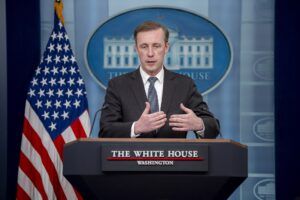
Immigration Minister Marc Miller said the government has to be deliberate.
“We need to look at whether we can declassify these documents, in what context and in the context of people that are still alive what presumptive due process they’re entitled to,” he said.
The report deals with people who were let into the country in the 1940s, ’50s and ’60s. Miller said he doesn’t know what’s in the classified sections of the report, but said it will require a nuanced approach.
“I would encourage people that are interested to actually read the report because it is telling, particularly through the lens of what we saw in the last week in Canada’s dark history with welcoming Nazis to Canada in the context of a post-war world,” he said.
“It is work that will require sensitivity. It will require a little bit of time and some work by people that put some thought into what elements get declassified.”
Twitter: RyanTumilty
Email: [email protected]

Follow Canada News Media
Get the day's top Canadian stories and our two daily 60-second news videos wherever you scroll.
X Threads Facebook Instagram LinkedIn TikTok YouTube Pinterest Reddit Substack Flipboard Newsletter RSS