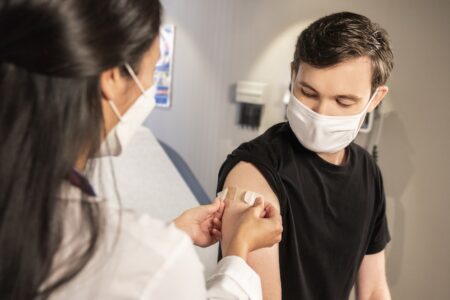



Health Minister Adrian Dix added that B.C. launched it’s vaccination campaign about nine days earlier than most other jurisdictions, which resulted in B.C. leading the country in terms of immunizing its population against all respiratory illnesses this year.

“This is because of the take-up and the remarkable efforts or pharmacies and health care workers and health authorities around B.C., but mostly, it’s because of people stepping up and getting vaccinated,” Dix said.
“Just yesterday (Nov. 9), 27,000 people aged 12 and above had their vaccination appointments, 3,400 between six months and 11 (years old) had their appointments. That’s more than 30,000 yesterday, so the campaign continues to be strong across B.C.”
The health minister added the 2022/23 respiratory illness season had a record number of people vaccinated with 1,775,000 doses administered, and said the fact that over one-million were already administered in the first month of this year was promising.
Henry provided an update on the respiratory illness season, saying there was a peak of COVID-19 infections in mid-October, but that had since leveled off.
She went on to say that while seniors, particularly those over the age of 80, are most at risk of severe illness, unvaccinated people of any age are also at the highest high risk of having a COVID infection result in severe illness, hospitalization, and Long COVID.
“A recent [study] really shows us how effective vaccines have been. The Zero Prevelance Study looked at how many people had evidence of antibodies from vaccination and/or from infection across the province by age group, and what we’ve seen is that older people were well protected by vaccines, which is great. It also means how important it is for us to keep the updated vaccines to make sure that we give a boost to that protection,” Henry said.
“For most people in the province we have this combination of vaccination and infection that gives us a high level of population immunity around the province, and for most of us, it meant that as we were vaccinated, the infections we had were very mild and many people didn’t even realize they had it.”
She noted the “hybrid immunity” emphasized the importance of getting vaccinated to not only protect against severe illness and hospitalization but also to lessen the symptoms of an infection.
The B.C. Centre for Disease Control’s (BCCDC) most recent weekly report saw a rise in COVID-19 cases in B.C. and the Interior on a weekly basis, though hospitalizations and deaths declined from the previous week. All instances of COVID were down compared to the reporting week prior to that as well.
- COVID-19 Cases / Hospital (ICU) admissions / Deaths
- B.C. Oct. 29 – Nov. 4 – 531 / 144 (16) / 36
- B.C. Oct. 22 – Oct. 28 – 460 / 168 (26) / 47
- B.C. Oct. 15 – Oct. 21. – 573 / 230 (30) / 70
- Int. Oct. 29 – Nov. 4 – 125 / 10 (3) / 11
- Int. Oct. 22 – Oct. 28 – 117 / 21 (1) / 13
- Int. Oct. 15 – Oct. 21 – 185 / 40 (4) / 23
The province was monitoring cases of RSV (Respiratory Syncytal Virus) and influenza.
“RSV test positivity has started to increase in children, so we’re seeing that primarily reflected from labs at B.C. Children’s Hospital and other labs around the province, and what we’re seeing now is levels that are a little bit above what we would expect at this time of year from pre-pandemic levels, but not what we saw last year when we saw the dramatic increase early on in the season. Overall, RSV activity across all ages still remains low, but it’s starting to increase now,” Henry stated.
“Influenza as well, we’re starting to see that increase, and it’s a bit more in line with what we used to see in pre-pandemic days. It’s mostly Influenza A and the H1N1 strain of Influenza A, about 80 per cent of the detections are that. We’ve seen very little Influenza B right now and, interestingly, there’s one of the strains of Influenza B called Yamagata that we haven’t seen worldwide in the last two years, so that’s an interesting phenomenon that we’re watching.”
Henry noted it would take some time to collect data on vaccine effectiveness for the flu, she said the strains are aligned with those used in the vaccines and “it’s looking like a good match” and would be able to provide protection.
The BCCDC did not have data on RSV or influenza cases available.
The provincial health officer noted visits to community health care practitioners, including primary care, nurse practitioners and pediatricians across the province have been increasing since mid-August, with a majority of the visits relating to respiratory illness.
She and the Dix both encouraged people to take action to protect themselves by getting vaccinated, and prevent the spread of respiratory illnesses this year by not going out when sick, keep up with hand washing and sanitizing, and wearing a mask if needed.