





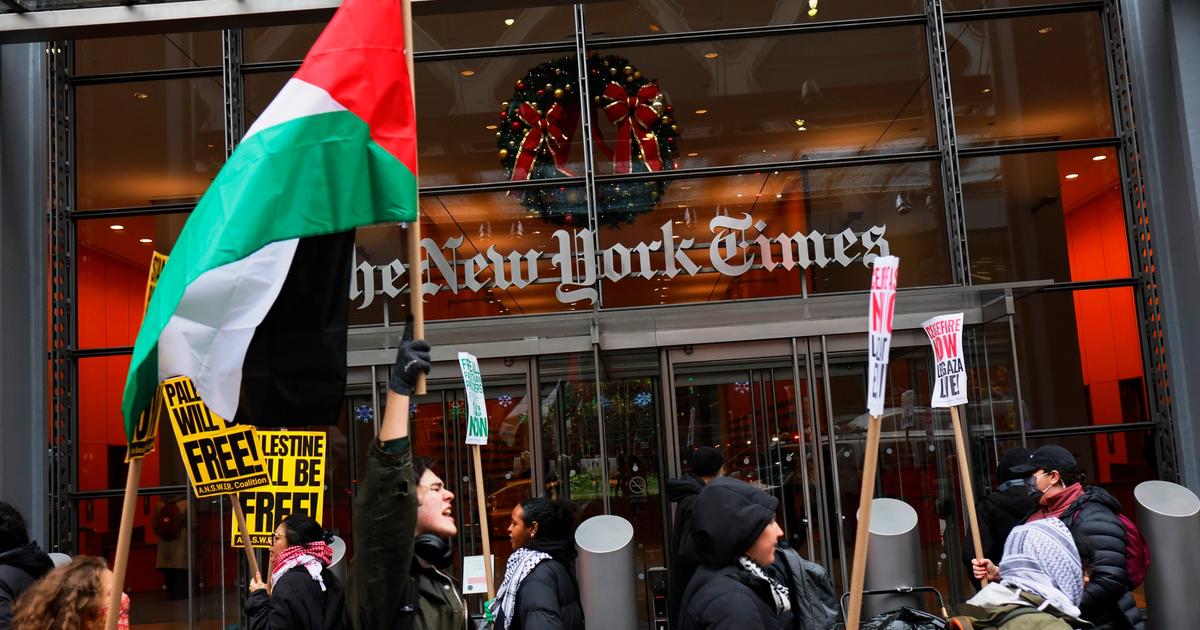
Like many of the Times’ critics and fans, I have not reported on the ground in Israel, and I don’t have new reporting on the details of Oct. 7. Nor will I attempt to answer the unspoken questions that have made this story and many others so gut-wrenching, in a conflict in which each party believes the other is trying to wipe them from the face of the earth — and is looking to the media to confirm those intentions.
But I believe I can shed some light on what is, to me, a mind-boggling fact: The Times turned crucial elements of its reporting on one of the most difficult and sensitive stories it has ever published to amateurs, one of whose social media posts would make reasonable people question her ability to be fair.
That sounds insane when you say it out loud. Why would you do that?
(The Times denies that’s what happened in this case: “We did not turn over crucial elements of reporting to researchers. Adam and Anat made valuable contributions. Jeffrey supervised their work closely and conducted dozens of interviews alongside them,” a spokesperson, Danielle Rhoades Ha, said.)
This is, in fact, how great American newspapers have always worked, particularly in moments of crisis. Many of their biggest names are able reporters, but the very top tier is often occupied by journalists who are also brilliant storytellers who synthesize large quantities of information into sparkling narratives. And they rely on teams — at best, trusted and experienced local reporters, at worst, whoever they can grab in a hurry — to do more of the original reporting than they used to admit.
This practice renders the journalism vulnerable in both directions: Correspondents might be republishing the sloppy work of incompetent helpers, or might burnish their reputations at the expense of talented locals. Or they might be manipulated by stringers and fixers who are agents of the local government or political factions. The Times and other outlets manage this practice with increasing care. But this uneven teamwork is a fading tradition among both foreign correspondents and domestic reporters covering parts of the United States that might as well be another country.
Even before the internet had totally shredded the veil around every institution, this reliance on invisible local hands occasionally produced scandals. In 2003, the Times fired a feature writer at the time considered its greatest storyteller, Rick Bragg, after a story on Florida oystermen full of resonant details like fish “that belly-flop with a sharp clap into steel-gray water” turned out to have been reported largely by his unpaid intern, Wes Yoder. This exposed a broader practice Jack Shafer described as the “dateline toe-touch,” in which a Bigfoot would come to town just long enough to claim to have been there, and keep his helpers invisible.
Even after the practice of relying on anonymous natives began to look like a colonial relic, and fixers began to be described as “local journalists” and given bylines, the power dynamics endured. One of the great recent scandals of the New York Times, the “Caliphate” podcast’s reliance on a fabulist, came after a reporter and her editors ignored a series of warnings from an experienced Syrian journalist about being duped by unreliable sources.
On the other side of the side of the ledger, my colleague Gina Chua, a former Wall Street Journal correspondent, recalls meeting a Taiwanese tobacco factory manager on the outskirts of Hanoi. As the interview went tortuously from Mandarin to Vietnamese to English, she asked her foreign ministry-appointed assistant what had transpired during the lengthy back-and-forths with his counterpart at the factory. “Oh,” he told her, matter-of-factly, “we were discussing what we should tell you.”
Gettleman is an easy target for these complaints, and is to his critics a caricature of the swaggering old-time narrative correspondent. He does much of his own reporting, and has had many big stories and legendary scrapes, including while reporting from Fallujah during the Iraq War. He also reports widely from varied countries whose languages he doesn’t speak. New-school international reporters love to hate his memoir, “Love, Africa.” A Post review complained that the narrative seems to dwell largely on “fancy, expat-centered hotels in conflict zones,” while the Times’ pan of its own reporter’s book called it a “bewildering” echo of colonial writers “interested in Africa mainly as a site for their dreams and nightmares.” A parody Twitter account, “Gettle Gems,” is followed by a couple of former Times Africa correspondents.
Some of the Gettleman criticism makes up its own simplified narrative. The Pulitzer Committee honored him for “for his vivid reports, often at personal peril, on famine and conflict in East Africa, a neglected but increasingly strategic part of the world.” He has often shared or promoted bylines with local journalists who work for the Times. “He has been for many years somebody who pushed to make sure [those writers] were getting bylines and in many cases doing stories on their own,” Greg Winter, the Times’ international managing editor, told me.
The criticism of Gettleman’s work has come in part because he revealed his reliance on Schwartz and Sella by giving them bylines. He was well within Times norms in deploying local helpers on this high-stakes story, though many local journalists are far more experienced than the two he relied on. The story also faced considerable resistance internally — and layers of fact-checking — before it was published. It then played a central role in an Israeli campaign to criticize American feminist organizations and the U.N. for not siding with Israel in what had become an intense invasion of Gaza, which has in the months since since killed tens of thousands.
The arguments over the Times coverage of both Israel and Gaza can seem hair-splitting and cruel. Few deny women were horribly assaulted amid the slaughter on Oct. 7, and the Times continues to defend the Dec. 28 story. While critics have raised reasonable questions about, in particular, the timeline of one witness account, they’ve also delivered their own flattening narrative of Times bias. Their evidence includes the political activity of editor-in-chief Joe Kahn’s father.
The Intercept’s first story cast Schwartz in its opening sentence as a “former air force intelligence official,” with the implication of a government conspiracy but no indication of one. It then published a translation of a podcast in Hebrew, in which Schwartz sounds like an inexperienced reporter trying to do her best, but working hard to prove a story’s thesis (and her boss’s assignment to her). (I began my career as an incompetent stringer for the Wall Street Journal, and did just this on far lower-stakes assignments.)
The Intercept also reported that the departure of the Times’ longtime Standards chief, Phil Corbett, was “tied to the pressure he was under to soften coverage in Israel’s favor.” Corbett emailed colleagues last week, in a message obtained by Semafor, that the report was “completely wrong” and that “there was no dispute or dissent on my part about that coverage, or the language we were using.”
Now all of the debates about Gaza and Israel playing out in Democratic Party politics are also playing out at the Times, whose international staff are bracing for a tense meeting in Istanbul this week amid anger over internal leaks and a hunt for the leaker. The Times union has claimed the company has targeted its Arab journalists, which the Times denies.
But inside the building, even some defenders of the underlying reporting wince at the Dec. 28 story’s headline. The phrase “weaponized sexual violence” is resonant and memorable — but it’s not entirely clear what it means in a literal sense. The Times story below the headline doesn’t show that Hamas leaders or field commanders planned or ordered sexual attacks — as has been documented in, for instance, the former Yugoslavia — though it doesn’t rule that out. The story’s most conclusive details, taken from photographs of sexually mutilated bodies, can’t answer that question.
Alia Malek, who runs the international reporting program at the CUNY Graduate School of Journalism and contributes to the New York Times Magazine, once remarked to me that old-school foreign correspondence was “dependent on the idea that our work wasn’t read by the people we were writing about.” The internet put that to rest years ago. More subtly, that older style also depended on the illusion that the correspondent’s byline represented one person’s work. That single (usually American) persona concealed local helpers — human beings who are usually patriots of their own countries and might even, from Israel to Korea, have done compulsory military service, as Schwartz had.
Meanwhile, the Times has also found itself defending fierce attacks on a Gazan photographer, Yousef Masoud, who a pro-Israel nonprofit ironically called “HonestReporting” accused, without evidence, of having advance knowledge of the Hamas attack. That’s part of a broad pattern of claims by Israel’s allies that Palestinian journalists are almost by definition untrustworthy.
There’s not some pat solution here. You can hardly expect news organizations to find local Israeli stringers who weren’t traumatized by Oct. 7, or Gazans who aren’t raging at Israel right now. You can demand, I suppose, that they only use polyglot foreign correspondents with no personal sympathies. Good luck.
Institutions of all sorts are struggling to win trust in this kaleidoscopic, networked world. If you can’t do the painstaking work of presenting an incontestable truth with absolute confidence, the alternative is humility and an openness to multiple points of view.
And the Dec. 28 story, with its evocative writing and vulnerable reporting, is particularly puzzling because there’s another method of journalism, invented at the New York Times as much as anywhere else, for approaching complex allegations often involving sexual violence. It’s forensic — painstaking, pedantic, reproducible. It’s modest in its writing and not always all that fun to read. (The film “She Said” did its best to dramatize the process of reporting on sexual assault. Read the frustratingly narrow and hedged first story that blew open the Harvey Weinsten scandal for a sense.) The reporters who do it are obsessed not only with what’s on the page, but how every element of their own work will appear when exposed to the light of litigation.
A Wall Street Journal story on the same subject as the Times’, published a few days later, offers a useful counterexample. The story lacks the confidence and narrative sweep of the Gettleman piece, though it also quotes Israeli officials’ claims without suggesting they’ve been confirmed.
But the story is pedantically careful to be silent on two crucially important points: The Journal reaches no conclusion on whether sexual violence was a deliberate strategy of war. And it does not say who committed specific acts of sexual violence — Hamas fighters or other Gazans who may have crossed the open border. A gruesome photograph won’t answer that question.
And yet the story’s subject is still the shocking violence against women and other civilians in a war zone, the effect of which shaped Israel’s current military campaign. Like the Times, the story describes photographs of mutilated corpses, but it makes less of an effort to craft a coherent narrative. “The Journal saw images taken by a first responder of a naked woman with a knife and three nails in the crotch area, women whose clothing was partially or entirely removed and women with blood from the crotch area. In another image provided by the first responder, a woman’s breast was almost entirely sliced off.”
My former colleague Miriam Elder, a veteran correspondent who created the foreign desk at BuzzFeed News, told me she finds both the questions about the Times story and the approach of its most relentless critics episode dispiriting. “The rushed story — and attempt to mechanically take it apart — is a disservice to the actual humans at the center of it,” she said.

