

With deserted roads and sidewalks in many cities due to coronavirus lockdowns, scientists are noticing some environmental side-effects such as reduced pollution, improved air quality and cleaner waterways. Now, they are reporting another boon – reduced seismic noise.
Seismometers are stationed all around the world, monitoring continuously for vibrations passing through the Earth’s crust. These sensors are vital to the reporting system scientists have in place to alert us of earthquakes and the potential for tsunamis.
One difficulty in maintaining these sensors is that they pick up any and all vibrations in their vicinity. So, they not only sense earthquakes, near and far, but they also pick up local vibrations. This can be from traffic driving along streets and highways, from local industry, and, if the instrument is sensitive enough, from the footsteps of people walking nearby.
Since these local vibrations are unwanted, and can actually interfere with capturing readings from weaker or more distant earthquakes, geoscientists refer to it as ‘seismic noise’.
Without this noise mixed in with the true earthquake signals, seismologists can actually get clearer readings from some seismographs, specifically those located in or near large urban centres or beside roadways. This may allow them to learn more about quakes detected during this period of social distancing.
“You’ll get a signal with less noise on top, allowing you to squeeze a little more information out of those events,” Andy Frassetto, a seismologist at the Incorporated Research Institutions for Seismology in Washington DC, told Nature. “There’s a big chance, indeed, it could lead to better measurements.”
A BIG CHANGE!
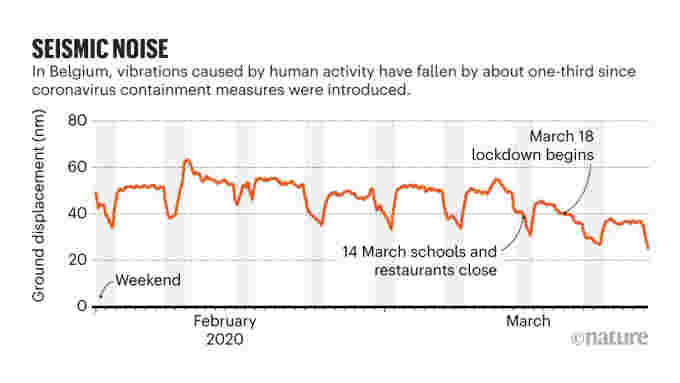
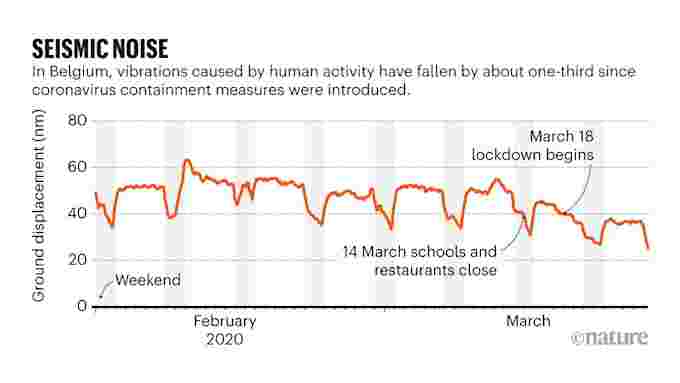 Seismic data from the Royal Observatory of Belgium shows a significant drop-off in seismic noise after the lockdown in Brussels. Credit: Royal Observatory of Belgium/Nature.com
In Brussels, the city closed all schools and restaurants as of March 14, and a lock-down that banned all non-essential travel was issued on March 18. Since then, seismologist Thomas Lecocq, from the Royal Observatory of Belgium, reported to Nature that their monitor had seen a one-third drop in the amount of seismic noise.
Stephen Hicks, a seismologist with the British Geological Survey, reported a similar drop-off in seismic noise from the seismograph near Swindon, along the M4 motorway, west of London, UK.
The #covid19UK lockdown as seen by a seismometer. This week has seen a reduction in average daytime background seismic noise level (purple line). Data is from @BGSseismology station SWN1 located close to the M4 motorway, so this probably reflects less traffic out on the roads.
“From the results above, it seems quite clear that over the last few days, the increase in noise level at dawn (blue line) is much less steep than over the past few weeks,” Hicks said on Twitter. “I guess this is due to a much weaker morning rush hour – fewer people commuting and no school runs.”
Caltech geophysics PhD student Celeste Labedz showed the effects of social distancing on seismograph readings in the Los Angeles area.
Cars, planes, industry, and even walking can make small vibrations in the ground, which means you can see #SocialDistancing on seismometers! I calculated noise levels from a seismometer in Los Angeles, and you can see a decrease in the past 3 weeks as folks have been isolating!
“I calculated noise levels from a seismometer in Los Angeles, and you can see a decrease in the past 3 weeks as folks have been isolating!” Labedz tweeted.
Referencing Labedz’s graph, Mark Panning, a planetary seismologist currently working with the Mars InSight mission at NASA/Caltech’s Jet Propulsion Laboratory, said: “So social distancing has reduced seismic power in downtown(ish) LA by 4 dB. For perspective, that means the seismic noise is decreased by a factor of 2.5, so the shaking is something like 40% of normal levels. That’s a big change!”
Sources: Nature | Stephen Hicks | Celeste Labedz | Mark Panning
RELATED: SHARP AIR TRAVEL DECLINE MEANS LESS ACCURATE WEATHER FORECASTS

Follow Canada News Media
Get the day's top Canadian stories and our two daily 60-second news videos wherever you scroll.
X Threads Facebook Instagram LinkedIn TikTok YouTube Pinterest Reddit Substack Flipboard Newsletter RSS