

There’s a good chance Ryan Straschnitzki will mark today’s second anniversary of the Humboldt Broncos bus crash by playing hockey.
Well, a version every young Canadian hockey player thrived on in basements and hotel hallways along the way.
“I love playing mini-sticks with my little brother,” said Straschnitzki, 20, from his home in Airdrie, just outside Calgary.
“I have a long hallway in my basement and decided to get my (sledge hockey) sled and started shooting the ball. I love ripping balls and foam pucks at Connor.”
Does he let the eight-year-old win?
“Oh God no,” he chuckled.
“I like the competition, and we both have fun doing it.”
It’s just another in a series of steps Michelle and Tom Straschnitzki might not have fathomed seeing after receiving the call two years ago, informing them of the crash at a rural Saskatchewan intersection near Nipawin.
It left their son paralyzed from the chest down in the collision that cost 16 teammates, coaches and support staff their lives. Thirteen others were injured, sparking a stirring wave of support thrown towards the tiny Saskatchewan town from around the world.
In the days and weeks following the accident, one of the first goals set by Straschnitzki was making the national sledge hockey team.
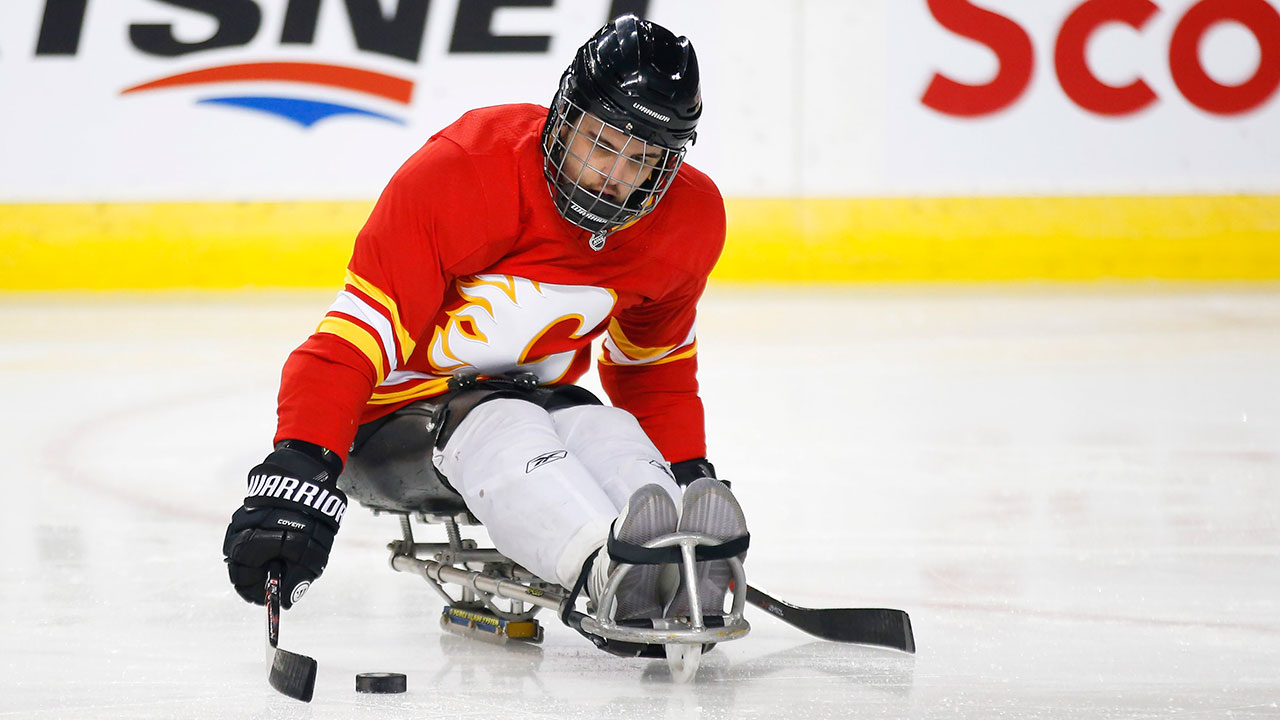
With the help of former Team Canada member Chris Cederstrand, that dream is still very much alive. He was recently named to the Alberta provincial team, and was looking forward to his first Nationals in May before they were cancelled due to COVID-19.
His chief goal continues to be walking, which is something he took great strides towards in November when he had experimental spinal surgery in Thailand. He continues to work on his mobility with the help of an epidural stimulator implanted to send electrical currents to trigger nerves and move limbs.
“It’s still a work I progress but it is getting stronger,” he said.
“After I use the device I have planted inside of me walking became easier. The muscles become more accustomed to using that motion, and flexing a certain way to make the step happen. Hopefully one day I can take assisted walking to the next level and maybe even walk some day.”
Before COVID-19 he spent four or five days a week on the ice with his sled, but has been forced to do all his training in his basement, which has been renovated to accommodate his life in a wheelchair.
“It’s going really well,” said the ever-optimistic defenceman.
“I’m still learning a lot of stuff about this injury. Unfortunately my synaptic rehab clinic closed down (due to COVID-19), so I’ve been trying to do physio here. For me being a high level para I think it’s important to work on my core balance. I have this stimulation bike where I attach stim pads to my leg and it flexes the muscles to keep my muscles intact for my legs.”
Much like the endless support his team received from coast to coast following the crash, Straschnitzki has continued to get help from various sources including his teammates, who stay in touch regularly via a team text chat. The exchanges intensified as Monday’s anniversary approached.
“It’s just another day, but at the same time you remember what happened and you just want to be there for your teammates and families,” he said.
“Part of the recovery process is just being there for the guys you were with that were involved as well.”
For the first year, Straschnitzki wasn’t keen on talking much about what he saw, heard and experienced that cold, awful night. But with the influence of friends, family members and teammates he’s started seeing a counsellor.
“I’ve been there a few times and spent hours just chatting, which I’ve never done before,” said Straschnitzki, a fixture outside the dressing rooms after Flames games where he’s forged relationships with everyone from Sean Monahan, Mark Giordano and T.J. Brodie to Connor McDavid, Tyler Seguin and Ryan O’Reilly.
“I’ve never been one to talk about what I’m feeling or thinking. At the same time it was nice to get things off my chest. Some guys want to keep it on the down low and keep it quiet, and others who want to talk to other guys about it. I was conscious through part of it (that night). It’s awful and I hope it never happens again.”
He also hopes to never have to deal with the hatred he saw late last month after it was announced his family had launched a $13-million lawsuit naming both drivers, amongst others, as defendants. He revealed he and his family were immediately subjected to online vitriol, which included death threats.
“I’m not sure what that’s all about, but there have been people who have reached out and maybe not said the nicest comments,” said Straschnitzki, whose family is following in the footsteps of several other families affected by the crash.
“There have been a few people that have tried to call the house, and we had the police driving by our house at night just to make sure. I’m not looking out for any altercations, but I’m looking out for my family and I don’t want this to affect them or me in any way.
“You have to understand the process of going through something like this. I probably wouldn’t have pursued it if I wasn’t this injured. We’re not actually going after the family (or team driver Glen Doerksen), it’s more for his insurance company. But people just think how greedy I am and I’ve got a bunch of comments about that.
“It was pretty tough. I’m not one to seek too much media attention – I’m just kind of looking out for myself. The cost of living in a wheelchair yearly is immensely huge. It’s not easy and I think any help I can get is what I need.
“I just ignore it and keep doing what I’m doing. The true supporters and people I’m close with always stick by my side and I’m not worried about anyone outside that group.”