

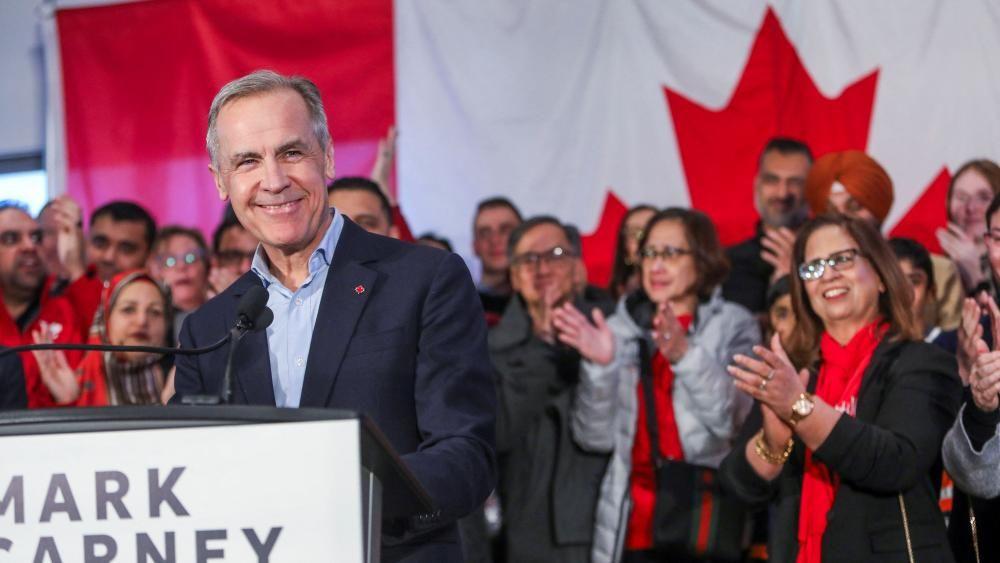
As Canadians headed to the polls on April 28, 2025, a significant chapter in the nation’s political history unfolded. Mark Carney, the former central banker turned political leader, secured his position as Prime Minister, CBC News projects, although it remains to be seen whether the Liberals have achieved a majority or a minority government.
This return to government is an extraordinary comeback for the Liberals, a party that, just months ago, seemed destined for defeat. Public opinion had turned sharply against the Liberals under former Prime Minister Justin Trudeau, and Conservative Leader Pierre Poilievre appeared poised to claim a long-anticipated majority government.
But early January brought Trudeau’s resignation, a rapidly escalating trade conflict with U.S. President Donald Trump, and Trump’s jabs about Canada becoming the “51st state.” These seismic shifts upended the election narrative and transformed it into a contest centered on leadership, sovereignty, and who could best navigate turbulent global waters.
“Trump is trying to break us so that America can own us,” Carney told supporters repeatedly throughout the campaign. “And well, that will never happen.”
Carney, projecting himself as a mature and steady leader, leaned heavily on his experience managing the 2008 global financial crisis as Governor of the Bank of Canada and guiding Britain through Brexit-era instability as head of the Bank of England. Though his lack of electoral experience and his “six-out-of-ten” French proficiency were initially seen as vulnerabilities, Carney emerged from critical French-language debates largely unscathed.
Voters responded positively to Carney’s narrative, seeing him as a stable hand in contrast to Trump’s erratic trade policies. The message resonated particularly in the final weeks as Trump announced, paused, and then re-announced devastating tariffs on Canadian goods, sparking fears of a prolonged economic war.
“This election was about leadership in uncertain times,” said political analyst Marissa Gordon. “Carney made the case that he’s the adult in the room, and enough Canadians bought into that vision.”
However, the road to election day was not without missteps. Carney faced criticism for downplaying Trump’s offhand suggestion during a phone call that Canada could “become part of the United States.” Opponents accused him of not being fully transparent, though it’s unclear how much this controversy influenced voters.
In contrast, Pierre Poilievre’s campaign focused squarely on the need for “change.” Poilievre hammered away at the Liberals’ decade-long rule, pointing to rising crime rates, a housing crisis, and economic stagnation as evidence that the country needed a fresh start. He portrayed Carney as merely an extension of Trudeau-era governance, emphasizing Carney’s role as Trudeau’s economic adviser.
“After the lost Liberal decade of rising crime, chaos, drugs, and disorder, we cannot risk a fourth Liberal term,” Poilievre said at a final rally in Oakville, Ontario. “We have to reverse the policies that got us into this mess.”
Despite early momentum and a commanding lead in the polls last fall, Poilievre’s support eroded as the campaign wore on, with NDP, Bloc, and Green voters gravitating towards the Liberals to stave off a Conservative majority.
NDP Leader Jagmeet Singh, meanwhile, found his party squeezed out of the spotlight, as the race increasingly focused on the Liberals and Conservatives. Singh emphasized that even in a minority situation, NDP MPs would push the government towards policies like pharmacare and dental care — initiatives the party had championed and which the Liberals had partly adopted during the previous minority Parliament.
“Sending more New Democrats to Parliament will keep the government honest and improve people’s lives,” Singh said, even as polls suggested the NDP could suffer seat losses.
The Bloc Québécois’s Yves-François Blanchet stirred controversy late in the campaign by describing Canada as “an artificial country” and “not my nation,” rhetoric that may have complicated the Bloc’s efforts to maintain its share of seats in Quebec.
The final days of campaigning were overshadowed by tragedy when a car-ramming attack at a Filipino street festival in Vancouver left 11 dead and more than 20 injured. Most leaders paused their campaigning to offer condolences, a somber close to an otherwise highly charged election.
Looking ahead, the key question remains: will Carney govern with a majority or minority mandate?
A majority would give Carney the political strength to move decisively on issues such as building a new economic strategy independent of volatile U.S. markets, expanding affordable housing initiatives, and reforming Canada’s defense spending. A minority would force the Liberals into delicate negotiations with the NDP and possibly the Bloc Québécois, much like Trudeau’s experience during his final years.
Regardless of the outcome, Mark Carney has made history. In just under two months, he rose from political newcomer to Prime Minister of Canada, offering a vision of resilience and sovereignty at a moment when many Canadians feared both were under threat.
As Carney cast his ballot alongside his wife, Diana Fox Carney, on election day in Ottawa, he embodied the hope of a Liberal Party given a second life — and the aspirations of a country striving to remain strong and independent in an uncertain world.
Stay tuned to CanadaNewsMedia for live updates and in-depth analysis as full election results continue to roll in.
Follow Canada News Media
Get the day's top Canadian stories and our two daily 60-second news videos wherever you scroll.
X Threads Facebook Instagram LinkedIn TikTok YouTube Pinterest Reddit Substack Flipboard Newsletter RSS