



Over the next two years, Ontarians will hear a lot about physical distancing, predicts the region’s medical officer of health.
The Simcoe Muskoka District Health Unit released new modelling projections today, alongside the province’s own release of the same, and said the modelling showed the need for physical distancing to continue — in waves of restrictions — over the next 24 months.
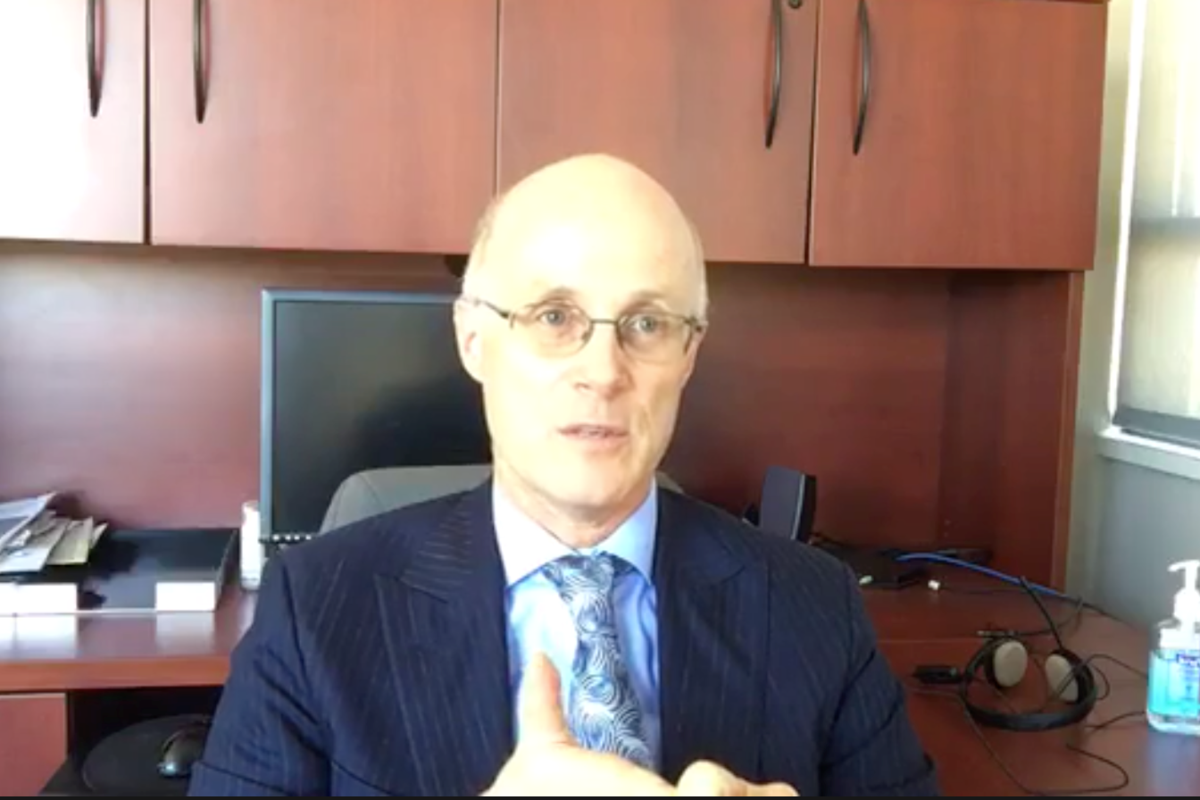
“What is most effective in these models is the physical distancing that we do and also the case and contact follow-up that the health unit does,” said Dr. Charles Gardner, medical officer of health for the region.
“This can make an enormous difference. I think we’re seeing evidence that we’re having an effect with this approach, all of us together.”
Among the key findings of the Simcoe Muskoka District Health Unit is this: “Without physical distancing being applied for at least 12 of the next 24 months, it is projected that Ontario would not have enough hospital (intensive care unit) beds.”
According to Gardner, the virus will come and go in cycles, and so too should public health control measures like physical distancing and business closures.
“Until we get a vaccine, we’re going to have cycles of the virus coming and going,” said Gardner. “It’s still circulating in our community. The potential is still there.”
Another finding listed in the SMDHU report on its latest modelling numbers suggest a repeated cycle of physical distancing that lifts physical distancing rules and replaces them when cases start to reappear would both prevent the health-care system from being overwhelmed and still allow mental health and economic breaks for people.
However, the question of when to start lifting physical distancing controls is complex.
“I don’t think anybody has the definitive answer,” said Gardner, who is part of a provincial working group that is considering the question. “Everything needs to be coming down and not up. You have to be beyond the peak and going down before you could consider backing away from controls.”
Backing off of controls would also mean preparing for a surge and keeping surveillance going in the province for early detection of a new wave of spread.
“We would also need to know that our system would be ready if we backed away from controls and then you had a resurgence of cases,” said Gardner. “You have to make sure the health care system is well-prepared with intensive care unit beds and ventilators.”
He said engagement with the community will also be key, and controls should be relaxed slowly and in areas where it would be less harmful.
For example, controls in long-term care homes would be the last to be lifted.
“We have the potential to learn from other countries that are beginning to do this,” said Gardner.
According to the province of Ontario modelling released today, we are currently in a peak for virus cases. Gardner said the region is seeing a flattening of the curve, but not a drop.
“We’re plateauing, but we’re certainly not coming down,” said Gardner. “It’s too soon to be actually doing it, but not too soon to be asking how and when we’ll be doing it.”
The modelling data released by the health unit today predicts between 130 and 200 cases confirmed through lab testing and about 15 to 20 deaths in the month of April.
There are now 202 cases in the region, but 52 of those cases were reported in March. There have been 12 deaths attributed to COVID-19 reported in Simcoe County and Muskoka.