



Mainstream media in Serbia play a major role in forming public opinion and usually reflect the dominant narrative of the ruling class, enforcing divides, fuelling internal and external conflicts and attempting to construct national cohesion on stories of the suffering and victimhood of the Serb people.
Despite the country’s transition into semi-democracy, most of the Serbian media haven’t given up the role they had during the dissolution of Yugoslavia, when they acted as a propaganda machine for President Slobodan Milosevic, spread false information and incited hatred.
Today, they don’t report from battlefields, but invent them in newspaper headlines and on website homepages. They make up stories of war in peacetime, instigate fear and present others as threats, label those who think critically as traitors and spies, and smear those who try to change the status quo.
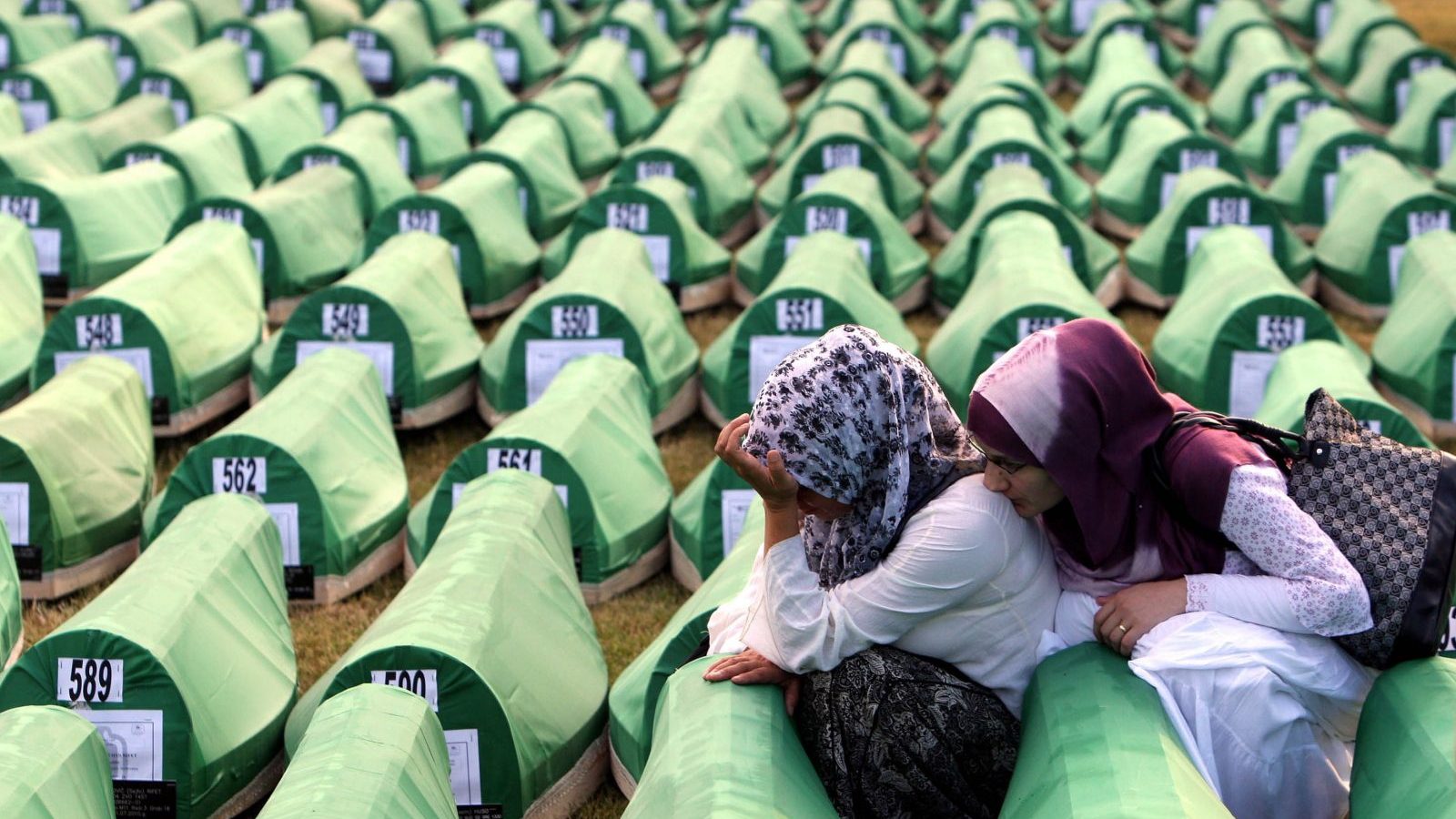
International and domestic courts in ex-Yugoslav states have sentenced 45 people to a total of more than 700 years behind bars, plus four life sentences, for the Srebrenica killings. The International Court of Justice has also ruled that the massacres constituted genocide.
But this has never resonated in Serbian society. Those who call Srebrenica a genocide in Serbia face condemnation and lawsuits.
The ruling elite and the majority of Serbs admit the killings were a crime, but believe there were not as many fatalities as courts have established, while they deny that Serbia had any role in supporting the Bosnian Serb regime that was responsible for the massacres.
Serbian courts will only try Srebrenica suspects for war crimes, not genocide, while Serbian legislation does prohibit genocide denial, but only if the genocide has been defined as such by the International Criminal Court – which has not ruled on Srebrenica.
Meanwhile in Belgrade’s Zemun neighbourhood, you can still eat a pancake named after Radovan Karadzic, and you can listen to a Srebrenica genocide convict called Vinko Pandurevic give guest lectures at various events in the Serbian capital.
The reporting of the Srebrenica Memorial Centre’s statement shows that the space for truth in Serbian media is narrow and that the media’s role in reconciliation is almost non-existent.
It is difficult to expect heavily-controlled media in Serbia to transform themselves overnight and become envoys of peace, but that should not stop us demanding factual and ethical reporting.
The Srebrenica Memorial Centre made an important step towards reconciliation that could inspire others to do the same, but as long as people remain blinded by divisive and hostile media narratives, it remains hard to tackle the dehumanisation of the ‘other’ and to create an environment for coexistence without fear.
The opinions expressed are those of the authors and do not necessarily reflect the views of BIRN.

Follow Canada News Media
Get the day's top Canadian stories and our two daily 60-second news videos wherever you scroll.
X Threads Facebook Instagram LinkedIn TikTok YouTube Pinterest Reddit Substack Flipboard Newsletter RSS