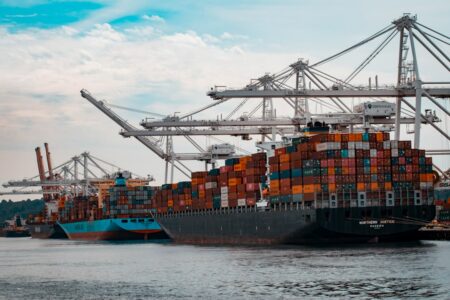




From the late 80’s to the early 2000’s, Canadian politicians and business leaders sung sweetly about the promises of free trade and globalization.
Indeed, in 2005, just three years before the 2008 global recession, a consortium of business leaders proudly declared “as an economy, Canada seems to be in great shape,” and that globalization in the 80’s and 90’s had “unleashed a wave of innovation and creativity” within the private sector.
Though after two decades of free trade evangelization from thought leaders, many of the arguments in favour of globalization were being repeated by rote: New markets to sell to. More foreign investment. Cheaper goods for consumers.
Sure, some jobs would be shipped overseas, but Canadians didn’t want to do those jobs anyways. Besides, shutting down the factory would free up time to brush up on our PowerPoint and Excel skills. We’d all become logic workers, enjoying the air conditioning and casual Fridays in the process.
It wasn’t until decades later that the experts began questioning their brashness.
Famously pro-free trade in the 1990s, Nobel Prize winning economist Paul Krugman admitted defeat in 2021, suggesting policy experts, himself included, “tended to underplay the disruptive effects.”
Today, rehashing the negative impacts of globalization has become trite. In Canada, over 500,000 manufacturing jobs have been lost in the manufacturing sector following China’s entry into the World Trade Organization (WTO).
Local economies built around manufacturing were decimated, and the social impacts like drug addiction and depression overlap too neatly on top of the communities most impacted by the ravages of free trade.
Some hold outs suggest it wasn’t all bad. Look at GDP, they say. Admittedly, some sectors did see growth. But even among winners the gains were unevenly distributed, and today, inequality in Canada has become Dickensian.
The experiment failed.
So why, at the dawn of the Artificial Intelligence revolution, are we trying another one?
Yet again, the same characters, with new casting, are in place. It’s the same sales play book, selling a new version of the same dream.
Businesses are bullish and doubling down.Ninety-five per cent of business leaders say Canada is well positioned to be a global leader in AI and the federal government is now prioritizing AI investment across the public service while a new Ministry of Artificial Intelligence and Digital Innovation has been created to encourage Canadian businesses to adopt AI tools.
Just as they said blue collar workers would upskill into the white-collar world, the same arguments are being repeated, and concerns about displacement being dismissed.
Don’t worry if we automate away the white-collar work. Once we implement AI into everything, we’ll be a nation of middle managers.
And if we resist AI adoption, we’ll be out-competed.
We haven’t yet fully dealt with fallout from the last great outsourcing, why are we working on self-inflicting another one that experts say will be worse?
CEO and Co-founder of Google DeepMind, Demis Hassabis suggests that the impacts of AI will be 10 times bigger than the industrial revolution and 10 times faster.
Though gauging the seriousness is difficult as tech CEO’s have been notorious in their embellishment of their tech’s capabilities, even conservative analysis of the potential impacts is shocking. According to the Labour Market Information Council, 60 per cent of Canadian workers could be impacted by AI job transformation, with 31 per cent at high risk of displacement.
Just as it wasn’t realistic to expect a whole class of blue-collar workers to upskill into the white-collar world, let’s not pretend that it will happen the other way around.
Even if reskilling at scale was possible, or painless, the jobs aren’t there. In the US, already, job openings for skilled electricians, plumbers and factory workers have dropped.
This is of course without factoring in the larger issue of domestic demand collapse if swaths of well-paying jobs are automated away.
And although you might not see it in headlines, just as in the dawn of free trade liberalization, robust pushback does exist. Unfortunately, the voices are quiet and unorganized.
Nearly a third of workers admit to trying to sabotage their company’s AI strategy. Some feed training tools bad data, others flat-out refuse to use new AI systems. Among young workers, those most at risk of AI displacement, the disdain is even more palpable, with 44 per cent admitting to obstructing their employers AI rollout in some way.
Unions, too, have begun push back against AI implementations. Though they are perhaps worse positioned than ever to put up a fight: according to Stats Canada, just 15.5 per cent of private sector workers are covered under a collective bargaining agreement.
The parallels between the globalization boosters and AI advocates are too striking. But we know what happens next. Overestimate the benefits and underplay the disruptive impacts.
And even though business leaders and policy experts might not be repeating themselves, their arguments sure are rhyming. We shouldn’t listen.
Canadians must not repeat the same mistake again. This time won’t be different.
Related Products
-
Sale!
One A Day Adult Multivitamin Gummies – Daily Gummy…
Products Original price was: $17.79.$13.97Current price is: $13.97. -
Anbbas Badger Hair Shaving Brush with Wood Handle,…
Products $35.99 -
Water Dental Flosser Cordless Teeth Cleaning MOCEL…
Products $39.99