


Sophie Lewis – CBS News
A car-sized asteroid just made the closest-known approach to Earth without actually colliding with the planet. And researchers didn’t know about it until hours after it had already passed.
Asteroid 2020 QG, formerly known as ZTFoDxQ, zoomed past Earth on Sunday at 12:08 a.m. EDT, getting as close as 1,830 miles (3,000 kilometres) away. It marks the closest asteroid flyby ever recorded in which the object actually survived, according to NASA.
For comparison, the International Space Station is 254 miles (400 kilometres) away.
“Near-Earth Asteroids (NEAs) pass by Earth all the time, but
2020 QG passed closer to Earth than any other known NEA without actually
impacting,” a NASA spokesperson told CBS News on Tuesday.
2020 QG was first observed at the Palomar Observatory a whopping six hours after
it passed over the southern Indian Ocean.
“It’s quite an accomplishment to find these tiny close-in asteroids in the first place, because they pass by so fast,” said Paul Chodas, director of the Center for Near-Earth Object Studies (CNEOS) at NASA’s Jet Propulsion Laboratory in Southern California. “There’s typically only a short window of a couple of days before or after close approach when this small of an asteroid is close enough to Earth to be bright enough but not so close that it moves too fast in the sky to be detected by a telescope.”
The asteroid was travelling at 27,600 miles per hour, or nearly 8 miles per second, which NASA said is a little slower than average. On average, an asteroid of its size passes this closely just a few times each year.
Being only about 10 to 20 feet in diameter, the
asteroid was not actually big enough to pose a serious threat. If it had been
on a collision course, it would have likely ended up as a fireball — an extremely bright meteor — as it broke up in Earth’s
atmosphere.
The asteroid “approached Earth from the direction of the Sun
and was not discovered until after it passed and could be observed in the night
sky by ground-based observatories,” NASA confirmed. “By some
estimates, there are hundreds of millions of small asteroids the size of 2020
QG, but they are extremely hard to discover until they get very close to
Earth.”
NASA carefully tracks near-Earth objects, but it’s only aware of a fraction of them due to such observational limitations.
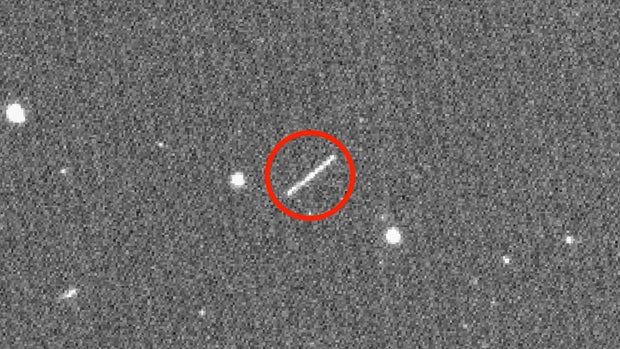
Scientists at NASA are developing a telescope that
could detect asteroids coming from the direction of the sun, eliminating the
current blind spot in their observations. The Near-Earth Object Surveillance Mission could launch as early as 2025.
NASA is also planning to launch the Double Asteroid
Redirection Test (DART) in July 2021. DART will purposely crash into a harmless asteroid moon in
the fall of 2022 to attempt to change its motion, in the first test for
planetary defense.
banner image shows asteroid 2020 QG’s trajectory bending during its close approach to Earth – courtesy NASA/JPL-Caltech

Follow Canada News Media
Get the day's top Canadian stories and our two daily 60-second news videos wherever you scroll.
X Threads Facebook Instagram LinkedIn TikTok YouTube Pinterest Reddit Substack Flipboard Newsletter RSS