



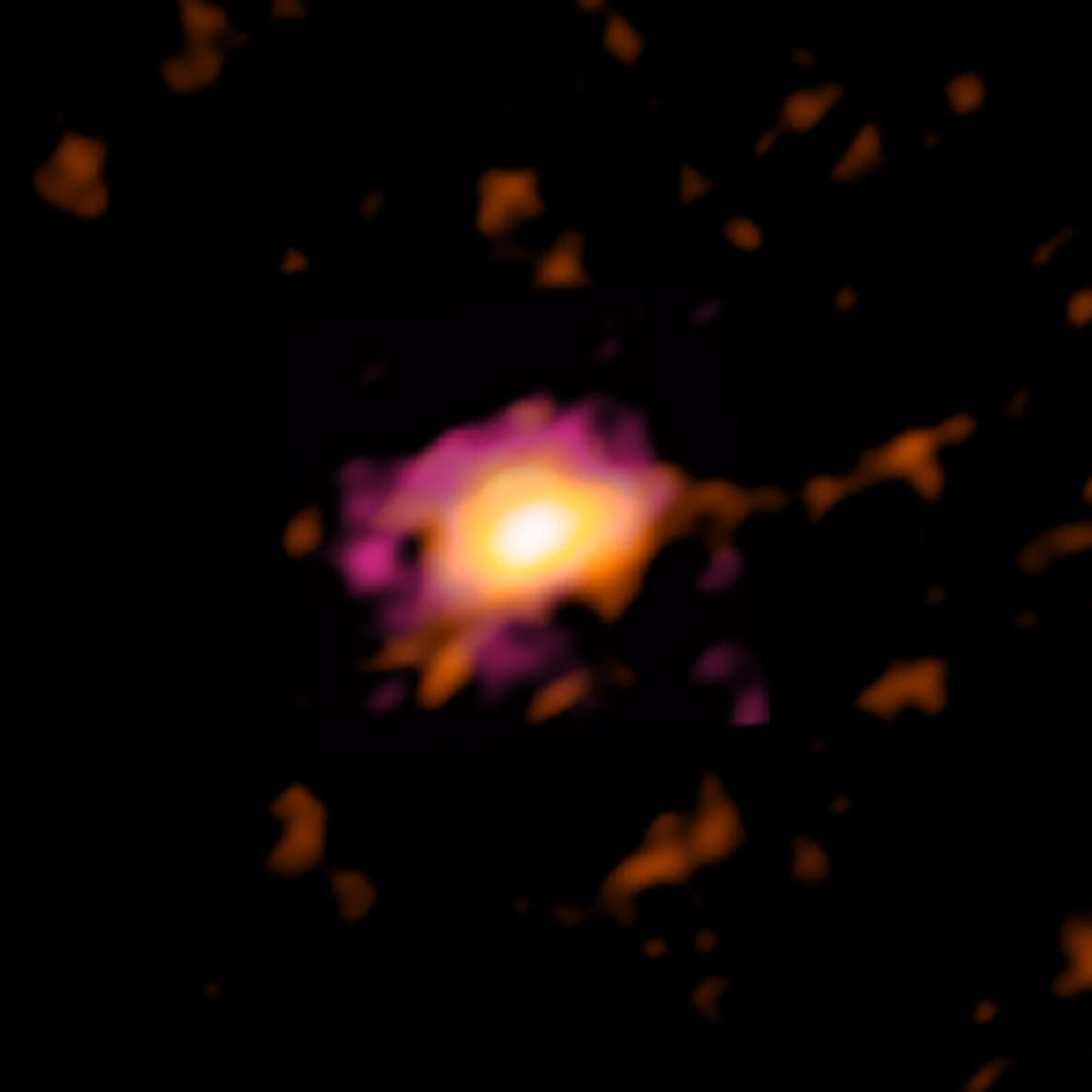

According to a recently published study in the journal Nature, astronomers using the Atacama Large Millimeter/submillimeter Array (ALMA) in Chile have discovered a massive disk galaxy that formed 12.3 billion years ago, merely 1.5 billion years after the Big Bang.
This stable disk galaxy is designated DLA0817g (Wolfe Disk) and has approximately 72 billion solar masses. For reference, our Milky Way galaxy has about 1.2 trillion solar masses. Wolfe Disk spins at about 272 km per second, which is similar to our galaxy’s rotational velocity. The rate of star formation in the Wolfe Disk, however, is about 10 times higher than in our galaxy.
Read Also: Luis Fonsi confirmed for the F1 Virtual Grand Prix
While it is currently only a sample size of one, Wolfe Disk presents a challenge to our current model of “hot mode” galaxy formation wherein hot gases fall in toward the galactic center to cool and condense gradually over time. In this scenario, it would take about 4-6 billion years before galaxies could form well-defined disks. Hierarchical mergers could also eventually form disk galaxies, but this process is also very gradual and similarly time-consuming.
Instead, the prevailing theory of early disk galaxy formation is “cold-mode accretion.” As the name suggests, the gas falling into the galactic center would have been cold, hence leading to rapid condensation. So far, this seems to best explain the formation of such a massive disk galaxy at such an early age in the Universe. If the theory is correct, we should eventually find more early galaxies like Wolfe’s Disk.
Do you want to publish on Apple News, Google News, and more? Join our writing community, improve your writing skills, and be read by hundreds of thousands around the world!

Follow Canada News Media
Get the day's top Canadian stories and our two daily 60-second news videos wherever you scroll.
X Threads Facebook Instagram LinkedIn TikTok YouTube Pinterest Reddit Substack Flipboard Newsletter RSS