

In the period A.C. (After Covid), I needed, more than ever, to look at Art. And given that I didn’t see traveling in the foreseeable future, I started to think: Where have I always wanted to go? What Museum have I always wanted to visit? What first came to mind: The Hermitage in St. Petersburg.

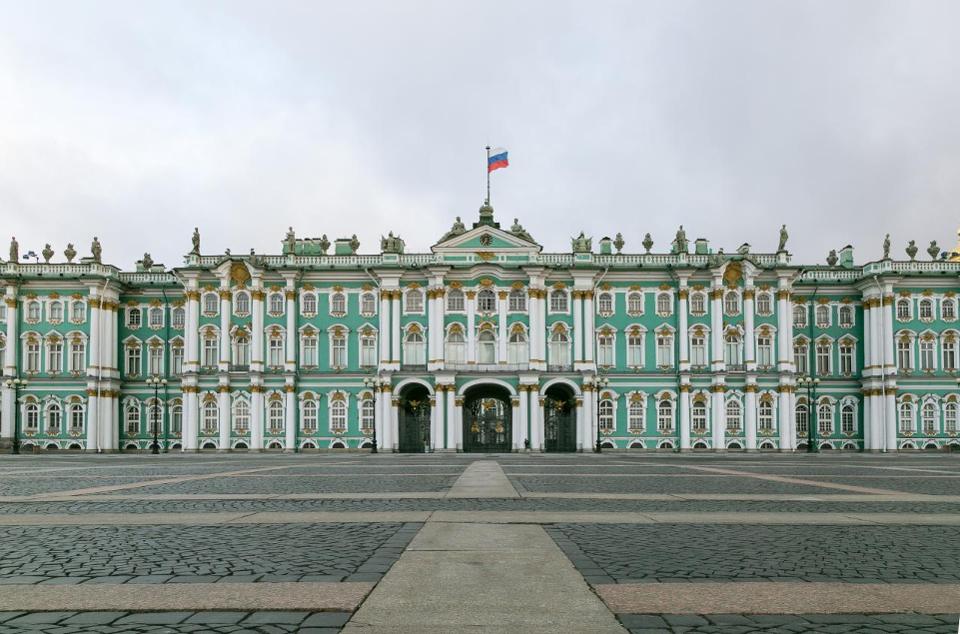
The Hermitage
Courtesy The State Hermitage Museum
Turns out The Hermitage has a fairly robust series of video tours, as well as a way to virtually visit the Museum.
What I expected was a touch of Old Russia, paintings exhibited in less than modern conditions with the holdings consisting of masterworks acquired by the Czars before the Revolution and masterpieces looted by the Soviet Red Army as part of their World War Two spoils of war. In this I was not wrong, but the Hermitage is so much larger and more beautiful than I imagined.
What I was not prepared for was the grandeur of the Hermitage with its impressive entryway and staircase for visiting dignitaries leading up to hallways (or galleries) filled with portraits of members of the Royal family (including a very imposing Catherine the Great who began the collection), as well as a hallway of generals who were critical in defeating Napoleon. There is a “Great Throne Room’ as well as a and a “Small Throne Room’, and I have to say that although I hold no monarchist sympathies, I found the rooms impressive and the experience of seeing it virtually no less humbling.
Apple has recently offered up a one-take five hour walk through the entire museum – with dancers prancing through some of the rooms. More of a commitment than I had in mind. But, thankfully, there are several good short videos that give tours of the Hermitage – in English. There are also short videos dedicated to specific collections such as the famous Faberge eggs (which are insane!) and the Gold Room with its collections of early gold pieces from the 1st Century BC Khurgans found among the grave of a Princess.
But I was there for the paintings. There are a few videos with highlights of the Museum’s collection. Virtually, one can see the Hermitage’s DaVincis and Raphaels and Rembrandt’s “The Return of the Prodigal Son,” all beautiful exemplars of the best of Renaissance and Baroque Art. As a further treat, one can compare Rembrandt’s Danae (with a gauzy Odalisque) to Titian’s voluptuary Danae (they each have aspects to recommend one over the other; but I’ll take the Titian).
For me, however, the highlight was the Hermitage’s French Impressionist collection. The Hermitage has the largest collection of French Impressionist and Post-Impressionist work outside of France. There are amazing artworks by Pissaro, Manet, Van Gogh, Gauguin, Toulouse-Lautrec, Renoir, Degas, Picasso, Matisse. Matisse’s iconic Dance is there (the twin is at MoMA in NY), as well as some exceptional earlier canvasses.

Edgar Degas, Place de la Concorde, 1875
The State Hermitage Museumq
There is a great tour of the French Impressionist Collection by one of the museum’s curators. However, it in French. The art it focuses on can of course be watched on mute. Should you understand French, it is a real treat. I found it informative and instructive and really allows for a deeper appreciation of the works in the Hermitage’s collection. For example, one of the masterworks discussed is Edgar Degas’ Place de la Concorde. It is a painting of a gentleman and his two children in the famous square in Paris. To modern eyes, it would seem typical of the era. But, as the curator makes clear what is revolutionary about the painting is the use of negative space at the center of the painting. The figures are not posing as if in a portrait but seem captured in a moment (what we would today call a ‘snapshot’). Thus, advancing the cause of ‘Impressionism’ and changing the history of painting.
After my visit to the Hermitage, I started bouncing around the web other videos and websites that the Hermitage led me to. I searched for the Amber Room – which the Nazis stole during World War Two and which has never been recovered although a facsimile was made in Russia in 2003. I thought about visiting the Kremlin and going to visit Lenin’s Tomb. Regrettably, although webcams and Google street view afford one a view of Red Square (much bigger than I imagined), no cameras are allowed inside Lenin’s Tomb or any of the churches surrounding the Kremlin, much to my regret.
And then I came across The Pushkin Museum with which I was not familiar. This museum has nothing to do with Russia’s most famous and beloved poet, but as indicated by its full name, The Pushkin State Museum of Fine Art in Moscow, it is the largest collection of European Art in Moscow. And what a collection!
There is a room of Gauguins each more captivating than the next, including some works done in Arles when he was Van Gogh’s roommate. There is also a haunting Van Gogh of prisoners walking in a circle in a prison yard. A sublime Degas pastel, “Blue Dancers.” Renoir’s “Portrait of Jeanne Samary” is as captivating as its subject must have been.
There is a Monet’s own take on “Dejeuner sur L’herbe” where the picnickers remain clothed – but the light plays off their clothing. As well as a Monet of the Boulevard des Capucines in Paris that is a great exemplar of all that Impressionism sought to achieve – the eye sees a whole street scene even though it is really one precise smudge of paint next to another.

Pablo Picasso, Old Jew with a Boy, 1903
Courtesy of the Pushkin State Museum of Fine Arts
There is a room of Matisses, and early Blue Period Picassos including one called “Blind Beggar with Boy” whose less politically correct name is “OId Jew and a Boy.”

Children on the Lawn, Kazimir Malevich, 1908
Courtesy of The Pushkin State Museum of Fine Arts
One of the more surprising canvases was a 1908 pictorial work by Kazimir Malevich (who would become famous for his Suprematist Abstractions), a rare gouache from his art student days that depicts children at play. Done in a flattened style it was as if Grandma Moses used the palette of the German Fauvists.
Just to be clear: I did not see all this in one sitting. With the site open in my browser I could return at my leisure to see one or two rooms at a time working my way through the collection of both The Hermitage and then the Pushkin. It was a very satisfying distraction.
One day, I hope to see all of this in person, but until then, these amazing collections are there to be seen and to touch the soul of all who gaze upon them.