


In the biggest celestial show ever seen, dying star Betelgeuse will be visible even during the day for several months
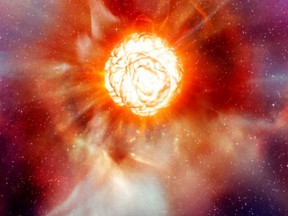
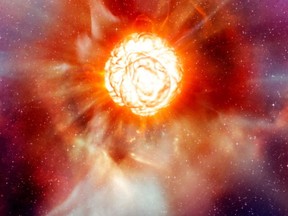
When it happens, it will be the astronomical event of the millennium. Betelgeuse, a red supergiant star in the constellation of Orion the Hunter, will explode into a supernova.
In a newly completed study, a team led by Hideyuki Saio of Japan’s Tohoku University suggests that Betelgeuse may be larger, and hence later in life, than other scientists have calculated.
If Saio’s numbers are correct, then the star may have exhausted all its hydrogen and helium – the elements that drive nuclear fusion in our own sun – and may be burning its way through its store of carbon atoms.
To be clear, most scientists assume a slightly smaller size for Betelgeuse, meaning it may have some way to go before a supernova event – perhaps 100,000 years, though that is still a blink of an eye in cosmic terms.
But even there, no one is certain of the exact timing. Predictions amount to a galactic gaming table. Bookmakers favour a tens-of-thousands-of-years timeframe, but there are long-shot odds for, say, next Tuesday.
Regardless of the timing of its eventual fate, the bright star Betelgeuse has given humans something to talk about for millennia. A tiny ivory tablet, more than 30,000 years old, appears to show an image of the constellation of Orion next to a tally of 86 notches, equal to the number of days Betelgeuse is visible in the sky. That’s also the number of days short of a year for human gestation, meaning the star may have been seen as a harbinger of fertility.
More recently, historians have noted that Chinese astronomers of the second century BC referred to the star as having a yellow hue, while four centuries later, Ptolemy of Alexandria was calling it red, suggesting a colour change over that time.
Then in 2019 came “the great dimming.” Scientists think Betelgeuse burped, sending off a huge chunk of its surface area, the resultant dust cloud shrouding its appearance from Earth for two next two years. One can only imagine what an earlier generation of astrologers would have made of the event being followed by a pandemic.
Betelgeuse has since bounced back from its belch, and is just now brighter than usual. (Interestingly, both its dimming and brightening have been seen in various scientific circles as evidence that its end is nigh.)
But beyond the certainty of its eventual demise comes news that scientists expect to detect neutrinos and perhaps gravitational waves about a day before the light of the explosion reaches us. Time enough to haul out the lawn chairs and sit back for the stellar fireworks show.

Follow Canada News Media
Get the day's top Canadian stories and our two daily 60-second news videos wherever you scroll.
X Threads Facebook Instagram LinkedIn TikTok YouTube Pinterest Reddit Substack Flipboard Newsletter RSS