


William Harwood – CBS News
Traces of a rare molecule known as phosphine have been found in the hellish, heavily acidic atmosphere of Venus, astronomers announced Monday — providing a tantalizing clue about the possibility of life. Phosphine molecules found on Earth are primarily a result of human industry or the actions of microbes that thrive in oxygen-free environments.
The researchers are not claiming life has been detected on the
second planet from the sun. But the observations suggest at least the
possibility of microbial activity in the upper layers of Venus’ atmosphere,
well away from the planet’s inhospitable surface.
“We have detected a rare gas called phosphine in
the atmosphere of our neighbor planet Venus,” said Jane Greaves, a
professor at Cardiff University in the United Kingdom and lead author of a
report published in Nature Astronomy. “And the reason for our
excitement is that phosphine gas on Earth is made by microorganisms that live
in oxygen-free environments. And so there is a chance that we have detected
some kind of living organism in the clouds of Venus.”
Even so, the team said, much more study is needed to support any
such claim, extraordinary as it would be.
“In order to make this quite extraordinary claim that there
might be life there, we really have to rule everything out, and that’s why
we’re very cautious saying we’re not claiming there’s life, but claiming
there’s something that is really unknown and it might be life,” said team
member William Bains, a researcher at MIT.
Sara Seager, a fellow MIT scientist who studies exoplanet
atmospheres, agreed, saying “we are not claiming we have found life on
Venus.”
“We are claiming the confident detection of phosphine gas whose
existence is a mystery,” she said. “Phosphine can be produced by some
(non-biological) processes on Venus, but only in such incredibly tiny amounts
it’s not enough to explain our observation. So we’re left with this other
exciting, enticing possibility: that perhaps there is some kind of life in
Venus’ clouds.”
Mars has long been considered the best candidate in
the solar system beyond Earth to have hosted microbial life in the distant past
or even in the present, as suggested by background levels of methane. NASA, the
European Space Agency, China, India, Russia and United Arab Emirates are all
pursuing exploration of the red planet in one form or another.
NASA also is planning a flagship mission to study the
moons of Jupiter. Scientists believe one of the
planet’s largest and best-known moons, Europa, heated by tidal stresses and
gravitational interactions with other moons, harbors a salty, possibly
habitable ocean beneath its icy crust. Other frozen moons in the outer solar
system, possible “water worlds,” are also candidates for study.
But Venus is the victim of a runaway greenhouse effect in which
thick clouds in a mostly carbon dioxide atmosphere trap sunlight, producing
temperatures at the surface that soar to nearly 900 degrees, hot enough to melt
lead.
In the planet’s upper atmosphere, however, temperatures are much
more hospitable. Despite the acidic nature of the clouds, scientists have
speculated it may be possible for alien microbes to exist.
“The surface conditions there today are really hostile, the
temperature is enough to melt our landers,” Greaves said. “But it’s
thought that much earlier in Venus’ history the surface was much cooler and
wetter and life possibly could have originated.
“There is a long-standing theory that some of the smallest
forms of life might have been able to evolve upwards into the high clouds.
Conditions there are certainly not nice, they’re extremely acidic and it’s very
windy, but on the other hand, if you’re talking about 50 to 60 kilometers up,
then the pressure is much like it is on the surface of the Earth and the
temperature’s quite nice, maybe up to about 85 degrees Fahrenheit. So it’s been
hypothesized that this is a living habitat today.”
Greaves’ team studied spectra of Venus’ atmosphere using the James
Clerk Maxwell Telescope in Hawaii and 45 radio telescope antennas in the
Atacama Large Millimeter/submillimeter Array in Chile and were surprised to see
unmistakable signs of phosphine. “It was a shock,” Greaves said.
The detection was rewarded with additional observing time on the
ALMA array and “in the end, we found that both observatories had seen the
same thing, faint absorption at the right wavelength to be phosphine gas, where
the molecules are backlit by the warmer clouds below,” Greaves said in a
statement.
Only trace amounts were observed, about 20 molecules per billion.
But additional research showed natural sources of phosphine — volcanoes,
lightning, minerals blown up into the atmosphere, the action of sunlight —
would only generate one ten thousandth the amount actually detected.
The team can rule out many non-biological ways to generate the
observed levels of phosphine, but that doesn’t mean life is the only
explanation. The atmosphere of Venus is 90% sulfuric acid, raising “many
questions, such as how any organisms could survive,” said MIT researcher
Cara Sousa Silva.
“On Earth, some microbes can cope with up to about 5% of acid
in their environment, but the clouds of Venus are almost entirely made of
acid,” she said.
Greaves’ team is awaiting additional telescope time to look for
signs of other gases associated with biological activity and to determine the
temperature of the clouds where the phosphine is present to gain additional
insights. Ultimately, future visits by spacecraft likely will be needed to
fully resolve the question.
“There can always be something we overlooked,” said Seager. “Ultimately, the only thing that will answer this question for us — is there life, is there not life — is actually going to Venus and making more detailed measurements for signs of life and maybe life itself.”
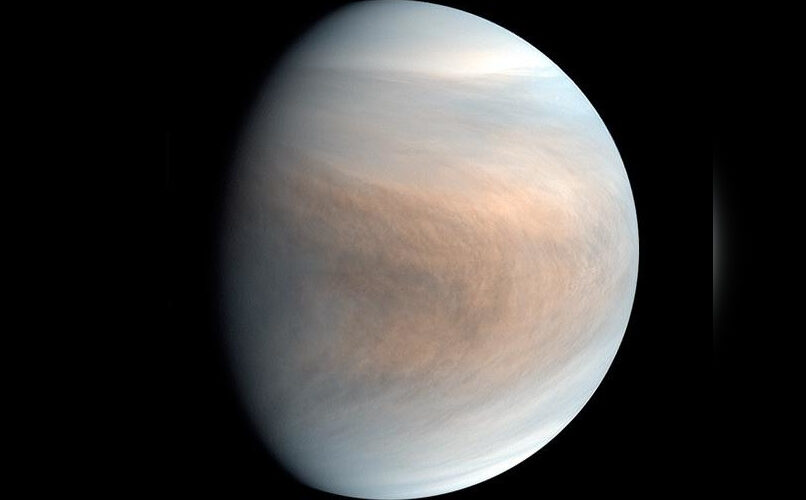
banner image: A false-colour image of Venus as captured by the Ultraviolet Imager aboard Japan’s Venus Climate Orbiter (Akatsuiki). JAXA