

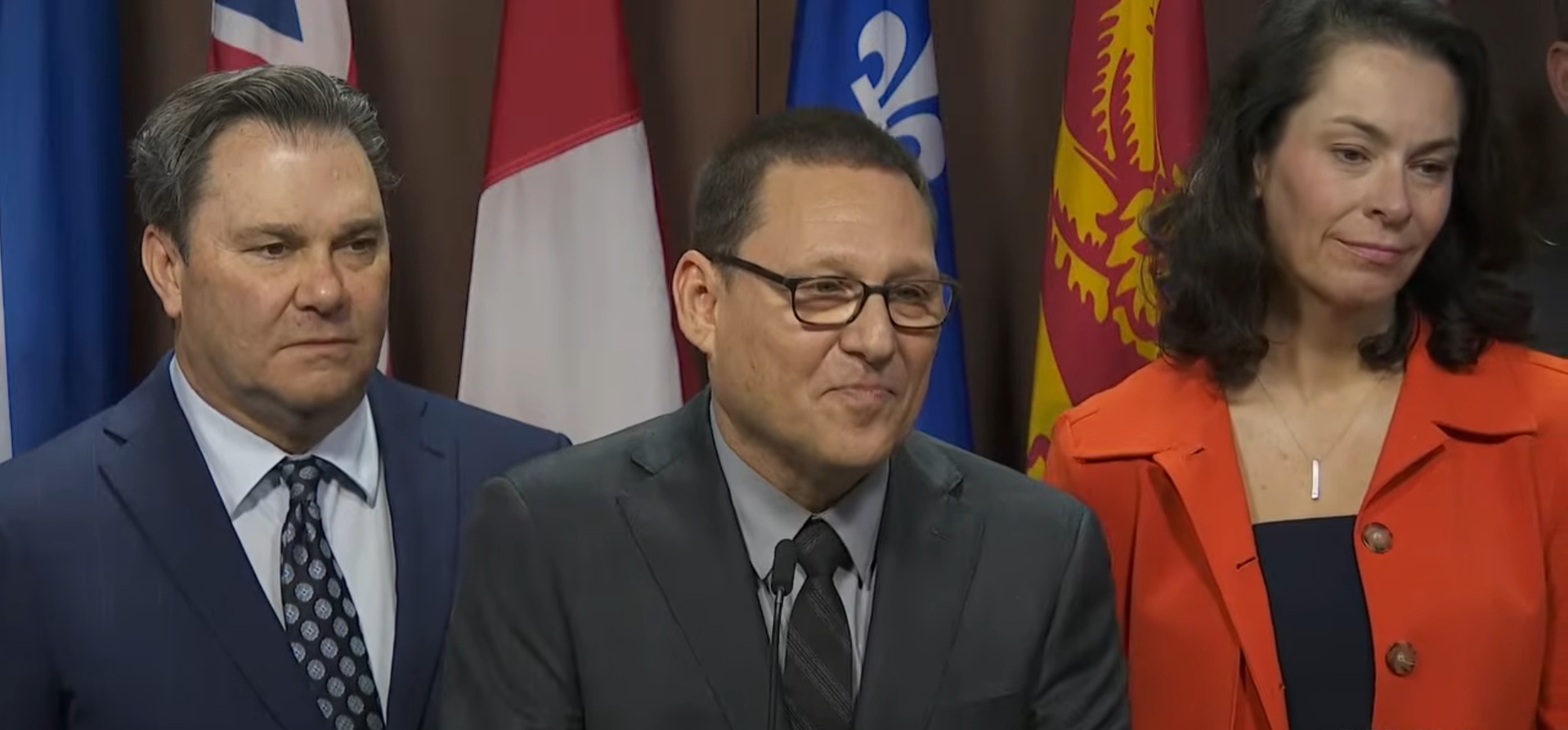
The New Democrats’ new leader Avi Lewis had his first news conference in Ottawa on Monday morning, April 12, mere hours before three by-elections gave the Mark Carney Liberals a majority.
The purpose of the NDP event was to urge the government to ban a phenomenon called surveillance pricing.
And what in the world is surveillance pricing?
It is a tactic for corporations to enhance their profits, using algorithms and AI to gather reams of personal information about all of us.
Using that data, businesses can determine a different price for a good or a service for each individual buyer.
Lewis gave the example of a desperate mother of a sick child who needs to buy a thermometer. Knowing the mother’s situation – by spying on her email and social media – a company could choose to charge her a higher price than that charged to others.
Lewis said such practices are now a reality – not just for thermometers but for many of life’s essentials, including food.
It is easy to see how surveillance pricing could happen for online purchases. Even before AI took centre stage, corporations had been using the online route to spy on us all.
We have become accustomed to the ads that pop up on our various feeds, based on our search and purchasing histories, and on what we share on social media.
Buy one book or CD from Amazon and you will be assaulted with ads for stuff some algorithm has decided to push your way.
And at Monday’s press conference Lewis underscored the fact that the use of electronic snooping to determine a tailored, individual price is not restricted to the digital universe.
It is happening in brick-and-mortar stores, as well.
Corporate-owned AI systems can spy on people’s phones while they’re shopping, Lewis said, and businesses can then set prices based on the information their snooping technology harvests.
The NDP leader did not explain how such physical businesses could get around the fact that they usually affix a visible price tag or label to goods for sale.
The answer seems to be: Where there’s a will there’s a way.
Unless it is contained by legislation and regulation, the vast power of AI will inevitably motivate the private sector to modify what have been standard retail practices for many decades – all for the purpose of squeezing every dollar possible out of consumers.
Lewis decried surveillance pricing as an example of what he called the “creepy” power of Big Tech.
He called on the Carney government to protect all citizens’ rights to fairness and privacy, and noted that in Manitoba Wab Kinew’s NDP government has introduced legislation banning such snooping and differential pricing.
We need a robust counterpart to that Manitoba initiative at the federal level, Lewis argued.
The New Democratic leader might have added that other provinces, with governments of different stripes from Manitoba’s, might not show as great a willingness to take on Big Tech as the Kinew government.
The federal NDP intends to put its proposal about surveillance pricing in the form of a private member’s bill, which MP Leah Gazan will sponsor.
Questions on other matters
Monday’s news conference gave Ottawa press gallery denizens a chance to ask Lewis and his colleagues about matters other than surveillance pricing – an issue that was not likely in their minds when they woke up Monday morning.
A number of reporters wanted to know Lewis’ views on the Alto high speed rail project. That project, if it ever gets built, will link Toronto to Ottawa, Montreal and Quebec City.
Local farmers and other property owners on Alto’s route object to the project. They complain they will get no benefit, but will pay a steep price. Some properties, they worry, will find themselves bisected by the new railway right-of-way.
Conservative leader Pierre Poilievre wants the entire light rail enterprise shelved indefinitely.
But Lewis said he is generally in favour – except that he does not like the public-private partnership model Alto uses.
Lewis’ view is that once you bring private, for-profit corporations onboard the transparency of a project disappears. As well, costs go up to accommodate the private partner’s need for a profit.
One journalist wanted to ask Montreal NDP MP Alexandre Boulerice about his personal plans.
Boulerice has been open about the fact he is considering running, this coming Fall, as a candidate for the provincial left-wing (but also sovereigntist) party, Québec Solidaire.
The NDP’s sole MP from Quebec did not outright deny that possibility, but would not comment further.
Leader Lewis was equally taciturn on the B.C. NDP government’s plan to suspend part of the United Nations Declaration on the Rights of Indigenous People (UNDRIP) in order to hasten high priority resource-development projects.
The federal NDP leader acknowledged there is, in his words, a “healthy debate” going on among British Columbia New Democrats.
But he added that, as federal leader, he would stay out of that debate.
A rookie unforced error
There was an awkward moment when one reporter wanted to pose a question on the U.S.-Iran war to the NDP’s long time foreign policy spokesperson, and Lewis’ former leadership rival, Heather McPherson.
Lewis snapped that he would answer that question rather than McPherson. The reporter was puzzled and asked why Boulerice could answer a question but not the foreign affairs critic.
Lewis curtly replied that the caucus had decided, in advance, that he, as leader, would take all the questions, on this occasion. He explained that he made an exception for Boulerice, because the question was about the MP’s personal plans, not party policy.
It was a situation that made one cringe.
Some who watched the news conference made a point of commenting to this writer that they were decidedly unimpressed with Avi Lewis’ demeanour at that moment.
Indeed, I have covered a great many Parliament Hill news conferences, going way back to 1981, and I can’t recall any occasion on which a person on the podium was prevented from answering a question posed directly to them.
Apart from that, the press conference was generally a good one for Avi Lewis.
He is a lively, colourful, articulate and sometimes passionate communicator. And those qualities were on full display this past Monday.
Even his unscripted answers in French were a cut above his recent performances – although someone should tell him the word in French for “private” is not “privat” it is “privé”.
But if the new NDP leader were looking for free advice on dealing with the press, here is some:
Take a deep breath and always remain calm, good-humoured and flexible. Do everything possible to avoid looking combative, excessively self-regarding, or defensive.
Members of the Canadian media are not perfect people, and some are, no doubt, hostile to the NDP, and progressives in general.
But now that we have a rightward leaning majority government running the show in Ottawa many media folk will be hungry for an alternative perspective from the Left. That is a role for the NDP, a role it should play to the maximum of its ability.
In such a context, the new NDP leader would be well-advised to avoid unforced errors.
And one thing he should never want to do is step on his own message by engaging in petty, trivial, and entirely avoidable fencing matches with journalists.
And so, Avi Lewis made a rookie error on his first encounter with the media on the Hill. He is not the first to do so, and he won’t be the last.
Many Canadians now hope the new New Democratic leader will learn from the experience, and do better next time.
Related Products
Follow Canada News Media
Get the day's top Canadian stories and our two daily 60-second news videos wherever you scroll.
X Threads Facebook Instagram LinkedIn TikTok YouTube Pinterest Reddit Substack Flipboard Newsletter RSS