



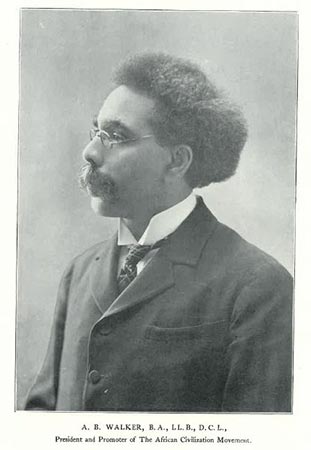
As we honour Black History Month in 2025, it is essential to reflect on the stories of trailblazers whose legacies have left an indelible mark on Canadian society. One such figure is Abraham Beverley Walker, a man who broke barriers in law, journalism, and civil rights advocacy at a time when racism and discrimination severely limited opportunities for Black Canadians. Walker’s achievements were not only remarkable for his time but continue to resonate today as we navigate issues of equity, diversity, and representation in Canada.
Born in Belleisle, New Brunswick in 1851, Walker was of Loyalist descent, part of a Black population that had been living in Canada for generations. His early education took place in Kingston, a small rural community on the Kingston Peninsula, where opportunities for Black Canadians were scarce. Walker’s aspirations, however, were far from confined by the limitations of his environment. His path would lead him to become Canada’s first Canadian-born Black lawyer, the first Black law student at the University of New Brunswick (UNB), and a pioneer in publishing.
Abraham Walker’s journey began with humble origins, but his intellectual curiosity and determination quickly became evident. In his youth, Walker worked as a stenographer and secretary for a touring lecturer, which took him to various provinces across Canada. This early experience exposed him to the wider world and deepened his resolve to pursue a career in law. Seeking higher education, Walker attended the National University in Washington, D.C., which would later become part of George Washington University. This move south was a bold step, especially considering the racial tensions in the United States during this period.
Upon returning to Canada, Walker continued his legal studies in Saint John, New Brunswick, where he worked as a shorthand reporter to support himself. In 1881, he was recognized as an attorney by the Supreme Court of New Brunswick, and a year later, he was admitted to the bar as a barrister. This achievement was groundbreaking, as it marked the beginning of Walker’s long and often difficult career in the legal profession.
Despite his qualifications, Walker faced significant challenges in establishing a successful law practice. Saint John’s small Black community provided limited clientele, and racial discrimination from his white colleagues made it difficult for Walker to gain a foothold in the legal community. Rather than succumbing to these barriers, Walker channelled his frustrations into activism.
Walker was deeply involved in the African Methodist Episcopalian Church and used his voice to advocate for the rights of Black Canadians. His numerous letters and articles, published in local newspapers, addressed issues of racial inequality, social justice, and the plight of Black Canadians. Walker’s commitment to his community and his relentless fight for justice laid the groundwork for future generations of Black Canadian activists and leaders.
One of his notable contributions to the intellectual landscape of Canada was the publication of “The Negro Problem or The Philosophy of Race Development”, a pamphlet he wrote during a brief period in Atlanta, Georgia. In it, he tackled the complex issues facing Black people in both Canada and the United States, offering insight into race relations and the potential for Black empowerment.
In addition to his legal and activist work, Walker made significant strides in the world of publishing. In 1903, he founded “Neith”, a literary and public affairs magazine named after the ancient Egyptian goddess of war, wisdom, and the hunt. While “Neith” was advertised as a Canadian magazine rather than a Black journal, its content often delved into issues of racial inequality and social justice, reflecting Walker’s lifelong commitment to these causes. Unfortunately, the publication folded after only five issues, but its impact was felt long after its closure.
Walker’s influence extended into federal politics, where he worked with both the Conservative and Liberal parties, advocating for policies that would benefit the Black community. His ability to navigate the political landscape of his time showcased his resilience and determination to make a difference, even in the face of systemic discrimination.
Abraham Beverley Walker’s contributions to Canadian society went largely unrecognized during his lifetime. He passed away in 1909 at the age of 58, after succumbing to tuberculosis. However, his legacy has since been honoured and celebrated. In 2019, Walker was posthumously awarded the Order of New Brunswick, a fitting tribute to a man whose life’s work continues to inspire.
Reflecting on Walker’s life, Angela Jones, a lawyer and Black community activist in Toronto, shared, “Walker’s story reminds us that Black Canadians have been fighting for equality and representation for over a century. His perseverance in the face of adversity is a testament to the strength and resilience of our community. It’s essential that we continue to celebrate figures like Walker, who paved the way for future generations of Black professionals.”
Another reflection comes from Dwayne Hamilton, a historian specializing in Black Canadian history. “Abraham Walker was more than just a lawyer. He was a visionary who understood that systemic change doesn’t happen overnight. His work in law, publishing, and politics helped lay the foundation for the civil rights movements we saw emerge in the mid-20th century. His impact is still felt today, especially as we continue to address the ongoing challenges Black Canadians face.”
In 2025, Walker’s legacy feels more relevant than ever. While Canada has made progress in addressing racial inequality, the systemic issues that Walker fought against persist. Black Canadians continue to face discrimination in various sectors, including the legal profession, politics, and media. In a time when diversity, equity, and inclusion initiatives are at the forefront of social discourse, Walker’s story serves as a reminder of the importance of representation and the need to amplify the voices of Black Canadians.
In the legal profession, Black lawyers remain underrepresented, and many face the same barriers Walker encountered over a century ago. Karen Thomas, a current law student at the University of New Brunswick, shared her perspective: “Studying at the same institution where Walker made history is both an honour and a responsibility. His journey shows us that we must continue to challenge the status quo and push for systemic change in the legal field. We owe it to Walker and others like him to ensure that the next generation of Black lawyers has the support and opportunities they deserve.”
Abraham Beverley Walker’s life and work encapsulate the struggles and triumphs of Black Canadians in the face of systemic racism. His contributions to law, publishing, and activism laid the groundwork for future generations, and his legacy continues to inspire. As we celebrate Black History Month in 2025, it is crucial to not only honour Walker’s achievements but also recognize the ongoing fight for equality and justice in Canada.
In a time when discussions about racial inequality are more prominent than ever, Walker’s story serves as both a reminder of how far we’ve come and a call to action for the work that remains. Abraham Beverley Walker was not only a trailblazer for Black Canadians—he was a beacon of hope for anyone striving to make a difference in the face of adversity.
As we celebrate Black History Month, let us remember Walker’s words and actions, and continue to advocate for a Canada that values and uplifts all its citizens, regardless of race or background.