





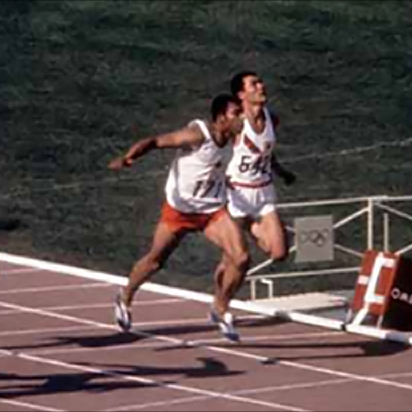
As February marks Black History Month, Canadians reflect on the contributions of prominent Black figures whose lives and legacies have shaped the nation’s cultural, political, and social landscapes. One such figure, often overlooked in the broader national conversation, is Harry Winston Jerome. An extraordinary athlete and an unyielding advocate for racial equality, Jerome’s achievements both on and off the track offer lessons that resonate powerfully today, especially in an era where Black Canadians continue to face systemic challenges.
Jerome’s story is one of perseverance, grit, and a deep commitment to pushing boundaries in the face of adversity. His journey through Canada’s sporting history is a tale of triumph and struggle, one that invites reflection on issues of racial inequality that continue to reverberate through Canadian society today.
Born on September 30, 1940, in Prince Albert, Saskatchewan, Harry Jerome moved with his family to North Vancouver, British Columbia, when he was a child. Growing up, he quickly developed an affinity for sports, particularly track and field. His early talent was undeniable, but as his sister Valerie Jerome recalls, he faced prejudice throughout his childhood. “We were one of the only Black families in North Vancouver, and it wasn’t easy,” Valerie said in an interview with the Vancouver Sun. “Harry had to prove himself twice over, not just as an athlete but as a Black person living in a predominantly white society.”
From a young age, Jerome was determined to excel in a society that often sought to diminish him because of his race. His resolve would carry him to the international stage, where he would become one of the world’s fastest sprinters.
In 1960, Jerome qualified for the Rome Olympics, and just two years later, he became the co-holder of the world record for the 100-meter dash, tying the record at 10.0 seconds—a feat that stunned the global sporting world. However, his success was not without significant struggles. Injuries marred his career, leading to early doubts about his longevity in track and field. After tearing his left quadriceps during the 1962 Commonwealth Games, many in the media labelled him a “quitter.”
This was a particularly painful accusation, not just for its inaccuracy, but because it mirrored the broader narrative of Black athletes often being subjected to harsher criticism than their white counterparts. “There was an undercurrent of racism in the way people spoke about Harry. They questioned his character in a way they wouldn’t have for a white athlete,” said Jason Webster, a Canadian sports historian, in an interview.
Despite the harsh media criticism, Jerome returned to the track stronger than ever. In 1964, he competed in the Tokyo Olympics, where he earned a bronze medal in the 100-meter sprint, solidifying his place as one of the world’s top athletes. Over the course of his career, he broke seven world records, and his resilience became a symbol of hope for many Black Canadians.
Harry Jerome’s contributions, however, extended far beyond his athletic accomplishments. After retiring from competition, he dedicated himself to advocating for youth, particularly Black youth, and fostering leadership in sports and education. He worked with the Canadian federal government to develop programs aimed at youth empowerment, and in 1971, he was named an Officer of the Order of Canada.
Jerome’s niece, Sarah Jerome, spoke about his dedication to community service. “Harry never forgot where he came from. He knew how hard it was to rise through the ranks as a Black person in Canada, and he wanted to make sure that future generations had more opportunities than he did,” she said in an interview with CBC News.
In 1982, Harry Jerome passed away from a brain aneurysm at the age of 42, cutting short a life of promise and purpose. Yet, his legacy continues to inspire. Today, the Harry Jerome Awards, an annual ceremony honouring Black excellence in Canada, serves as a testament to his enduring impact on Canadian society.
Jerome’s story resonates particularly deeply with Black Canadians, many of whom still face systemic challenges in accessing opportunities in various sectors, from sports to education and beyond. Black History Month serves not only as a moment to celebrate figures like Harry Jerome but also as a time to reflect on the unfinished work of dismantling racism in Canada.
“As a Black person growing up in Canada, you’re always aware that you have to work twice as hard to get half as far,” says Charles Daniels, a Toronto-based activist. “Harry Jerome’s story is a reminder that while talent and hard work are critical, they’re often not enough in a society structured by racial inequities.”
Dr. Yolande James, a professor of history at McGill University, notes that Jerome’s ability to rise above the prejudice he faced in the 1960s offers an important lesson for today’s generation. “Harry Jerome’s perseverance in the face of overwhelming adversity is something that Black Canadians can draw strength from, particularly as we continue to confront systemic barriers in our own lives,” she says.
While Jerome’s legacy is one of triumph, it also highlights the broader struggles that persist for Black Canadians. Today, Black athletes, entrepreneurs, and leaders continue to face obstacles, whether it’s in accessing funding, representation in leadership roles, or confronting everyday racism.
“Harry Jerome is a role model for us all, but his story also reminds us of the work that still needs to be done,” says Nadia Thompson, a Vancouver-based educator and community organizer. “It’s not just about celebrating his accomplishments but also about using this moment to push for more opportunities for Black Canadians in every field.”
As Canada moves further into the 21st century, it’s clear that Harry Jerome’s legacy will continue to inspire. Black History Month offers an opportunity to not only celebrate his remarkable achievements but to recognize the barriers that Black Canadians still face—and to commit to creating a more just and equitable society for all.
As we celebrate Harry Jerome during Black History Month, his life reminds us that progress, while slow, is possible with resilience, determination, and support from the community. His legacy serves as a beacon of hope and an enduring call to action. Jerome’s message was not just about winning races but about breaking down barriers—whether they be on the track or in society. In 2025, his story remains as relevant as ever. The fight for equality is ongoing, and the lessons learned from Jerome’s life continue to inspire the next generation of Black Canadians to push the boundaries of what’s possible.
Follow Canada News Media
Get the day's top Canadian stories and our two daily 60-second news videos wherever you scroll.
X Threads Facebook Instagram LinkedIn TikTok YouTube Pinterest Reddit Substack Flipboard Newsletter RSS