
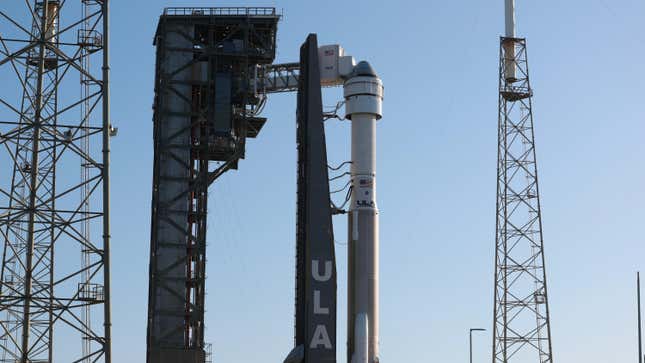
Boeing’s CST-100 Starliner, its long-awaited spacecraft designed to go back and forth to orbit like the space shuttle used to, is stuck at the International Space Station (ISS). After it was supposed to launch its first crewed mission on May 6, a number of delays saw it remain earthbound until early June, when it successfully left the atmosphere on its way to docking at the ISS. But now its return has also been delayed a number of times: On Friday, NASA officials said the Starliner would not be coming back from space until July 2 at the earliest, more than two weeks after its original expected return date.
Suggested Reading
Suggested Reading
What’s the problem?
The cause for concern is a number of helium leaks that have been observed in the system that governs the Starliner’s propulsion system. The helium is used to control the amount of propellant that hits the ship’s thrusters — akin to the power steering in a car. The same problem had been observed before the launch, but the leaks were deemed insufficiently problematic to stop the mission. Still, NASA officials have said that studying the issue is a priority.
“We are taking our time and following our standard mission management team process,” said Steve Stich, manager of NASA’s Commercial Crew Program on Friday. “We are letting the data drive our decision making relative to managing the small helium system leaks and thruster performance we observed during rendezvous and docking.”
Is it hard to fix?
This is not the kind of thing that can be repaired from space. Michael Lembeck, a clinical professor of aerospace engineering at the University of Illinois, says that the helium leaks could have any number of factors. Maybe parts controlling the helium escape volume were improperly put together. Maybe forces that weren’t fully accounted for affected the helium tanks. Whatever it is, it’s in NASA and Boeing’s interest to figure it out now. The cabin, which holds the astronauts, has lots of heat protection for fiery trips through the atmosphere. But the service module, which stores the engines and the fuel and the helium tanks, does not.
“The service module itself you don’t bring home,” Lembeck said. “That burns up in the atmosphere when the capsule returns.”
Are the astronauts in danger?
There has been some worry about the fate of the astronauts flying on the Starliner, Butch Wilmore and Sunita Williams. For Williams especially, the international anxiety for her is haunted by the death of her friend and fellow astronaut Kalpana Chawla. When the space shuttle Columbia disintegrated in 2003, Chawla was aboard. But NASA officials have stressed that there is more than enough helium to bring the Starliner home. At a June 18 press conference, officials reiterated that the ship needs seven hours of helium to make it home and has 70 hours’ worth aboard. But if the leaks turn out to be so bad that’s not enough, the Starliner’s crew could stay at the ISS until it can catch another ride home — maybe aboard a SpaceX Dragon.