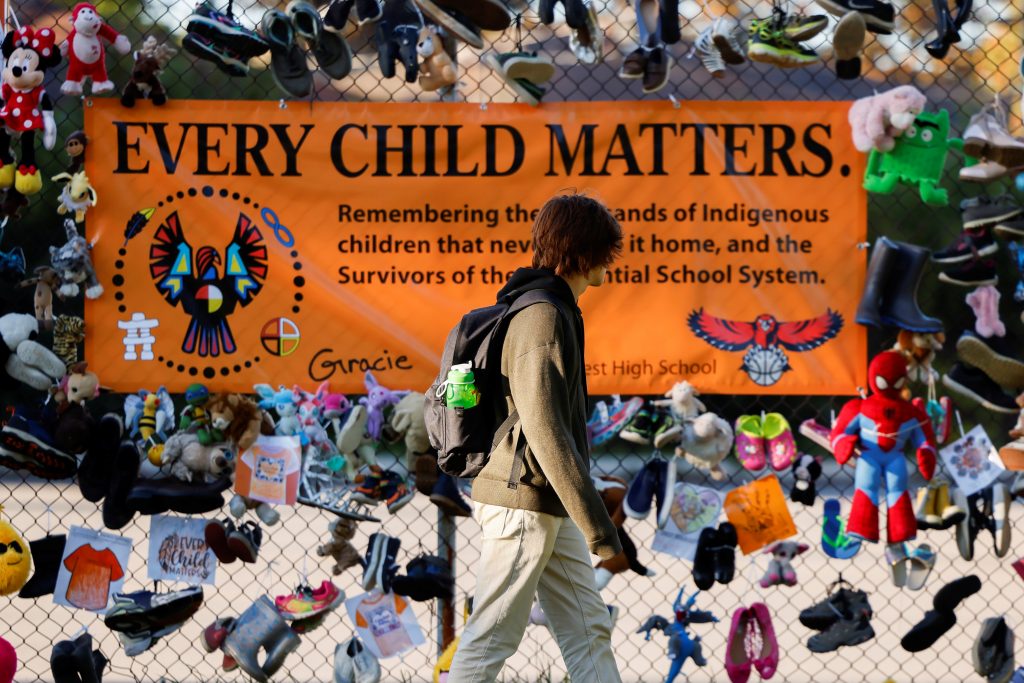

Today, Canada marks its second National Day for Truth and Reconciliation — a time to remember children who died while being forced to attend church-run and government-funded residential schools, those who survived and made it home, and the families and communities still affected by lasting trauma.
The day was made a federal statutory holiday last year, realizing a recommendation made by the Truth and Reconciliation Commission.
Ceremonies will be held across the country to reflect on the country’s history and treatment of Indigenous people. All federal government buildings in Canada — including the Peace Tower in Ottawa — will lower their flags to half-mast from sunrise to sunset.
Sept. 30 is also Orange Shirt Day, which honours the story of Phyllis Webstad, a former residential school student who had her orange shirt taken away on her first day at a residential school. The National Centre for Truth and Reconciliation is encouraging Canadians to wear orange as an act of solidarity.
In Ottawa, the day started with an eagle feather ceremony on Parliament Hill in front of the Peace Tower, which included a traditional round dance that saw dozens of members from the crowd participate.

Anishinaabe (Algonquin) Elder Claudette Commanda spoke of how the day is a moment for Canadians to listen and reflect on their history.
“It’s a day for you Canadians to listen, to learn, to understand, to have it in your heart and in your spirit to feel the beauty of Indigenous people, the strength and resilience of survivors, but to learn history,” she said.
“Reflect on the truth, learn from the past, walk together in peace, understanding and healing. Walk together this journey called reconciliation,” she said. “Everyday is Sept. 30.”
The ceremony will be followed by a walk to nearby LeBreton Flats Park, where attendees will lay children’s footwear on the ground to commemorate those who died in residential schools. A one-hour commemoration ceremony will take place there in the afternoon.

A year after spending the first National Day for Truth and Reconciliation on vacation in Tofino, B.C., Prime Minister Justin Trudeau attended a sunrise ceremony in Niagara Falls, Ont., this morning.
Following the ceremony, Trudeau spoke with residential school survivors and later challenged Canadians to be more accepting of the stories of survivors during an address to the crowd.
“How many times do Indigenous peoples need to tell their stories of trauma, of loss, of pain, of grief, until we absorb those stories as non-Indigenous people and make them our own?” he said.
“They too are the story of Canada and therefore they too are the story of each of us.”
‘We are still here’
Speaking ahead of Trudeau, Haudenosaunee Grandmother Marie Jones noted that the day should also be a reminder that the effort of residential schools — the forced assimilation of Indigenous children — failed.
“As Indigenous people we are still here,” she said, garnering applause from the crowd.
Governor General Mary Simon challenged all Canadians to commit to reconciliation — not just today, but year-round.
“I encourage you to start the conversation at school, at work, at home: What will you do, today, tomorrow and every day, to be part of a better Canada, one that reflects us all?” she said in a statement.
Conservative Leader Pierre Poilievre attended a sunrise ceremony in Ottawa this morning.
“Today, we listen to the survivors, remember those — the children — we lost, and commit to continue walking the path of healing and reconciliation with Indigenous people,” he tweeted following the ceremony.
NDP Leader Jagmeet Singh, who attended the ceremony on Parliament Hill, said he wanted to show his support for Indigenous communities.
“‘[I’m] here to remember the children, to stand in solidarity, to remember the harms [caused by residential schools] and make it clear that we are here to fight for justice,” he said.

A sunrise ceremony kicked off the second full day of activities at Nathan Phillips Square in Toronto on Friday, celebrating Indigenous cultures, traditions and languages through workshops, presentations, stories, teachings, dance, film and music.
Dozens of Indigenous and non-Indigenous people gathered at dawn around a sacred fire outside city hall for the ceremony. There was a sage smudging ceremony and dried tobacco was passed around to those gathered to place in the fire as an offering.
In the centre of Halifax’s downtown, hundreds gathered to mark the day and hear from Acadia First Nation Chief Deborah Robinson, Mi’kmaw elder Alan Knockwood and Halifax’s Indigenous adviser Cheryl Copage-Gehue.
Knockwood told the crowd at the city’s Grand Parade that as the community comes together to reflect on Canada’s legacy of colonialism, the children lost in the residential school system are “here in our hearts and they are with us here.”
Here’s how to follow the events on all CBC platforms:
- A one-hour commemoration ceremony in Ottawa will begin at 1 p.m. ET. This special event honours residential school survivors, their families and their communities, and includes a commemorative program from the National Centre for Truth and Reconciliation, in association with APTN.
- CBC News chief correspondent Adrienne Arsenault will host special coverage of the events starting at 12:30 p.m. ET on CBC, CBC Gem, CBC News Network, CBCNews.ca and the CBC News App.
- On CBC Radio One and CBC Listen, Falen Johnson will host the live coverage, beginning at 1 p.m. ET.
- CBC.ca will have regular updates and livestream the events.
Support is available for anyone affected by their experience at residential schools or by the latest reports.
A national Indian Residential School Crisis Line has been set up to provide support for survivors and those affected. People can access emotional and crisis referral services by calling the 24-hour national crisis line: 1-866-925-4419.
Mental health counselling and crisis support is also available 24 hours a day, seven days a week through the Hope for Wellness hotline at 1-855-242-3310 or by online chat at www.hopeforwellness.ca.