

The willingness of Canadians to comply with vaccination requirements and harsh public health restrictions did more to bring COVID-19 under control than the fragmented, deficient and “unsavvy” response of governments, concludes a major review published by the influential British Medical Journal.
“Beneath the surface of a general sense of satisfaction lie major pandemic failures,” the BMJ editorial reads. A “particular disgrace” was the mass COVID outbreaks and deaths at long-term care homes. Canada leads wealthy nations for COVID-related fatalities in care homes, despite more than 100 reports and inquiries over 50 years that foreshadowed a nursing home crisis.
“In other words, Canadians delivered on the pandemic response while its governments faltered.”
The authors of the BMJ series are calling for an independent federal inquiry, among the reasons, they argue, is that lacking one “allows others to step into the frame.” The “National Citizens Inquiry,” a citizen-led inquiry originally launched by former Reform Party leader Preston Manning, “appears fuelled by vaccine safety misinformation and ideological concerns” about stringent COVID measures, according to the BMJ editorial, “and is far from the full, national and public inquiry led by independent experts that Canada’s pandemic performance deserves.”
On the surface, Canada appears to have held its own, they said: Compared with the “shambolic” U.K. response, and the “chaos and divisiveness” of the American response, “Canada may seem to have risen to the occasion of COVID-19,” wrote the editorial’s authors, who include the BMJ’s editor-in-chief.
However, “We wouldn’t know because no pandemic inquiry has been established by its federal government. This is a mistake.”
The Liberal government has deferred calls for a full-blown inquiry, saying only that a full investigation would be done at the “appropriate time.”
Canada has recorded a total of at least 53,063 COVID-related deaths, and nearly 4.7 million infections.
The BMJ post-mortems explore the highs and the lows of Canada’s response after a traveller returning home to Toronto from China was identified as the country’s first COVID case in January 2020.
Each province and territory created its own rules for school closures, mask mandates, vaccine mandates, limits on public gatherings, curfews and lock-downs, “leading to substantial variation in policy and practice across the country, widely varying hospital admission rates and public confusion,” Tania Bubela, Simon Fraser University’s dean of health sciences and colleagues wrote.
There was no clear or consistent messaging. “As the pandemic progressed, public confusion arose from jurisdictional inconsistencies in advice and case reporting.” Most jurisdictions reported raw case numbers, but not where those cases were concentrated, meaning public health measures were universally applied — an all-purpose response, instead of tailoring interventions and strategies.
There was fragmented health leadership, and confusion over data sharing between the Public Health Agency of Canada and provincial health authorities, a situation that will persist “without major reform,” the authors said. The public also must be involved in future decision-making “through direct consultations and inclusion of community organizations.”
“For health workers, the post-pandemic feeling is exacerbation — even rage — about the inertia of governments, health authorities and professional medical associations and their failure to tackle the depth of the dysfunction in Canada’s health-care system,” the editorial’s authors wrote.
“Were lives lost as a result of the broken systems,” they asked. “Were decisions by governments taken appropriately and equitably?”
“Those are questions that need to be put to a public national inquiry,” Dr. Jocalyn Clark, the BMJ’s international editor who commissioned the series and wrote the lead editorial, said in an interview. There’s a sense of “déja vu of a lot of things that were raised” after the SARS-CoV-1 outbreak in 2002-2004, she said, including squabbling and dysfunctional relationships between different levels of government. “If any nation, Canada should have been prepared,” said Clark, a Saskatoon-born adjunct professor of medicine at the University of Toronto, who now lives in the U.K. “This series shows they weren’t sufficiently prepared.”
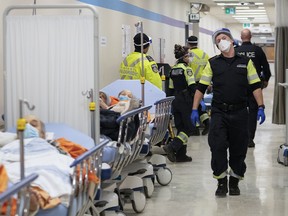
Underpaid and undervalued staff faced a lack of personal protective equipment, and even bed linens and wound care supplies. When the Canadian Armed Forces were deployed to seven Ontario homes, “military personnel reported hearing residents crying out for help from 30 minutes to two hours, while awaiting staff response.” Residents weren’t appropriately bathed or toileted. Twenty-six people likely died from dehydration at one home alone before the military arrived.
While the Liberal government “waxed lyrical” about sharing vaccines with poorer nations, Canada became “one of the most prominent hoarders of the limited global COVID-19 vaccine supply, despite itself being wholly reliant on importation,” other researchers wrote in the BMJ.
“Pandemics are mass events from which few can escape,” wrote Kelley Lee, Canada research chair in global health governance. The distinction between national and global interests, she said, “becomes moot.
One reason for the discord between Canada’s talk and its actions is the belief “that domestic political success means not championing global equity too loudly for fear of alienating voters with conservative values,” Lee said.
“But in an unequal world, it is inequity that breeds disillusion, detachment and division.”
By the end of 2022, Canada had administered almost 92 million doses, while delivering fewer than 29 million abroad.
Canada contributed to “devastating” COVID deaths by not sharing enough vaccines, the editorial’s authors wrote. “Canada was judiciously ungenerous and unsavvy in its global behaviour, despite repeated pledges by its prime minister to deliver global solidarity during COVID-19.”
The authors hint that the federal government’s relationship with the drug industry, which had been aggressively pushing back against reforms aimed at lowering drug prices, pre-COVID, became “more congenial” as the Liberal government sought vaccines and drugs.
“The demands of the COVID-19 response were also invoked as a reason behind multiple delays in implementing PMPRB (the Patented Medicine Prices Review Board) reforms,” researchers wrote. The PMRB, a federal agency that controls wholesale drug prices, recently faced an internal meltdown with the resignation of several senior leaders amid allegations of ministerial interference.
“However, despite ominous statements by drug companies and industry groups that these reforms would delay Canadian access to products including vaccines, the government downplayed any direct use of access to COVID-19 vaccines as leverage,” Pai and his co-authors wrote.
Among the “highs” of Canada’s handling of COVID, Canada had one of the lowest reported rates of cases and deaths per population than most in the G10 countries, the nation became one of the most vaccinated in the world, and women led the country’s public health response to the outbreak.

Follow Canada News Media
Get the day's top Canadian stories and our two daily 60-second news videos wherever you scroll.
X Threads Facebook Instagram LinkedIn TikTok YouTube Pinterest Reddit Substack Flipboard Newsletter RSS