



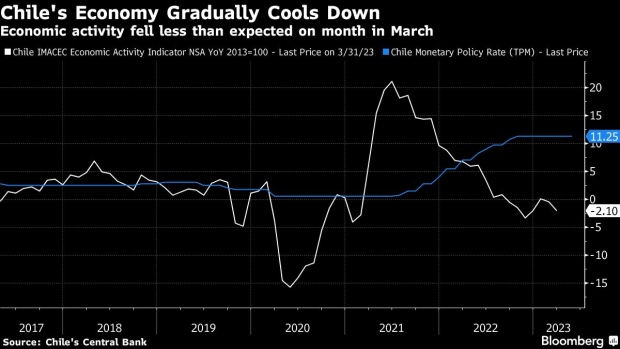
(Bloomberg) — Chile’s economic activity fell less than expected in March as services remained resilient, backing up the central bank’s insistence on keeping interest rates at an over 20-year high to cool inflation and consumption.
The Imacec index, a proxy for gross domestic product, fell 0.1% in March from the previous month, less than the -0.4% median estimate of analysts in a Bloomberg survey. From a year prior, activity declined 2.1%, the central bank reported on Tuesday.
Chile’s economy has held up better than forecast in recent months despite headwinds including above-target inflation, tight monetary policy and falling liquidity. In April, the central bank raised its forecasts for inflation, at the same time as opening up the possibility that gross domestic product may expand this year. Put together, there is no indication that borrowing cost reductions are near.
Read more: Chile’s Costa Dismisses Early Rate Cuts, Even as Inflation Slows
Services rose 0.9% on the month in March, the central bank said. On the other hand, both mining activity and commerce declined by 1.8% during the period.
Policymakers won’t cut rates until underlying inflation is on a clear downward trend, central bank chief Rosanna Costa said in an interview last month.
President Gabriel Boric rolled out a plan in April to develop the local lithium industry, with the government taking a controlling stake in future public-private partnerships in the largest brine deposits. It’s part of efforts to seek a bigger role for the state, while also attracting more private capital.
Still, critics such as Canadian mining billionaire Robert Friedland said the initiative will deter local investment and may hurt the clean energy transition.
–With assistance from Rafael Gayol and Giovanna Serafim.