


Father Dunstan Massey, Order of St. Benedict, was considered one of Canada’s most original artists
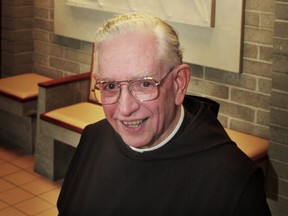
Considered by many to be one of Canada’s most original artists, Father Dunstan Massey died on Boxing Day in the infirmary at Westminster Abbey in Mission, aged 98.
“I had barely set foot in high school when I decided (amazingly with parental permission) that I would prefer to study art rather than algebra,” Massey once wrote.
So at 18 Massey turned his back on the secular world and began training for the priesthood at Christ the King Seminary, part of the abbey he would call home for his remaining 70 years, where his much-admired frescoes, paintings, bas-reliefs and sculptures abound and where he taught art, literature and philosophy.
The cloistered monk kept painting to the end, until he moved into the abbey’s infirmary a short time before his death, said Father Mark Dumont, Westminster’s guestmaster.
The other is called The Stone Ship: A Nocturne in Three Watches, and is also a poetic drama published in 2014, 12 years after Mystic.
As well, he had a book written about him, Artist in the Cloister, by historian Daphne Sleigh.

Born William Massey, he chose his priesthood name after Saint Dunstan of Canterbury, patron saint of artisans and goldsmiths.
The head of the Vancouver Art Gallery once told him he should get out more, become au courant, fully informed, up to date, he told The Vancouver Sun in 2002.
“It’s the last thing I want to do,” Massey said. “I don’t think I could have survived the rough-and-tumble of the modern art world.”
One big fresco of Massey’s is called The Vision of St. Benedict, depicting how his patron saint saw “the whole world in a ray of light,” a mystical moment of ecstasy. Another large fresco, The Celestial Banquet, was inspired by Leonardo da Vinci’s The Last Supper, only with Matthias the Apostle replacing Judas Iscariot.
It took Massey four years to complete Temptation, six years to finish Banquet, Westminster’s guestmaster Dumont said.
And it took seven years to craft the crucifix — cast in bronze and plated with silver — that has hung above the Westminster Abbey altar since 2014.
“An artist doesn’t very often get a chance to do the whole ornamentation of a church,” Massey told B.C. Catholic in 2017. “That’s a rare thing.
Massey’s life was a cycle of daily prayer, eating in silence, creating his art while listening to classical music and sleep, up again next morning for 5 a.m. breakfast to do it all over again.
His art, he once said, is meant to convey hope.
“I think our modern society needs hope more than anything, because there is so much alienation, which leads to despair.”