

 \
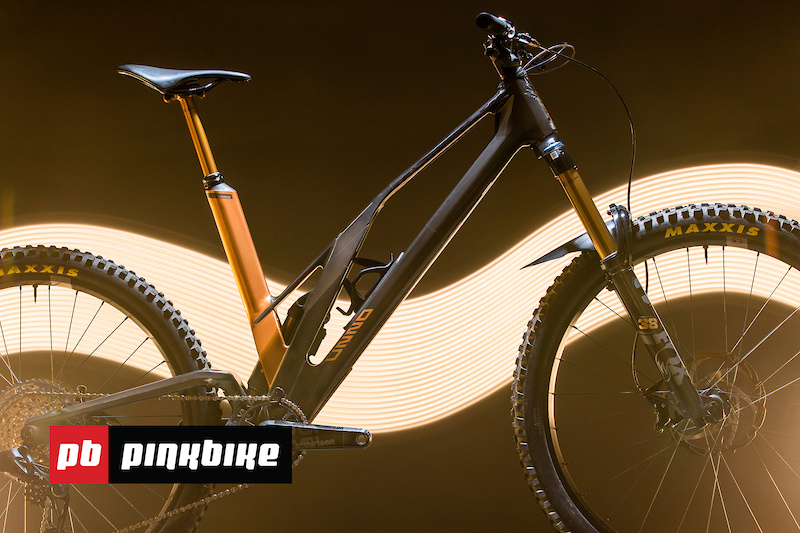
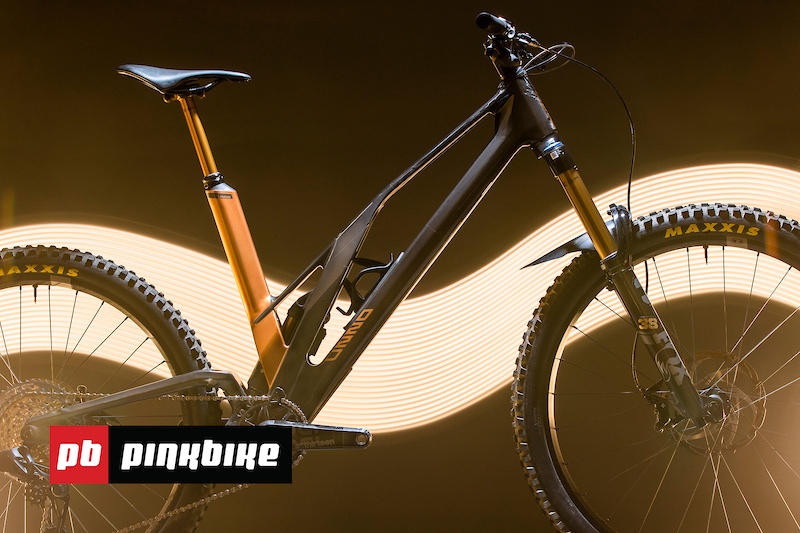
\Unno is a brand whose reputation precedes them. As a mountain biker, I seem to know a lot about the brand, whether it’s their inception under the leadership of designer Cesar Rojo, their initial forays into domestic carbon fiber production or their boutique bikes that seem to have little regard for convention.
Quite honestly, it was an exciting prospect to ride one of these sought-after machines. Unno says they “started again from zero” to update their enduro platform, and the Burn is nothing if not out there. To look at it, there seems to be elegance mixed with brutish features, pragmatism mixed with absurdity.
Unno Burn Details
• Travel: 160mm rear, 170mm front
• Carbon frame
• Mixed wheels
• 64° head-tube angle
• 76.5° seat-tube angle
• Reach: 470mm (S2)
• Chainstay length: 445mm
• Weight: 33.4 lb / 15.1 kg
• $8,897 USD
• More info: unno.com
The Burn features its own novel suspension layout and it’s not just radical in its looks – Unno suggests running this at around 30 to 40% sag. They can do this because the bike has a very progressive kinematic curve.
This level of progressivity will ensure that there are no harsh bottom-outs. Although much of the progression happens in the beginning portion of the stroke (one of the reasons for the Burn’s sensitive initial travel), a kinematic like this can make it difficult to use full travel other than during very large impacts. This might not be a bad thing if you demand lots of initial activity and want to save the rest of the travel for a rainy day, but there is a reason why most bikes don’t offer this level of change throughout the stroke.
Our test bike, which was a size S2, was the Race model and retails for just less than $9,000 USD. There are frame-only options, plus an entry point Elite and Factory model to sit on either side of the Race in their pricing. Our bike featured an SRAM GX AXS drivetrain, Formula Cura 4 brakes, Fox Factory suspension, alloy Crankbrothers Synthesis e-bike wheels, and a Duex enduro one-piece bar. The bar itself is an interesting prospect. Despite it looking quite wild, dimensionally it’s nothing too out-there. Its flat shape obscured its actual rise, which is achieved by the sleeve of the stem extending quite a long way down the steerer. The bike features in-frame storage, a universal derailleur hanger, and through-the-headset cable routing.
The geometry of the S2 impressed us with its sheer balance. Its high stack, middling-to-short 470mm reach, and 445mm stays all played their role in this. Although the reach might not be in the same vein as other bikes meant for those around 175 to 185cm in height, which might typically have 480-485 mm of reach, it proved a hit with us. There was one significant outlier though – the seatpost and seat tube.
At 460mm the seat tube is very long. This in itself isn’t the end of the world, and you can get it low enough to give enough clearance. The plot thickens, though, because the seat tube sits directly above the shock – it’s not only very high but also with a short insertion depth. This means that while the post is high, you also can’t fit in a long dropper (our test bike had a 150mm post when something over 200mm would have been preferred). With the saddle dropped it was too high, and if you lowered the seat post itself to an appropriate length for a descent it would then be too low for pedaling when at full extension. It’s further exacerbated by the fact that it doesn’t use a seat tube collar but rather a wedge to clamp against the post.
Climbing
The Unno offers a great platform for climbing. Due to the fact that it’s so happy to get into its stroke its tracking is very good, and, even with anti-squat values of around 120 to 90% depending on where in the sag range of 30 to 40% you are, the grip is good and there is a great degree of composure in terms of how the rear wheel handles the terrain. It’s very happy to follow the contours of the ground and also give a decent degree of efficiency. It’s also the joint lightest bike on test.
However, as we’ll get into more in the descending, it’s not without its foibles. The suspension might take tech-climbing in its stride but there are some geometry and component outliers that make climbing the Unno more complex than perhaps it should be. One issue is the slacker 76.5-degree seat tube angle, which brings the rider’s weight more rearward. This in itself wouldn’t be an issue, but the actual seat tube angle is slacker still and, when combined with the high stack and stubby stem does mean that sometimes the bike feels very light on the front.
The suspension does offer a lot, but I again wonder if that seat tube angle is trying to negate the inherent problems caused by the frame’s layout.
Descending
Descending the Unno should be an enticing proposition but for some test riders the initial excitement soon blurred into confusion and then deflation. The squat links that connect the front triangle to the swing arm are neat and provide a taut, stiff platform to really drive the bike. The geometry plays in that too, It made for a bike that had lots of the rider’s weight going through their feet, and it meant that you could focus on applying weight with your hands when you want to initiate a turn or pump the bike, rather than ever being pulled forward or having large amounts of weight in your hands by default.
The geometry cuts a sensible balance, and one that feels like it’s been honed in on during real-world riding and years of reflection. It’s interesting to see something so balanced with a suspension system so extreme. There are other examples of both virtues and vices juxtaposing one another. For instance, the frame storage sits beneath a panel that holds the water bottle. It works well and is both simple and effective. Yet, it leaves the bottle rattling on the underside of the top tube. The suspension gives a feeling that thrives on sleep-slow tech, but then the seat tube is so long, with such short insertion depth, that it means you’ll struggle to get the saddle out of the way for the very trails the bike was meant for.
It’s a fascinating bike and they’ve clearly compromised some elements or dimensions to grant the real estate to make their own suspension platform, and it poses a question right at the heart of the issue – is any suspension platform good enough for these compromises? Probably not. Is this suspension system a game-changingly wonderful take? I wouldn’t say so.
It’s okay in certain situations, such as the steeper technical trails, but it also struggles because while you may never hit bottom out, you do often hit that wall of support. At times, it felt like this bike was reduced to a frame with a lot less travel than it actually had. During my testing, I experimented between 140-210 psi, which is a huge swing and didn’t get bottom out in either. In fact, the 210 psi felt better if only because it gave more initial support, and I just learned to accept that I would largely be using far less than full travel.
All these problems, and the intense ramp-up, mean that on flat-out fast trails, this bike can be very fatiguing. You’re not bouncing off the bottom out, but you may as well be. It can also lead to a hanging-up sensation in some instances that will not only punish mistakes but also your wheels. After our test period, the rear was in a sorry state.
Technical Report
Two Too Many Wedges: Both the Duex bar and the seat post were cinched via wedges that would be driven with 4mm Allen keys. This seems unwarranted and unnecessary, and I think would prove unpopular with mountain bikers at large, much in the same way it did with our test team.
Finishing Kit: The bike isn’t cheap, so it’s frustrating that you’d want to immediately explore options in terms of low-stack seat posts. Plus, if it were my bike, I would take the bars and grips off too. They’re just a kook too far for me. That’s not even to mention the E13 cassette and YBN chain in a combination that didn’t offer as good a shift as I have come to expect from a full complement of SRAM parts.
Formula Brakes: The Foruma Cura 4 Brakes offered good power, even if the feel didn’t give as much bite as I would personally like. That said, there was plenty of modulation and adjustment on offer, although sadly the latter wasn’t tool-free.

Follow Canada News Media
Get the day's top Canadian stories and our two daily 60-second news videos wherever you scroll.
X Threads Facebook Instagram LinkedIn TikTok YouTube Pinterest Reddit Substack Flipboard Newsletter RSS