


Europe and North America were connected by land across the Arctic then, as the North Atlantic had not yet opened enough by continental drift to fully separate them. But was the ancient far-northern climate suitable for their passage?
The scientists found that the ancient climates were hot where these ants lived in Wyoming and Europe. They further found that modern ants with the biggest queens also inhabit hot climates, leading them to associate large size in queen ants with high temperatures. This creates a problem, however, as although the ancient Arctic had a milder climate than today, it still wouldn’t have been hot enough to allow Titanomyrma to pass.
New findings build on earlier research
The researchers suggested in 2011 that this might be explained by geologically brief intervals of global warming around the time of Titanomyrma called “hyperthermals” creating short-term intervals of friendly conditions for them to cross.
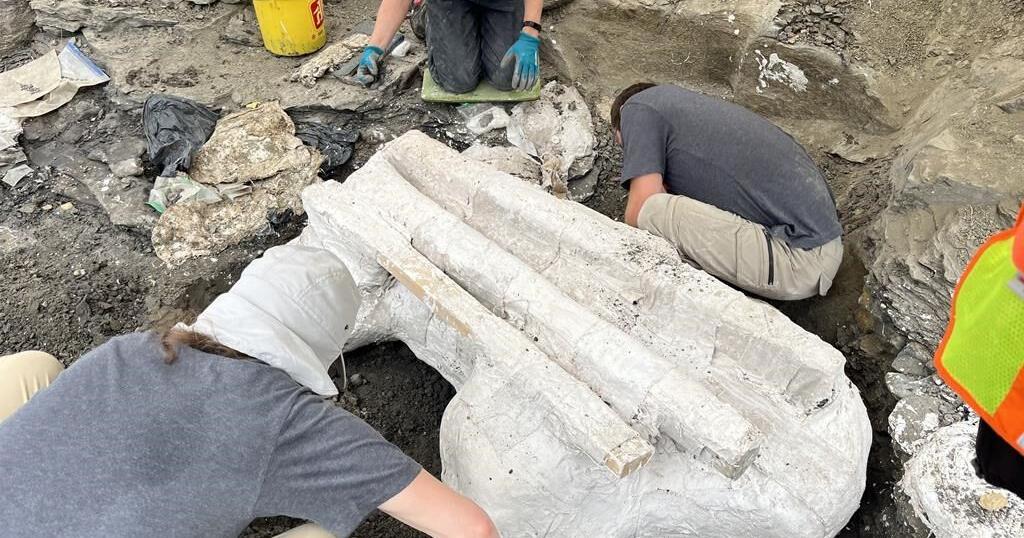
They then predicted that Titanomyrma wouldn’t be found in the ancient temperate Canadian uplands, as it would have been cooler than Titanomyrma appears to have required. But now one has been discovered there.
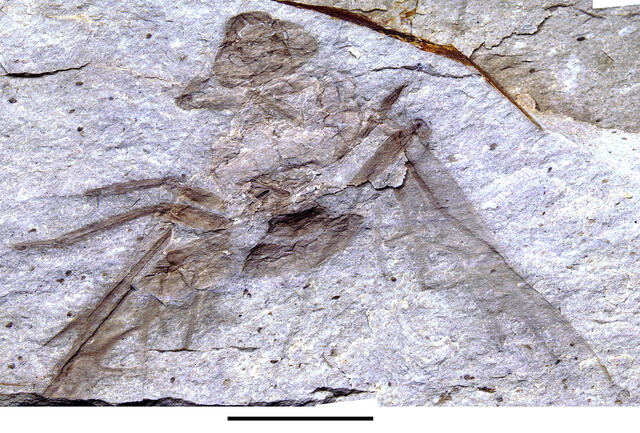
The story becomes more complicated and interesting, as the new Canadian fossil was distorted by geological pressure during fossilization, so its true life size can’t be established. It might have been gigantic like some of the largest Titanomyrma queens, but it could equally be reconstructed as smaller.
“If it was a smaller species, was it adapted to this region of cooler climate by reduction in size and gigantic species were excluded as we predicted back in 2011?” says Archibald. “Or were they huge, and our idea of the climatic tolerance of gigantic ants, and so how they crossed the Arctic, was wrong?”
Archibald says the research is helping scientists better understand how B.C.’s community of animals and plants were forming when climate was much different. “Understanding how life dispersed among the northern continents in a very different climate 50 million years ago in part explains patterns of animal and plant distribution that we see today,” says Archibald.
“Titanomyrma may also help us better understand how global warming could affect how the distribution of life may change. To prepare for the future, it helps to understand the past.”
He adds: “We’ll need to find more fossils. Do our ideas of Titanomyrma’s ecology, and so of this ancient dispersal of life, need revision? For now, it remains a mystery.”