


Article content continued
In particular, the eBOSS team’s measurement of the current rate of expansion of the universe, the previously mentioned Hubble’s Law, is about 10 per cent lower than the value found from distances to nearby galaxies. The mysterious invisible component in the universe we call “dark energy” has been thought to have something to do with this, but like many other phenomena in the universe it remains unexplained.
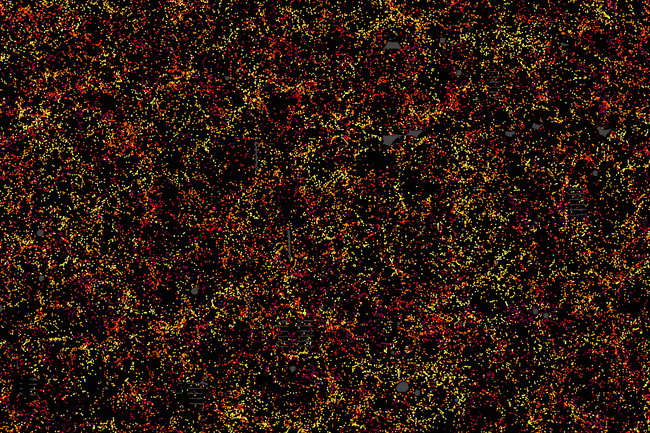
While this is the largest map to date, Percival hopes that the next generation of surveys will gather more galaxies and potentially solve this mystery by “really getting a handle on the theory of dark energy.”
Some of these projects may include the Dark Energy Spectroscopic Instrument (DESI) and EUCLID, a European Space Agency satellite mission and another galaxy survey. Percival is involved in both. He says that DESI is about twenty times faster than the Sloan telescope they used for this map and is possibly a few months away from starting depending on the ongoing pandemic.
“I should emphasize that this is a group collaboration, hundreds all around the world in every continent. Its been an incredible team resource and I’m so happy to see it come to fruition,” says Percival.