



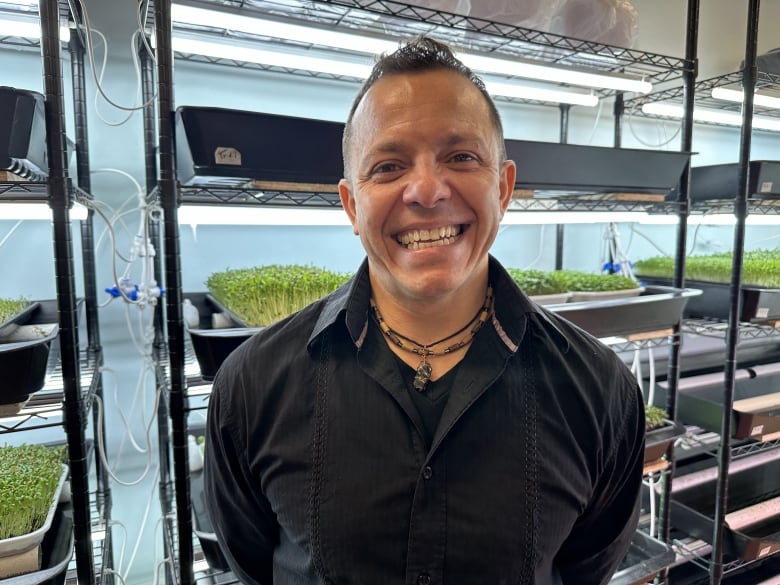
Walking along King Street across from Budweiser Gardens, you wouldn’t know you were walking past a farm.
Tucked inside a storefront at the base of a downtown London, Ont. highrise is an indoor urban farm specializing in the year-round production of microgreens, the nutritionally-dense young versions of vegetables, harvested within a couple of weeks of seeding.
Launched in 2020, Forest City Microgreens (FCM) grows 14 different kinds of vegetable seedlings at its King Street location, which it has occupied for two years.
The goal, says Santiago Ramirez, who co-owns FCM with parents Christina and Jamie, is to provide Londoners access to highly-nutritious produce grown in the core through sustainable vertical farming.

“We’re the first licensed urban microgreen farm in London,” Ramirez said.
“Our model is Farm to Fork within 48 hours… It’s very versatile. You can put it (in) everything from a salad to a smoothie to a pizza to a hamburger.”
The King Street facility measures roughly 750 sq. ft., and is filled with racks of broccoli, arugula, red cabbage, rainbow radish, cilantro, red amaranth, and other varieties, which FCM sells direct to customers and local restaurants, including through a subscription service.
Microgreens, Ramirez says, have higher concentrations of nutrients and antioxidants compared to their fully-grown counterparts, making them an excellent dietary addition.
While not a panacea for the food insecurity issues facing Canada, microgreens and indoor urban farming could play a positive role in the agricultural landscape, said Geneviève Metson, associate professor with Western University’s Department of Geography and Environment.
“Especially in colder climates, where we can’t grow year-round, obviously, growing indoors means that we can sometimes access more fresh, green vegetables,” she said.
Other potential positives could be informing the public about what it takes to grow food, impacting people’s purchasing decisions in buying local, and getting more people interested in food production.

With an indoor vertical farm, microgreens can be grown year-round, requiring little in the way of space and water. FCM says it utilizes a closed loop irrigation system to curb water waste.
“I think that, absolutely, people participating in different types of urban, peri-urban, or rural food production is really positive,” she said.
“But from an environmental perspective, if you’re going to tell me that microgreens are replacing people eating more meat, I’d be like, ‘yeah, there’s a huge environmental benefit, almost regardless of how the microgreens are produced.'”
For Ramirez, the positive response from the community has them considering expanding to a larger location sometime down the road.
“Larger location, more variety. The possibilities are sort of endless as to how much we can produce,” he said.
Until then, FCM will continue growing along King Street, and educating the public about sustainable urban farming. On Jan. 13, Ramirez says they’ll be selling microgreens at London Food Co-Op, and distributing growing kits that allow Londoners to grow their own.
“Hopefully you’ll see us at other locations, continue to educate and share our values and the reason why we’re doing this.”

Follow Canada News Media
Get the day's top Canadian stories and our two daily 60-second news videos wherever you scroll.
X Threads Facebook Instagram LinkedIn TikTok YouTube Pinterest Reddit Substack Flipboard Newsletter RSS