



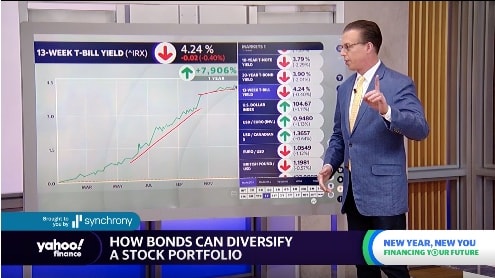

Yahoo Finance’s Jared Blikre explains why the bond market is still important for investors.
Video Transcript
[AUDIO LOGO]
AKIKO FUJITA: Welcome back to “New Year, New You,” brought to you by Synchrony Bank Savings. Well, let’s take a look at bond market performance today, tomorrow, and even far into the past. We’ve got Yahoo Finance’s Jared Blikre at the Y-Fi Interactive to walk us through this one. Jared.
JARED BLIKRE: That’s right. And let’s start out with the bond market, as we’ve been talking about. This is the 13-week T-bill, so technically not a bond. This is a short end of the curve. This tracks what the Federal Reserve has been doing. And over the last year, we’ve had a surge of activity. Went from near zero, accelerated in the summer, and then started plateauing later in the year. But still going up, and very important to understand that. That has put considerable pressure on risk markets.
Now, here is the S&P 500. One year ago, the market was making record highs, first time we ever made a record high on the first trading date of the year. And you can see we’re still well within a bear market, trading at the lower end of the range here, down 20% over this time period. Now, was it a bad year for bonds? Yes, it was. In fact, it was a worse year for bonds going back about 100 years. You’d have to go back to World War I. After World War I as that was wrapping up, we had a worse year.
And also interesting is that we were coming out of a pandemic, the worst pandemics since the last very recent one that we had. Also interesting to look at this chart because B of A has done a great job of going back all the way to the 1700s. South Sea bubble– if you guys haven’t heard of that, you should look it up. The Civil War is in here, post-World War I, UK going off the gold standard, Marshall Plan. That’s World War II. Suffice to say, these are game-changing moments for the market.
Now, let me show you my next slide here. This is negative yielding debt. Why is this here, maybe out of place? No, because I am seeing this as the final chapter on easy money. Negative yielding debt was an experiment that grew in the era of easy, cheap money. And look at that decline here from the pandemic stimulus to right now. That is round-trip to zero. I’m not saying it can’t go up again, but I think this is probably in the history books as a failed experiment.
Now, looking ahead, January actually has very positive seasonality, especially in the third year of the presidential cycle, which is where we are right now. You can see this the Dow’s second-best month out of the year. S&P 500 and NASDAQ– that is their best month of the year, number one place here. And stocks go up. Dow usually goes up 4% in January, S&P 500 about the same amount, and the NASDAQ almost up 17%.
And a really good track record over the years since 1950. 16 up, 2 down, 11 up, 2 down only because of the time period that we’re looking at here. So we could see some activity pick up in January. And there’s an old saying– as January goes, so does the year. That’s in play too. So January a very important bellwether for the entire year.
I want to close on this. This is a look back on the total days when the S&P 500 index moved 2% or more. And this goes back all the way to the 1960s, basically the beginning, almost so. And you can see we are in an era of elevated volatility. 2020-2022 really impacted the markets because of that high volatility, and there’s no reason to think that it’s just going to disappear out of the blue this year. But we’ll have to see.

Follow Canada News Media
Get the day's top Canadian stories and our two daily 60-second news videos wherever you scroll.
X Threads Facebook Instagram LinkedIn TikTok YouTube Pinterest Reddit Substack Flipboard Newsletter RSS