


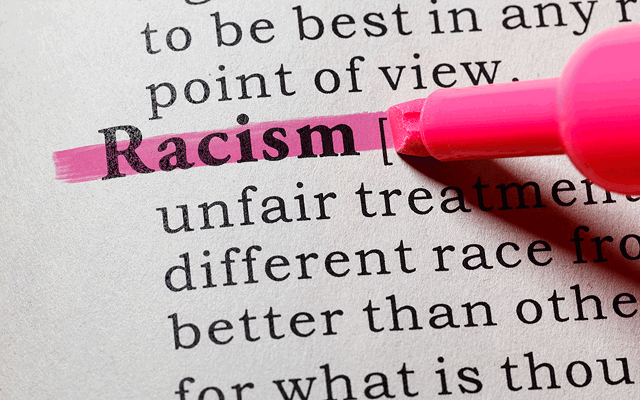
Racism in Canada is not limited to overt acts of discrimination by individuals. While individual racism, such as a racially charged insult or discriminatory behaviour, often receives media attention, it is only the most visible tip of a much larger iceberg. Beneath the surface, systemic racism quietly operates, deeply embedded in the social, political, and economic structures of Canadian society. As a result, racism becomes not just an individual act but a system of oppression that permeates every aspect of life for marginalized communities, particularly Black and Indigenous Canadians.
This article delves into how different levels of racism—individual, institutional, and structural—interact with one another to create complex webs of inequality that have devastating impacts on marginalized communities. By exploring how these layers of racism interact, we can begin to see why focusing solely on individual racism is not enough to dismantle the pervasive inequities in Canadian society.
The Layers of Racism
- Individual Racism
Individual racism refers to personal prejudices, beliefs, and actions that discriminate against people based on race. This can range from microaggressions—small but cumulative acts of bias—to outright hostility and violence. While individual acts of racism are damaging, focusing exclusively on them often allows for the misconception that racism is an isolated or uncommon occurrence, perpetrated only by a few bad actors. However, this narrow focus ignores the more insidious forms of racism operating within Canadian institutions and systems. - Institutional Racism
Institutional racism refers to discriminatory policies, practices, and procedures within organizations and institutions, such as schools, hospitals, police departments, and businesses. These practices often disproportionately disadvantage racialized groups, regardless of the intentions of individuals within the institution. For example, discriminatory hiring practices, lack of representation in leadership, biased policing tactics, and unequal access to education are all manifestations of institutional racism. - Structural Racism
Structural racism goes beyond individual acts and institutional practices to encompass the ways in which entire systems are built on racial inequities. These inequities are woven into the fabric of society, shaping everything from who holds political power to who gets access to resources like housing, healthcare, and education. Structural racism is often invisible to those who benefit from it, but its effects are felt deeply by marginalized communities. It is sustained through policies and practices that appear neutral on the surface but have disproportionately negative impacts on racialized groups.
How These Layers Interact
Systemic racism operates on multiple levels, with each level reinforcing and exacerbating the other. For example, individual acts of racism within institutions such as the police force or healthcare system may perpetuate institutional racism, which in turn is reinforced by broader structural inequities in society. To focus solely on individual racism is to ignore the ways in which these systems work together to maintain the status quo.
Dr. Sarah Ahmed, a sociologist at a Canadian university, explains, “When we focus only on individual incidents of racism, we often miss the bigger picture. The policies and practices within our institutions, like schools or hospitals, reflect the deeper structural inequities that make racism a pervasive issue in Canadian society. It’s not just about one person being biased; it’s about how those biases are built into the systems that govern our daily lives.”
The Impact on Black and Indigenous Canadians
The consequences of systemic racism are far-reaching, particularly for Black and Indigenous Canadians. Black Canadians often face barriers in employment, housing, healthcare, and education, while Indigenous peoples continue to struggle with the ongoing impacts of colonialism, including land dispossession, cultural erasure, and inadequate access to essential services.
For example, Black Canadians are more likely to experience unemployment or underemployment, even when they possess the same qualifications as their white counterparts. This can be traced back to both individual and institutional racism in the workplace, where biases and discriminatory hiring practices often favour white candidates. Similarly, Indigenous Canadians face disproportionate rates of poverty, lack of access to clean water, and inadequate healthcare, all of which stem from centuries of colonial policies that continue to shape their lives today.
Ryan, a Black Canadian professional, shared his experience with institutional racism in the job market: “I’ve been in interviews where I know I’m the most qualified person for the job, but I still don’t get it. It’s frustrating because it’s not just one time—it happens over and over. It’s like the system is rigged against you from the start.”
Education as a Site of Racial Inequality
One of the clearest examples of how different levels of racism interact can be seen in the Canadian education system. Indigenous and Black students are disproportionately streamed into lower-level academic programs, face higher suspension rates, and often receive less support from educators. This is not just a matter of individual teachers being racist; it’s a reflection of institutional and structural biases that affect the entire education system.
“The educational system in Canada is not designed for us,” says Maya, a Black high school student in Toronto. “From the curriculum to the way we’re treated by teachers, it’s clear that the system doesn’t expect us to succeed. We’re told to aim lower, even though we know we can do more.”
These disparities in education have long-term consequences. Students who are pushed into lower academic streams are less likely to attend post-secondary institutions, which in turn limits their career opportunities. The cycle of disadvantage continues as Black and Indigenous Canadians are systematically denied access to the same opportunities as their white peers.
The Justice System and Racial Disparities
Another institution where racism manifests itself is the Canadian justice system. Black and Indigenous Canadians are disproportionately targeted by law enforcement, face harsher sentencing, and are more likely to be incarcerated. While individual police officers may hold racial biases, the problem is much deeper than that. It’s a reflection of a justice system that has long been skewed against racialized groups.
Lena, an Indigenous activist, notes, “The justice system is stacked against us from the beginning. We’re over-policed, we’re overcharged, and we’re over-incarcerated. It’s not about one bad cop or one bad judge—it’s the entire system that’s been set up to keep us down.”
Addressing Systemic Racism: The Path Forward
Recognizing the different levels of racism is the first step in addressing it. Solutions must target not just individual acts of discrimination but the broader institutional and structural factors that perpetuate inequality. This requires a multi-faceted approach, including:
- Policy Reforms: Governments and institutions must implement policies that actively combat institutional and structural racism. This includes addressing racial disparities in employment, housing, healthcare, and education.
- Education and Awareness: More must be done to educate Canadians about the realities of systemic racism. This includes updating school curriculums to include the histories and contributions of Black and Indigenous Canadians, as well as providing anti-racism training for professionals in key sectors.
- Representation: Institutions must strive to ensure that Black and Indigenous voices are represented at all levels of decision-making, from government to corporate boardrooms.
Racism in Canada operates on multiple levels, from individual acts of discrimination to institutional and structural inequalities that are embedded in society. To dismantle these systems of oppression, we must recognize how these layers of racism interact and work together to perpetuate inequality. Focusing on one level of racism, such as individual acts of discrimination, is insufficient in addressing the broader, more pervasive issue of systemic racism. Only by targeting the entire system can we hope to create a more just and equitable society for all Canadians.
As Maya, the high school student, poignantly observes, “It’s not just about one person being racist—it’s about how the entire system is set up. If we want real change, we have to change the system, not just the people in it.”
Follow Canada News Media
Get the day's top Canadian stories and our two daily 60-second news videos wherever you scroll.
X Threads Facebook Instagram LinkedIn TikTok YouTube Pinterest Reddit Substack Flipboard Newsletter RSS