


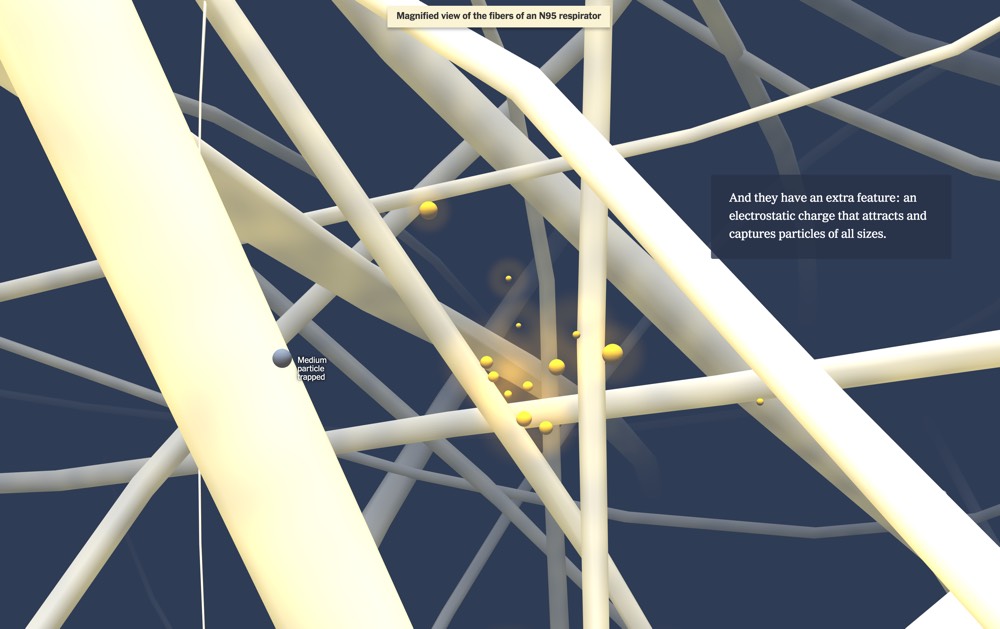
The NY Times has a fantastic visualization on how face masks help keep us safe from catching Covid-19 by taking readers on a journey through a mask to see how they block aerosols and droplets.
A lot of the pushback around the efficacy of masks from non-scientists focuses on the size of the droplets and aerosols (super tiny) compared to the gaps between the fibers in the masks (relatively large). Intuitively, it seems like masks don’t stand a chance of stopping anything. But as this visualization shows, multiple layers of fibers do the job quite well. Masks don’t work like sieves, which will let every particle smaller than the holes through the mesh. Instead, imagine shooting a BB gun into a thick stand of trees — no one tree stands a good chance of getting hit by the BB but the forest will stop it eventually.
N95, KN95, and masks made from polypropylene have an extra weapon against particles: the fibers carry and electrostatic charge that attracts particles to trap them. Picture our BB flying through a forest of magnetic trees — it’s got a much better chance of being captured that way.
The visualization also touches on the importance of making sure your mask fits properly. The best masks fit tightly around the edges and include a space around your nose and nostrils. Masks with unfiltered valves should not be used — you’re just breathing virus out into the air. It’s been 8-9 months now that we’ve been dealing with the pandemic and there will be many more months of wearing masks. If your mask is fits poorly around your nose, your straps aren’t tight enough, you need to fuss with it after putting it on, have a mask with a valve, or (god forbid) are still just wearing a bandana, please please do yourself and others a favor and upgrade your mask. High-quality, well-made masks are much easier to find now than 6-8 months ago.1 If you can’t afford a proper mask, email me and I’ll buy you one. Masks are one of the most successful low-tech interventions we can do to prevent the spread of Covid-19, and the better our masks, the more effective they will be.
More about…