

The Apple TV sci-fi thriller Severance captivated audiences around the world with a mind-bending concept: completely separating work and personal lives through the manipulation of memory. In this world, created by Dan Erickson, employees forget their home lives when they enter work, and vice versa.
Severance brings viewers in with a compelling storyline that is highlighted by the creative use of art and style. It begins with the use of Apple’s signature font during the title sequence, reminding viewers that tech giants have a strong influence on our lives and society.
But that’s only the beginning.
The opening scene itself looks almost like an oil painting. Helly, played by Britt Lower, is laying on a large table in a mid-century-style conference room, and she doesn’t remember who she is outside of work. Her entire organization, Lumon, opted for the procedure that divides their memory between their professional and personal lives.
The aerial view of a woman lying alone on a table at work explains why the staff chose this route: work is isolating and lonely.
Production designer Jeremy Hindle makes subtle references to historically influential art pieces throughout the show. The nods are easy to miss if you aren’t watching closely.
For example, Petey (Yul Vazquez), a former Lumon employee, scribbles a map with a face baring its teeth and wearing a crown. This is a reference to Basquiat, an artist from the 1980s who rebelled against the status quo. Petey fought against Lumon’s transition, just like Basquiat fought American society.
Petey drawing on this map expresses to viewers that parts of his personality seeped into his working life memory. Despite having his mind severed, Petey was rebelling through the use of art.
The Lumon offices feature original paintings inspired by real pieces from art history. The painting of a man on a cliff overlooking hills and lakes is a nod to Caspar David Friedrich’s “Wanderer above the Sea of Fog” (1818). This piece is used to show that Lumon attempts to convince employees that they are at the helm of a great voyage.
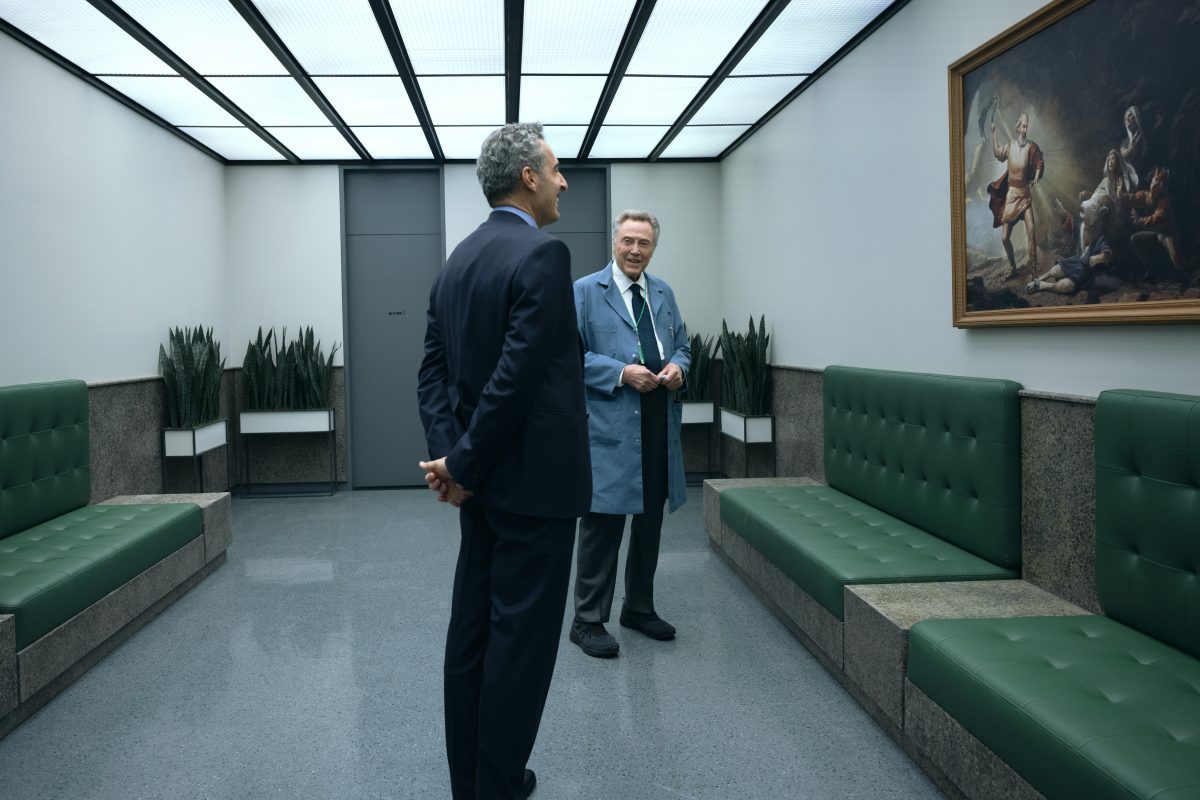
In episode five, we see a painting of people devouring one another. The organization’s leaders perpetuate an idea that the two departments, MDR (Macro Data Refinement) and O&D (Optics and Design), should be kept separate. Otherwise, destruction will surely occur.
Francisco Goya’s “Saturn Devouring His Son” (1819–1823) inspired this gruesome image. Each department has its own version of the same painting to remind the staff that co-mingling will lead to carnage. Meanwhile, it makes viewers consider what human beings are truly capable of. Lumon knows that divided groups are more loyal to the powers that be, and cooperation could lead to an overthrow.
Although the world of Severance is filled with people who are watered-down versions of their true selves, the series uses art to make viewers consider the depth of our subconscious and the strength of our innate needs.
Follow Canada News Media
Get the day's top Canadian stories and our two daily 60-second news videos wherever you scroll.