




This section outlines one of the principal outcomes. The profiling results to investigate current research trends on DC are displayed in Table 2. It comprises academic contributions, research themes, keywords, and application areas.
Publications & citation counts
Figure 2 summarizes annual publications and citation counts. The average citation counts were calculated from the three databases used in the article selection process. The earliest publication year was 2013 [41]; and the most cited article was published in 2014 [32]. The most-cited article received approximately 188.33 citations over the past five years. Although there were few publications before 2019, citations had been rising steadily. From 2013 to 2016, only six articles were published, but they achieved 75 citations. Citations increased significantly in 2016, 2019, and 2021. The average number of citations per article also increased in 2016 and 2019, but not greatly in 2021. Even in years with high citation counts, publications only increased slightly. This suggests that the increase in citations was due to growing interest in DC, not just the number of publications.

An overview of annual publications & citation counts
Academic contributions
From the standpoint of the sources of the selected articles, ethics and genetics were the most prevalent areas of published journals. The close relationship between DC and ethics stems from its emphasis on the data sovereignty of individuals. DC is also intricately connected to genetics because its principal application area is biobanks. Besides these areas, the journals also covered digital health and medical information. DC operates based on digital interfaces as opposed to conventional consent mechanisms; therefore, it is inextricably linked to the field of information and communication technology.
Scholarly contributions to DC have originated from a diverse range of sources, transcending any particular journal or publisher. The majority of articles appeared in the European Journal of Human Genetics ((n = 7)), published by Springer. The other sources were Digital Health ((n = 2)) from SAGE; The Journal of Law, Medicine & Ethics ((n = 1)) from Cambridge University Press; BMC Medical Ethics ((n = 2)) from BMC; the Journal of Medical Internet Research ((n = 1)) and JMIR Medical Informatics ((n = 2)) from JMIR Publications; the Journal of Ambient Intelligence and Humanized Computing ((n = 1)) and Asian Bioethics Review ((n = 1)) from Springer; Frontiers in Medicine ((n = 1)) and Frontiers in Public Health ((n = 1)) from Frontiers; Applied Sciences ((n = 1)) and Technologies ((n = 1)) from MDPI; and Public Health Genomics ((n = 1)) from Karger.
The country column in Table 2 was populated with the affiliation of the first author’s institution. The UK ((n = 8)) was the most prolific, followed by Australia ((n = 3)), the US ((n = 2)), South Korea ((n = 2)), Norway ((n = 2)), Switzerland ((n = 1)), Germany ((n = 1)), Italy ((n = 1)), Malta ((n = 1)), and Malaysia ((n = 1)). European countries, including the UK, Norway, Switzerland, Germany, Italy, and Malta, comprised more than half of the total, demonstrating substantial academic effort in the European region.
Research themes
The analysis of the selected articles revealed three overarching themes: conceptual evolution, feasibility analysis, and technological advancement. Table 3 provides the annual number of publications for each of these three themes, offering a clear overview of the research trends related to DC.
Conceptual Evolution: Articles pertaining to the theme of conceptual evolution explored the evolutionary history of the DC concept while emphasizing its ethical strengths. Early-stage publications highlighted the major debate surrounding broad informed consent compared to DC. These articles contended that the contemporary communication attributes of DC could effectively tackle apprehensions regarding broad informed consent with its superiority in autonomy, information, engagement, control, social robustness, and reciprocity [41]. Furthermore, these articles underscored the advantages of DC, especially its ethical merits in terms of transparency and efficiency, as well as its conformity with legal standards [32].
Feasibility Analysis: These articles examined the acceptances among various stakeholders in DC. Researchers employed a variety of methodologies to gather stakeholder opinions (Additional file 1). Several studies used quantitative methods, such as pilot tests and questionnaires, to assess individual preferences [42, 50]. Other researchers collected qualitative data, including perspectives on DC, attitudes towards digital-based interfaces, and intentions to use them, through focus group interviews [44, 45, 54]. There were also studies that used mixed methods, combining quantitative and qualitative data [34], or organized a multidisciplinary workshop with experts from various fields [35]. Participants in most studies showed positive feedback on digital-based consent; however, concerns were also raised regarding the risks of handling sensitive data and the necessity for improved identity verification procedures. Nonetheless, most participants expressed the belief that the benefits of DC outweighed its drawbacks.
Technological advancement: As the fundamental principle of DC necessitates digital interfaces, several articles have been dedicated to the implementation of DC systems. Significantly, there have been growing interests in incorporating blockchain technology into DC systems. Some researchers suggested blockchain-based consent management systems along with the use of smart contracts [48, 49, 53, 55, 57]. This scholarly attention has been directed towards leveraging the blockchain’s fundamental features, such as integrity, transparency, and accountability, to enhance the trustworthiness of digital-based consent management. However, since blockchain is not a security technology, concerns regarding privacy and security continued to be formidable obstacles.
Keywords & application areas
Figure 3 presents the frequency of author-provided keywords as a word cloud. Since “dynamic,” “consent,” and “data” have natural occurrences in common, these were omitted to focus on other primary keywords. Table 4 displays the author-provided keywords categorized by related topics, including the omitted keywords from the word cloud.
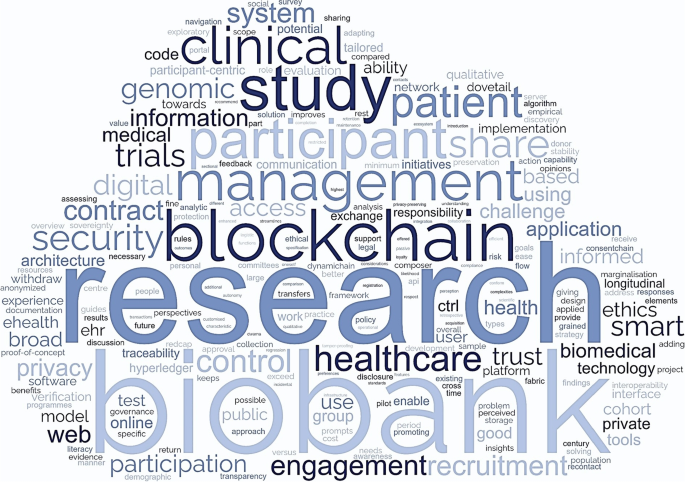
Keyword word cloud
The key terms “research” and “biobank” were the most frequently recurring. These keywords, in addition to “clinical,” “trials,” and “study,” indicate the primary application areas for DC. DC is primarily used in biobanks; however, its application is expanding to other fields that utilize personal health data. As shown in Table 4, in addition to the biomedical and genomic fields, clinical trials and longitudinal cohort studies are emerging as new application areas for DC.
Additionally, the word cloud highlights keywords related to participant initiatives, including “participant,” “patient,” and “engagement.” These keywords reference data subjects’ sovereignty, which is a key concept in DC. Topics related to participant initiative include “patient-centered,” “engagement,” and “ethics.” The term “blockchain,” commonly used to implement DC systems, is also frequently mentioned. Information technology-related terms, such as “security” and “privacy,” have also emerged.
Primary characteristics
Overview
The primary features of DC differentiate it from conventional consent methods. This section summarizes the findings from synthesizing the selected articles to identify its nature characteristics, focusing on the facilitators of and barriers to adopting DC in digital health ecosystems.
Facilitators
Flexibility: The ability to support a variety of consent mechanisms is suitable for the purpose and context of digital health ecosystems [32]. This flexibility of DC allows researchers to obtain consent in a more sophisticated manner than conventional consent methods [35]. DC is not a fixed method; rather, it allows for the selection of an approach that is appropriate for a range of situations. Conventional consent methods, such as broad informed consent, can also be used if needed; for example, individuals can consent to a wide range of data uses if they so desire. These various consent mechanisms are established depending on the type of researcher or specific data use.
Tailored options: DC provides tailored options regarding data utilization. Individuals could customize the degree of accessibility that consumers could be granted to personal health data according to the institution or group to which the consumers are affiliated [46]. Additionally, the method of communication with the DC system may vary from traditional paper-based forms to digital means, such as email, text message, or social networking sites, according to individual preferences [32]. Individuals can choose their preferred information, contact method, and frequency, and these can be changed at any time according to individual preferences.
Continuous two-way communication: Anywhere, individuals and data consumers are able to interact in real time, anywhere. Digital interfaces enable individuals to centrally manage their personal health data, including tracking consent history, thereby empowering them to take a more proactive stance in using their data [58]. Previously provided consents can be modified or withdrawn at any time in response to circumstances that are constantly evolving, courtesy of digital interfaces [43]. A previous study demonstrated that the digital-based consent system was highly preferred by individuals in comparison to the previous consent procedure [34].
Afterward information: Individuals can receive additional information that is derived from their data provision. The afterward information may include the most recent developments in research, primary findings, and clinical or analytical outcomes. It can be delivered in the preferred timeframe and fashion, with the degree of engagement customized to suit individual preferences. DC is an appropriate approach for reporting research progress, discoveries, and study outcomes [41]. Providing individuals with additional information heightens their awareness of how their data is being used. A previous study demonstrated that the individuals held a positive perception of digital interfaces for DC, especially with regard to feedback about research outcomes [45].
DC can meet internationally accepted ethical and legal standards. It is considered to enable transparent international co-research in situations where countries differ in the extent to which broad consent is authorized. The adoption of DC can help alleviate the ethical concerns associated with the use of broad consent and enable harmonized international research collaboration. Kaye Jane et al. argued that the DC model offers a flexible and responsive solution to deal with changing legal and ethical requirements due to the enhanced ease of participant recontact [32]. Most studies promoted DC solutions as an alternative to improve transparency and public trust in complex research networks [45].
Barriers
Excessive role to individuals: Individuals can be more engaged with DC by exercising granular control over the utilization of their health data, for instance. Some individuals may perceive DC as burdensome because of the excessive number of decisions it necessitates, which can lead to consent fatigue. If enormous amounts of information are provided to individuals to make fully informed decisions, there is a risk of making it difficult to distinguish between relevant and irrelevant information before providing consent [41]. In addition, any risk that DC may further promote consent fatigue would undermine the intentions of the approach [46]. It would also lead to an accountability problem in research for not ensuring mutual understanding.
Digital divide: The digital divide is an ethically challenging issue related to DC. Unlike other consent methods, DC requires users to interact with digital interfaces such as websites and mobile applications. These digital interfaces can be difficult for those who are unfamiliar with technologies, thereby alienating themselves from the process of utilizing personal health data prior to experiencing its benefits. Susan E. Wallace and José Miola were concerned that some populations, including the elderly or disadvantaged, may be unable or unwilling to participate in a technology-based consent process owing to a lack of interest, comprehension, or access to resources [54]. Given that older and disadvantaged people will suffer more from disease, it will be problematic under the principles of equality and justice. If individuals are not prepared to engage using the technology, there exists the potential to aggravate marginalization and disenfranchisement [46]. This may equally apply to communities, such as those in isolated areas of Australia, that lack access to technology or stable infrastructure, such as WiFi networks, to enable significant dependence on these tools. Ultimately, the digital divide may result in selection bias among the study population and lower the quality of research results.
System implementation: To benefit from DC, a system supporting its concepts should be implemented. The successful implementation of a DC system requires careful interface design and a robust architecture to establish trust with system users [45]. For instance, it is imperative that the DC system has the ability to interact with legacy systems that store personal health data. Furthermore, data consumers, such as researchers, require dedicated interfaces to furnish individuals with afterward information regarding their data uses. Notwithstanding recent technological advancements, implementing a DC system necessitates pragmatic investments of time, money, personnel, and the willingness of stakeholders. These additional burdens may have an adverse effect on the adoption of DC [46].
Privacy and security: There must be a secure connection between researchers and individuals for large amounts of traceable health information without risk of privacy exposure. Establishing a balance among security, privacy, accessibility, and usability will continue to be a difficult challenge [42]. Privacy and security are indispensable components of any information system, including DC systems [48]. Notably, individuals are more concerned about the disclosure of their information because health data contains sensitive personal information. Therefore, DC systems must be implemented alongside privacy and security technologies that data subjects are able to use with trust.
Technical trends
The articles that examined technological advancements addressed system implementation and related technologies for applying the DC concept (Additional file 2). A discernible trend toward the implementation of DC systems utilizing blockchain technology has been identified. With two exceptions [52, 56] that put forth a web-based DC system, the majority of the articles examined the application of blockchain technology. Permissioned blockchain was mostly utilized, rather than permissionless public blockchain. The most widely used platform was Hyperledger Fabric [53, 55, 57]. Hyperledger Composer [48, 49] was also mentioned, but this platform has been deprecated since August 2019. One article used Hyperledger Besu [55]. Prominent digital assets that were stored on a blockchain network comprised consent histories and hash values pertaining to personal health data. The personal health data was stored separately in external storage rather than on the blockchain, and the hash value or identifier of the personal health data was stored on blockchain networks.
The design goals discussed in these studies were privacy, security, traceability, compatibility, and legal compliance. Since most health data contains sensitive information, most articles have considered privacy and security when implementing the DC system. Traceability is discussed with blockchain technology. Along with immutability, the representative characteristics of blockchain are accountability and transparency. All transactions that occur within a blockchain network are transparently recorded, including who initiated the transaction and when. These features enable individuals to track their data usage and follow their consent history within DC systems. However, compatibility and legal compliance were discussed less frequently than other design goals.