
Among other qualities, becoming a dentist requires many years of study, constant dedication over time and continuous professional development. Anybody wishing to join the profession must learn to manage complex cases and remain up to date with the solutions made possible by advancing technology.
To work as a dentist in Italy, you must first obtain a degree course in dentistry and dental prosthetics, then complete a period of internship in a public hospital and pass a national examination. Dentists must also keep up to date and be fully informed with the latest materials and impression-taking techniques like alginate dental impressions commonly used in dentistry to satisfy many professional needs.
If you are planning to become a dentist, it is a good idea to become familiar with this type of material. So, let us examine together the most common uses and the main properties of alginates.
When to use alginates
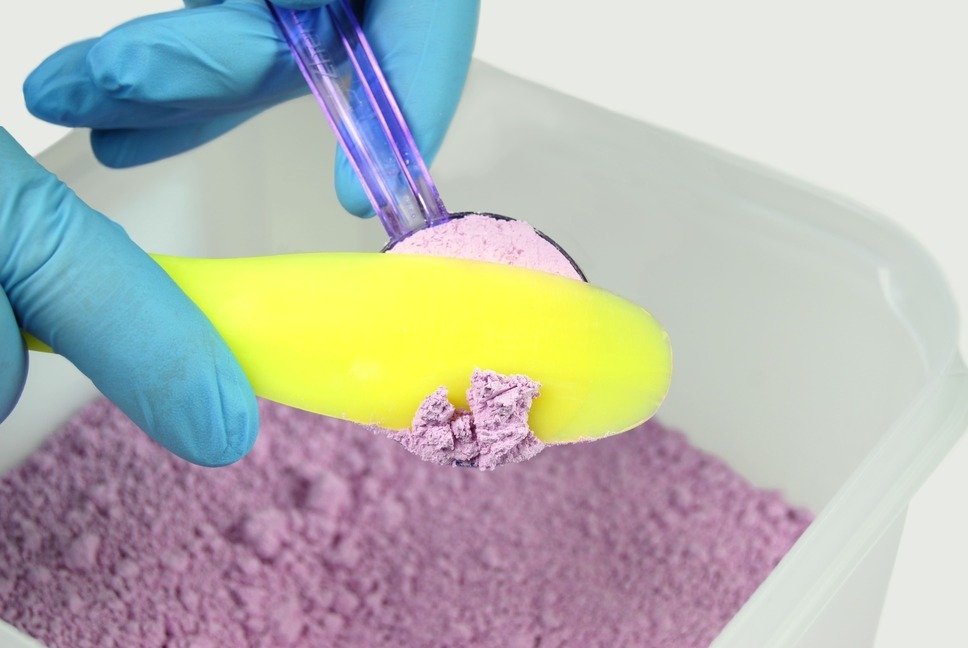
Alginates are essential impression materials for many areas of dentistry and are used in all procedures that require collaboration between the dentist and the laboratory. Thanks to the ease with which alginates can be mixed, impressions can be obtained from them very rapidly. Alginates are also cheap and are well tolerated by the vast majority of patients.
This type of material is commonly used to produce preliminary and primary impressions, and to produce study and other models. Many dentists even use alginates to produce final impressions for removable prostheses. Many dentists today have simplified their procedures and processes – a tendency that certainly benefits practices with less experienced staff. Recent research carried out in a university clinic showed that teaching newer, simpler techniques requiring only one alginate impression instead of two to produce a complete prosthesis not only reduced the number of appointments needed to fit the finished prosthesis but also avoided the need for modifications and adjustments after fitting.
One of the reasons that make alginates the preferred material for primary impression taking in removable prosthesis production is their mucostaticity and hydrophilia. These properties result in an overextended impression and ensure that the post dams, frenums and depth of the vestibule are clearly visible in stone models. In double-step impression techniques, these anatomical details enable the dentist to produce an accurate custom impression tray and identify the limits of the complete prosthesis.
Main physical and chemical properties
Alginates are irreversible hydrocolloid compounds of the sodium and potassium salts of alginic acid. They guarantee unique physical and chemical properties and excellent performance.
Alginates are used extensively in dental practices for their compatibility with the gypsum needed to produce the stone models on which prostheses are made, and for their hydrophilia, which ensures a good reaction with water and the saliva found on the surfaces of the oral mucosae.
Finally, alginates offer dentists generally short setting times, though these vary with the type of product used. Certain products are purposefully formulated with longer setting times to achieve greater accuracy in recording the position and shape of the frenums – indispensable information for establishing the limits of removable prostheses and creating custom impression trays.
The trends behind the latest dental procedures seem to confirm the concept of Appropriatech: present and future dentists should adopt simple and economical methods and materials to provide good quality prostheses to the majority of edentulous patients. As in all medical professions, of course, every patient presents a unique case that requires evaluation and adaptation to its needs. The dentist’s choice whether to use classical or more innovative materials and techniques for their patients is therefore of primary importance. Thanks to the latest developments in the field of alginates, dental professionals can choose materials with characteristics suitable for use in partly or completely edentulous patients and for the production of partial and complete prostheses.
Follow Canada News Media
Get the day's top Canadian stories and our two daily 60-second news videos wherever you scroll.
X Threads Facebook Instagram LinkedIn TikTok YouTube Pinterest Reddit Substack Flipboard Newsletter RSS