


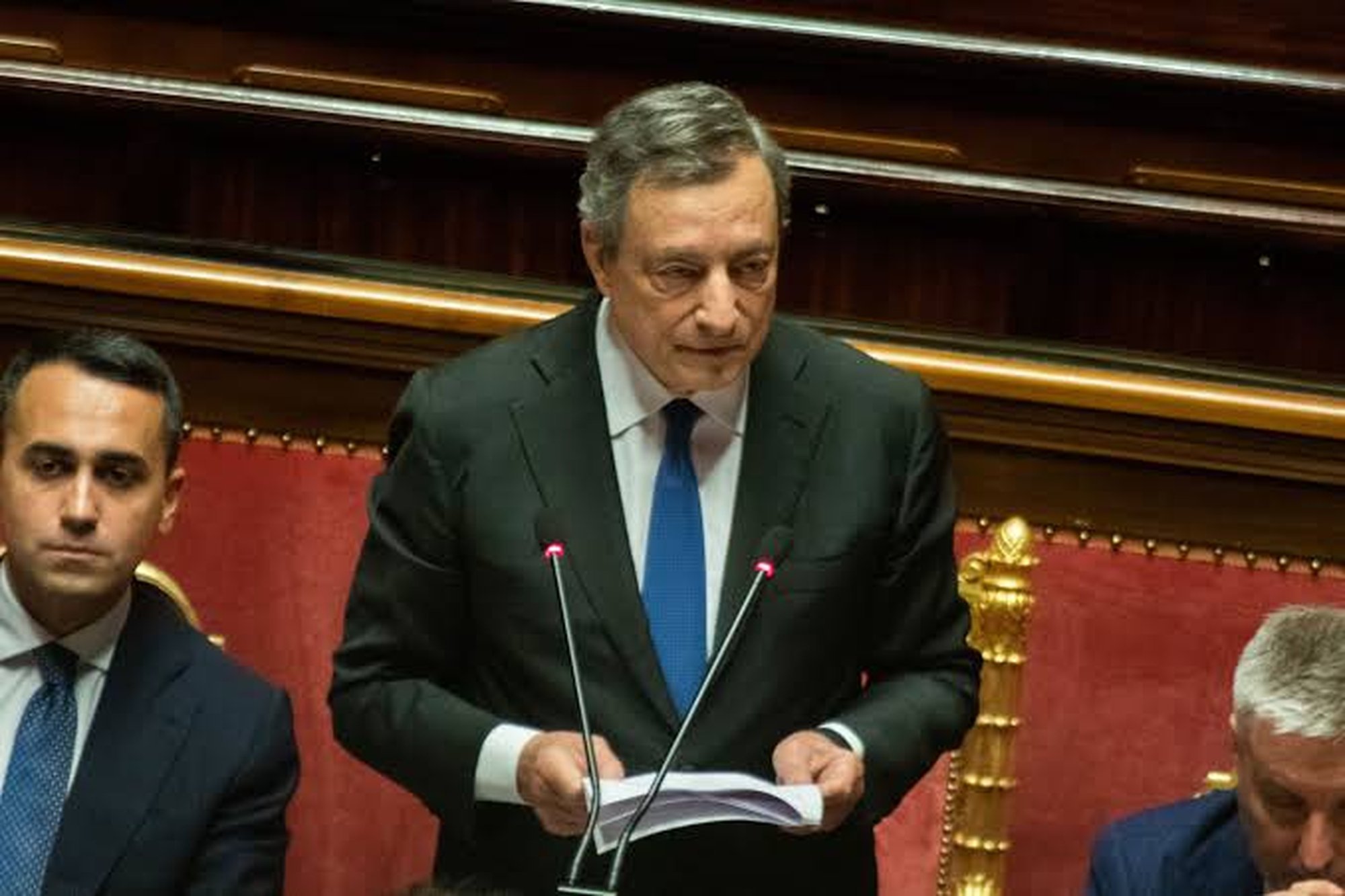
Rome, Italy- Prime Minister Mario Draghi has tendered his resignation again a day after a last-ditch effort to persuade the country’s fractious parties to stick together for the benefit of the nation.
Draghi’s government of national unity imploded on Wednesday after members of his uneasy coalition of right, left and populists rebuffed his appeal to the band back together to finish the Legislature’s natural term and ensure implementation of the European Union-funded COVID-19 pandemic recovery program.
Instead, the centre-right parties of Forza Italia and the League and the populist Five Star Movement boycotted a confidence vote in the Senate, in a clear sign they were done with Draghi’s 17-month government.
Last week, Draghi tendered his resignation after the 5-Star Movement, the largest political party in the country’s coalition government withdrew its support in a parliamentary confidence vote on a package designed to tackle Italy’s cost-of-living crisis. He had previously said that he would not lead a government that did not include 5-Star. Draghi’s resignation, however, was rejected by Italy’s President Sergio Mattarella, who urged him to stay and find a solution.
While the next steps are unclear, the outcome suggests Mattarella could dissolve Parliament after a period of consultations, paving way for an early election as soon as late September or early October. The Legislature’s five-year term had been due to expire in 2023.
Meanwhile, the country’s financial markets have sold off following Draghi’s resignation. The yield on Rome’s 10-year government bond jumped 0.13 percentage points to 3.5 percent after Draghi lost the support of members of his national unity coalition in a confidence vote on Wednesday night.
Economists widely expect the Central Bank to increase borrowing costs by 0.25 percentage points from their current level of minus 0.5 percent, but rate-setters were also poised to discuss a possible 0.5 percentage point rise.
“Draghi’s departure from the political scene and snap elections is a clear negative for Italy and the European Union. This will complicate the potential design and use of the European Central Bank’s anti-fragmentation tool,” said Ludovico Sapio, macro analyst at Barclays.
A FTSE gauge of Italian stocks slid 1.9 percent in early trading. The country’s largest banks, which are big holders of Italian debt, led the declines, with Intesa Sanpaolo and UniCredit each down about 5 percent.
The ructions in Italian debt also put pressure on other eurozone bond markets, with Greek, Spanish and Portuguese yields also rising.
Follow Canada News Media
Get the day's top Canadian stories and our two daily 60-second news videos wherever you scroll.