


(Bloomberg) — The UK Labour Party’s plans to borrow to fund greater public investment could have a “lasting and meaningful” positive impact on the economy, according to analysis from Bloomberg Economics.
The opposition party has pledged to borrow to kick-start growth in the UK if it wins a majority in a general election expected next year, taking investment “up to the level that is needed to compete internationally,” Shadow Chancellor Rachel Reeves said.
Bloomberg Economics’s Ana Andrade and Dan Hanson said that while this would be “no easy task, it would be a step in the right direction to help solve the problem of Britain’s ailing growth prospects.”
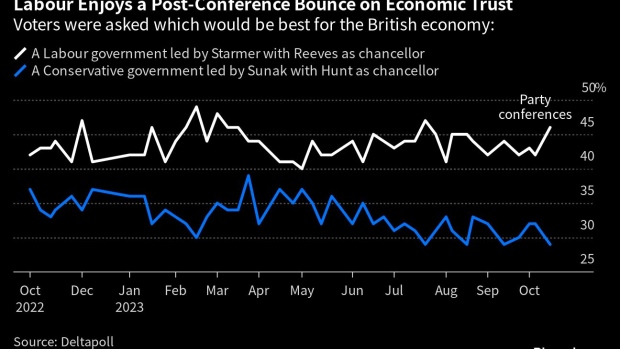
It comes as recent polling from Deltapoll found Labour had gained four points following its party conference last week on the question of which party “would be best for the British economy.” The Conservatives had lost three points, leaving the gap between the two at 17 points.
This appears to align with the reception each leader received within their party. While Tory insiders are increasingly worried that Prime Minister Rishi Sunak is leading them to an election defeat, Bloomberg reported Saturday, Labour is cautiously optimistic about leader Keir Starmer’s prospects.
Starmer’s investment plans, outlined last week, are part of a concerted effort to garner favor in the City of London by outlining credible ways in which to boost the economy. According to Andrade and Hanson’s analysis, a permanent 0.7 percentage point uplift to the level of real government investment as a share of gross domestic product would increase the level of output by around 1.5% in the long run.
“An even larger boost to move the UK to the top end of G-7 economies — targeting an investment share of around 4.5% of GDP to leave the country only behind Japan — would deliver double the boost to the economy,” they said.
But there are risks — the gains could be larger if broader potential productivity gains are included, such as the benefits to the future workforce from building a new school, or smaller if any money is used unwisely, Andrade and Hanson warned.
Read more: Sunak’s Tories Worry Reset Fell Short of UK Election Turnaround
In a separate interview with Bloomberg News, former Bank of England rate-setter Kate Barker said she was in favor of Labour’s plans to build new towns around the UK.
Barker, who was appointed by Tony Blair’s Labour government two decades ago to lead a review of housing supply, said Starmer’s plans to build new towns on the “grey belt” — areas of disused land on the green belt such as wasteland and old car parks — were “particularly appealing.”
“New towns were something I proposed actually 20 years ago,” she said. “Without having some new towns, having some really big places that are being built out more or less consistently, I think we will struggle to get up to the 300,000 a year [house building] target.”
Ramping up house building would be one way to improve affordability for first-time buyers, Barker said, while rising interest rates should also help to bring down house prices. She is expecting a peak-to-trough decline in prices of 10-15%, larger than the 8-10% forecast by many economists. Mortgage lenders Nationwide Building Society and rival Halifax have currently recorded drops of around 5%.
–With assistance from Lizzy Burden.
©2023 Bloomberg L.P.

Follow Canada News Media
Get the day's top Canadian stories and our two daily 60-second news videos wherever you scroll.