
:format(webp)/https://www.therecord.com/content/dam/therecord/news/waterloo-region/2022/10/05/laurier-discovery-could-change-how-we-target-and-kill-virus-and-cancer-genes/dewitte_orr_stephanie.jpg)
WATERLOO — When that pesky cold hits and you’re stuck in bed sneezing with a runny nose, wouldn’t it be nice to have an inhaler that could kill the virus in its tracks?
Or what about more severe viruses like SARS-CoV-2, or even cancers like glioblastoma?
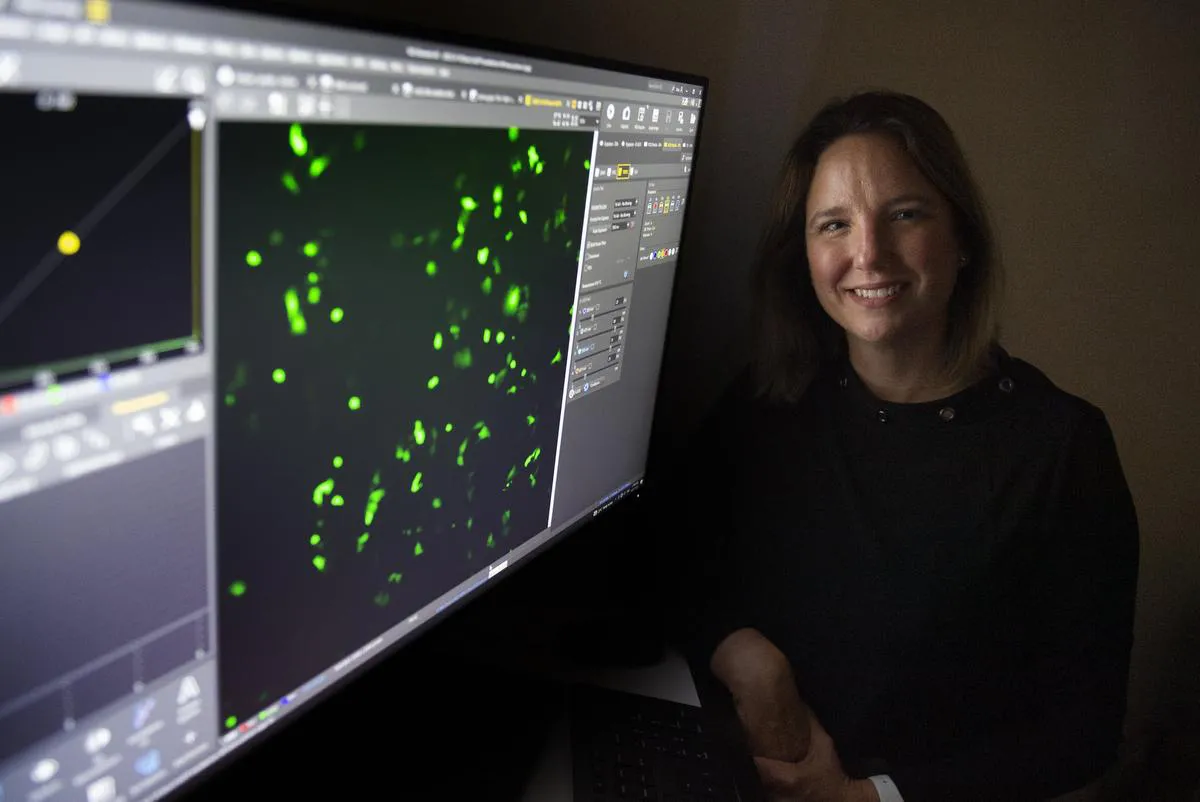
A new discovery by Wilfrid Laurier University virologist and immunologist Stephanie DeWitte-Orr has the potential to change the way we target and kill cancer and virus genes in the human body.
“Sometimes cells make proteins they are not supposed to make, or they make too much of a protein, and it makes you sick,” said DeWitte-Orr, who was recently named Laurier’s 2022-23 University Research Professor. “What we found is a way of shutting down those proteins specifically.”
The research, recently featured in a paper published in the journal “Frontiers in Immunology,” focuses on long double-stranded ribonucleic acid, or dsRNA, a nucleic acid produced by viruses. In the body, a healthy cell will use dsRNA as a “red flag” to detect when it has been infected by a virus and kick-start an immune response.
In plants and invertebrates, researchers had previously been able to use dsRNA to target and shut down the spread of illness in healthy and cancerous cells.
However, it was never possible in humans until now.
The process, known as RNA interference, allows DeWitte-Orr to put a variety of different sequences into the same molecule, which can target a host of different viruses or cancer cells in the body.
“So we can use these big, long molecules to put lots of sequences in to shut down lots of different proteins at the same time,” she said.
She gives the example of a person who has a cancer cell, which will create oncogenes, which transforms cells into tumour cells.
“If we can make our molecule to target those oncogenes and turn them off, we can stop the cancer cell,” said DeWitte-Orr.
In the lab, her team was able to successfully demonstrate this method in human lung cells infected with SARS-COV-2, the virus that causes COVID-19.
The method has also been successful with other coronaviruses that cause the common cold, and it has worked with human brain cancer cells as well.
“In viruses, we saw up to a 90 per cent knock down in virus production,” she said. “And for cancer, we can actually kill the cancer cell in one to two days.”
Previous research in the area had scientists putting too much of the dsRNA into a test subject to target the cells, which doesn’t replicate a natural response to a virus. Using a smaller amount of the dsRNA better mimics the reaction to a real-life virus, said DeWitte-Orr, and allows a more controlled response to the virus.
“We could put all of the influenza sequences for the flu variants that are circling today, and then we could throw in some coronavirus variants as well in there, and put it in one molecule, you could inhale it, and your airway would be protected against infection,” she said.
Her team is already getting some interest from some outside companies who are interested in partnering with them on the project.
“It’s such a paradigm shift, and paradigm shifts in science are always difficult to be accepted at first,” she said. “We are trained as scientists to be critical thinkers, but now I think we have enough data behind us to say, ‘Yes, there is a phenomenon here.’ ”
She just submitted a grant application to attempt the dsRNA process in living subjects in preclinical trials. Until now, it has only been successful in lab dishes. The next step requires moving to more complex systems, which will include preclinical trials in a hamster model with SARS-CoV-2. If successful, she will then move on to human trials, a process that could take years.
At the tissue level, she is also embarking on testing for glioblastoma, a rare form of brain cancer.
“Any situation where a cell makes too much of something, you could use our technology in that application,” she said. “This technology has incredible potential, but we can only go as fast as the resources will support it. So, we need money, because we can only do the research that the money will fund.”